A Cloud Can Weigh Tons and Still Float
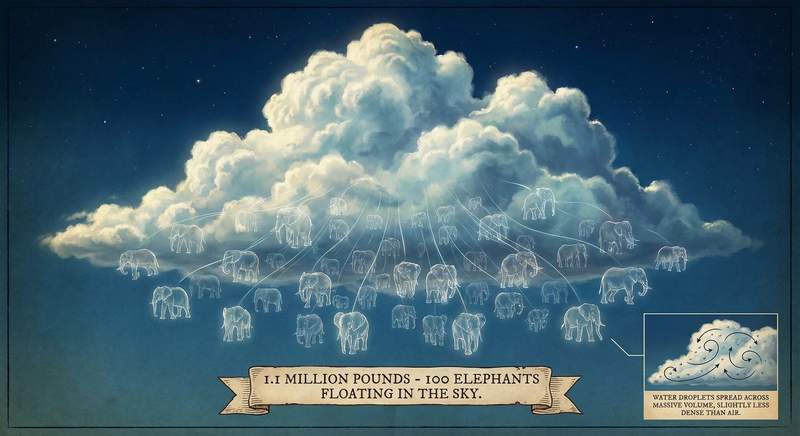
Clouds look weightless because their water is spread through a huge volume of air in tiny droplets, not because the water has no mass. For a typical cumulus cloud, standard educational estimates land around 500,000 kilograms of water, though the exact figure depends heavily on cloud size and water content.
Published
Filed under
Byline
 Brainblast archive
2026-03-02-04-03-00-cloud-weight.png (source: app assets)
The fact
“Clouds may look light and fluffy, but an average cumulus cloud weighs approximately 1.1 million pounds (500,000 kg)—equivalent to about 100 elephants floating in the sky. The cloud stays aloft because its water droplets are spread across a massive volume and only slightly less dense than the surrounding air.”
A fluffy white cloud does not look like something that should have measurable heft, much less something comparable to a loaded airliner or hundreds of cars. But the numbers are real. The U.S. Geological Survey’s cloud-weight explainer walks through the classic estimate: take a typical small cumulus cloud about one kilometer on each side and assign it a liquid-water content of about 0.5 gram per cubic meter. The answer comes out to roughly 500,000 kilograms, or about 1.1 million pounds. The Library of Congress explanation presents the same basic calculation.
The first reason this feels wrong is that we instinctively confuse “floating” with “weightless.” But a floating thing can still be heavy. A cargo ship weighs an enormous amount, yet it floats because the average density of the ship-and-air-filled-hull system is lower than the density of the displaced water. Clouds behave differently in detail but similarly in principle. USGS emphasizes that the cloudy air parcel is less dense than the surrounding drier air, which is why it can remain suspended.
The second reason it feels wrong is that the water is dispersed. The Library of Congress page explains that clouds form when invisible water vapor condenses into tiny liquid droplets or ice crystals. Those droplets are extremely small and spread throughout a huge volume. So when we say a cloud “weighs” 500,000 kilograms, we do not mean there is a hidden lake sloshing inside it. We mean that a giant box of air contains a very dilute suspension of many tiny droplets whose total mass adds up.
That dilution is the entire trick. A cubic kilometer is a gigantic amount of space. Even a tiny amount of liquid water per cubic meter multiplies into a large total when spread over that much volume. USGS’s worked example makes this explicit: one billion cubic meters times 0.5 gram per cubic meter yields 500 million grams, or about 500,000 kilograms. The calculation sounds surprising only because our brains are poor at combining “tiny concentration” with “enormous volume.”
There is also an important caveat: there is no single cloud weight. The Library of Congress explanation and the USGS page both frame the number as an estimate for a typical cumulus cloud. Bigger clouds, denser storm clouds, or clouds with different water contents can contain much more water. Wispy or smaller clouds can contain much less. The 1.1 million-pound figure is a teaching example, not a universal constant stamped on every cloud.
The word “weight” also needs a little precision. USGS notes that one could mean either the weight of the cloud droplets themselves or the weight of droplets plus air. Most popular versions of the fact refer only to the water droplets or ice particles that make the cloud visible. That keeps the estimate simple and meaningful, but it is still a chosen convention rather than the only possible definition.
So why does the water not simply rain out immediately? Because being inside a cloud is not the same as being inside a still room. Tiny droplets fall very slowly, and the air in and around clouds is constantly moving. Updrafts, turbulence, mixing, and ongoing condensation can all help keep droplets suspended. A fair-weather cloud is not a fixed object hanging in empty space; it is a dynamic process.
This is part of why the fact is so satisfying. It looks like a contradiction—something huge and heavy floating over your head—but it really reflects basic fluid physics. The cloud is heavy in total mass, yet locally dilute enough and dynamically supported enough to remain aloft. Once enough droplets grow larger and local support weakens, precipitation can begin. In that sense, rain is not a cloud suddenly gaining weight. It is a cloud’s water distribution changing enough to stop hiding its mass so effectively.
So the headline survives. A typical cumulus cloud really can contain on the order of 500,000 kilograms of water, as shown by USGS’s standard calculation and the Library of Congress explanation. The needed footnote is simple: clouds are not weightless, they are dilute. That is why something so heavy can still look like it belongs in a pillow commercial.