Why Some Anglerfish Literally Fuse With Their Mates
In several deep-sea anglerfish species, tiny males bite larger females and may remain attached for life, eventually sharing tissues and blood supply. The most startling twist is that these lineages also evolved unusual losses in adaptive immune function, allowing a kind of vertebrate fusion that seems almost impossible at first glance.
Published
Filed under
Byline
 Brainblast archive
2026-03-02-14-18-00-anglerfish-parasitism.png (source: app assets)
The fact
“Deep-sea anglerfish practice 'sexual parasitism' where tiny males permanently attach to much larger females and fuse their tissues, eventually sharing a circulatory system. To enable this without triggering immune rejection, anglerfish have evolutionarily sacrificed critical components of their adaptive immune system—including the loss of functional genes for B and T lymphocyte functions. This makes them one of the only vertebrates known to have given up major immune defenses in exchange for guaranteed reproductive success in the vast, dark depths where mates are incredibly rare.”
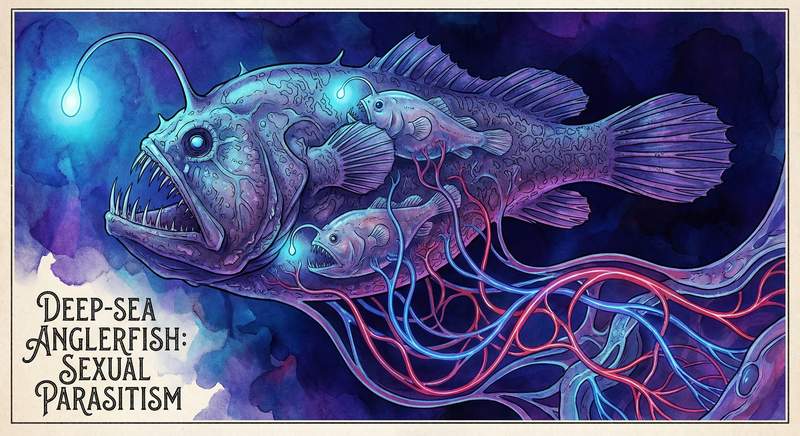
Deep-sea anglerfish are already famous for looking like creatures sketched during a nightmare, but their sex lives are stranger than their teeth. In some species, the male is tiny compared with the female, and once he finds her he bites in and never really leaves. The Science paper on the immunogenetics of sexual parasitism describes how attachment in certain ceratioid anglerfishes can progress to fusion of epidermal and dermal tissues and eventually connection of circulatory systems. At that point the male becomes dependent on the female for nutrients and functions, in effect, as a permanent sperm-producing appendage.
That arrangement makes evolutionary sense in the deep sea, where mates can be desperately hard to find. Yale’s 2024 explanation of the phenomenon emphasizes the basic ecological pressure: the deep sea is vast, dark, and sparse. If two members of the same species do manage to meet, there is a huge advantage in turning that chance encounter into a lifelong reproductive guarantee. Sexual parasitism is an extreme solution to an extreme environment.
The most astonishing part is not simply the attachment. It is the immune problem. In ordinary vertebrates, tissues from another individual are supposed to trigger rejection. That is why organ transplantation is so complicated in humans. Yet some anglerfish species permit a genetically distinct male to fuse into the female’s body without mounting the kind of adaptive immune response most vertebrates rely on. The Science study found that species with temporary attachment have already lost some immune functions, and species with permanent attachment show even more dramatic changes, including losses affecting canonical adaptive immunity.
This is where the viral version of the fact can oversimplify. Not all anglerfish do this. Not even all deep-sea anglerfish do it in the same way. The Yale summary notes that in some species males attach and later detach after mating, while in others the fusion is permanent. So the accurate headline is that several deep-sea ceratioid lineages practice sexual parasitism, not that every animal called an anglerfish turns mates into body parts.
The same caution applies to the word “parasitism.” From a human-language point of view, it sounds one-sided and grotesque. Biologically, it is a label for the mode of attachment and dependency, not necessarily a moral judgment on who benefits. The male gains food and long-term reproductive access. The female gains a reliable sperm supply in a habitat where another male may never appear. The trade can be so advantageous that evolution tolerated profound changes to the immune system in the relevant lineages.
What makes the story even richer is that this does not appear to be a single freak accident in one branch of the family tree. The Science paper describes sexual parasitism as having evolved repeatedly within deep-sea anglerfishes, with different degrees of attachment and different immune modifications. That repeated evolution suggests the ecological payoff was large enough for natural selection to find similar answers more than once.
Researchers also care because anglerfish may illuminate a broader question: how flexible is the vertebrate immune system over evolutionary time? Yale’s article points out that understanding how these fishes tolerate tissue fusion could eventually inform human medicine, especially in areas like transplantation and grafting. No one is suggesting humans should copy anglerfish romance, thankfully. But the fish show that vertebrate immune rules are more adjustable than textbooks once implied.
There is still plenty we do not know. The genetic findings are strong, but the exact physiological choreography of attachment, fusion, tolerance, and long-term maintenance remains an active area of research. The new Yale work also links sexual parasitism to a broader package of traits that helped some anglerfish groups invade deep pelagic habitats, rather than treating it as a standalone weird trick. That matters because evolution usually works in bundles, not isolated party facts.
So the headline is real, just better with the details included. Some deep-sea anglerfish males really do attach to females for life and may fuse their tissues and blood supply, as shown in the Science paper. And as Yale explains, that bizarre reproductive system is part of a larger deep-sea survival strategy. It is not just one of nature’s weirdest love stories. It is a case study in what evolution will do when finding a partner is the rarest event in your world.