Why Earth's core is younger than the surface
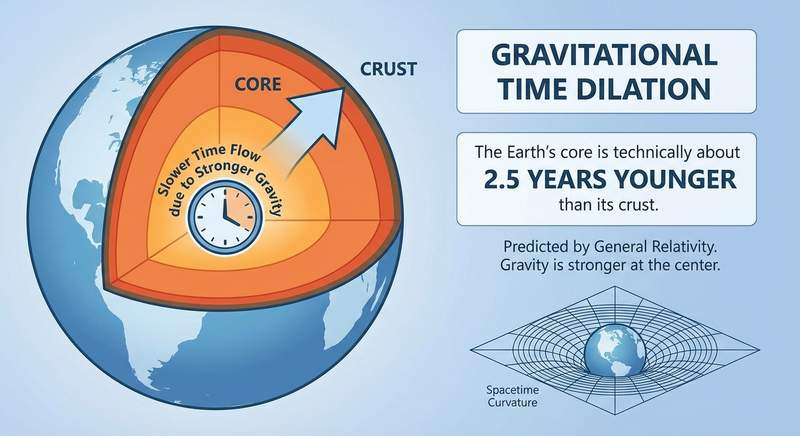
General relativity says clocks deeper in a gravitational well tick more slowly. Over Earth's 4.5-billion-year history, that tiny effect adds up: the planet's center has experienced slightly less time than the surface, by roughly two and a half years depending on the model used.
Published
Filed under
Byline
 Brainblast archive
2026-03-06-16-24-24-fact.png (source: app assets)
The fact
“Due to the effects of gravitational time dilation predicted by general relativity, the Earth's core is technically about 2.5 years younger than its crust. Because gravity is slightly stronger at the center of the planet, time passes more slowly there, meaning the core has literally experienced less time than the surface over the Earth's 4.5 billion-year history. This phenomenon demonstrates that time is not absolute and is physically warped by the mass of the planet itself.”
If you could place one perfectly accurate clock at Earth's center and another at the surface, the two clocks would not agree forever. The one deep inside the planet would tick a little more slowly. That is not geology or metaphor; it is a straightforward prediction of general relativity. In the calculation presented in the European Journal of Physics paper and its openly accessible arXiv version, the accumulated difference over Earth's history is not milliseconds or days but about two and a half years.
The basic idea is gravitational time dilation. Einstein's theory says time does not flow at exactly the same rate everywhere. A clock deeper in a gravitational potential well runs more slowly than a clock higher up. That effect is tiny in everyday life, but Earth is old. Add up a tiny difference over about 4.5 billion years and it becomes noticeable on a human scale. As Science News explained in its coverage of the calculation, the result is best understood as a home-planet illustration of relativity, not as a revision of Earth's geologic history.
One part of the claim sounds counterintuitive at first. We often learn that gravity is zero at the exact center of a symmetric sphere, so why would time be slowest there? The answer is that the relevant quantity is not the local pull you feel but the gravitational potential: the amount of work needed to move outward. Even if the net force vanishes at the center because surrounding mass cancels symmetrically, the center still sits deepest in Earth's gravitational well. In that sense it is the hardest place from which to climb out, so it accumulates slightly less proper time than the surface does, as the authors show in the journal article.
The number itself has an interesting backstory. Richard Feynman once mentioned the same idea and reportedly estimated the difference as only a day or two. The authors of the arXiv paper revisited the problem and argued that a careful back-of-the-envelope calculation already gives a result of a few years, while a more detailed model yields roughly 2.5 years. That makes the central punchline more dramatic, but it also makes the paper a good lesson in scientific humility: even memorable statements from famous physicists are worth checking quantitatively.
Just as important is what the result does not mean. It does not mean the rocky crust formed before the core in ordinary geologic time. In fact, the core differentiated very early in Earth's history, and much of today's crust is far younger because crust is continuously recycled by plate tectonics. The relativity claim compares how much time ideal clocks would register at different positions in the planet's gravitational field. It is about elapsed proper time, not the formation age of specific rocks. Saying "the core is younger" is catchy, but without that clarification it is easy to hear the statement as a geology claim when it is really a relativity claim.
There are also modeling nuances. The exact answer depends on how you represent Earth's interior density, how you treat the planet's shape, and whether you include rotational effects. Rotation introduces a tiny special-relativistic correction in the opposite direction for a clock moving with the surface, but the gravitational contribution dominates, so the center still ends up younger overall. The authors of the European Journal of Physics version present the calculation as an educational example rather than a precision geodesy result, and Science News likewise emphasized that geologic processes matter far more to Earth's actual structure than a differential of a few years.
That mix of precision and perspective is what makes the fact memorable. It is large enough to feel surprising, small enough to be harmless, and clear enough to show that relativity is not reserved for black holes, GPS satellites, or exotic thought experiments. It is quietly at work under your feet. Earth's center is not younger because anything magical happened there. It is younger because space, time, and gravity are linked everywhere, including on the planet we call ordinary.