Earth's atmosphere contains significantly less xenon than predicted by models...
Earth's 'missing xenon' problem may reflect deep-Earth chemistry: under extreme pressures xenon can react with iron, nickel, and certain iron oxides, though scientists are still testing exactly where any hidden reservoir resides.
Published
Filed under
Byline
 Brainblast archive
2026-03-06-16-45-15-fact.png (source: app assets)
The fact
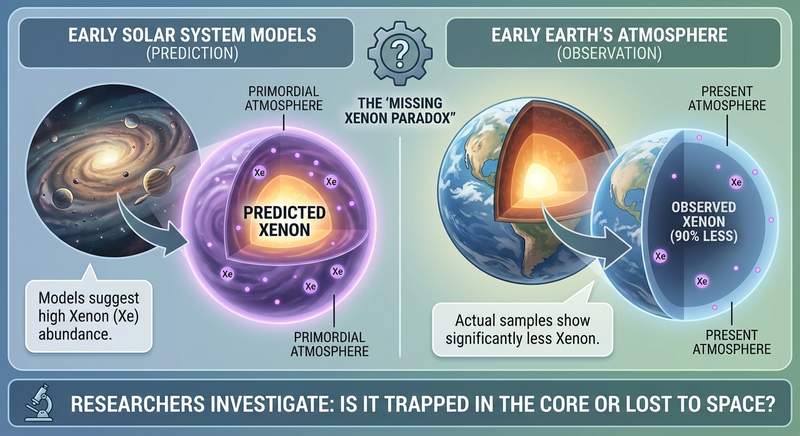
“Earth's atmosphere contains significantly less xenon than predicted by models of the early Solar System, a mystery known to scientists as the "Missing Xenon Paradox." Researchers discovered that at the extreme pressures found deep within the Earth, xenon can chemically bond with iron and nickel, suggesting the "missing" gas is actually trapped inside the planet's solid inner core. This reveals that noble gases, which are typically non-reactive, can form stable compounds under the intense gravitational forces of a planetary interior.”
Earth’s atmosphere really does contain less xenon than many models of planetary formation would lead you to expect. That mismatch is called the missing xenon problem or missing xenon paradox. Xenon is a noble gas, so it ought to be chemically aloof, yet it is more depleted from Earth’s atmosphere than some lighter noble gases. Carnegie Science summarizes the puzzle bluntly: meteorites preserve early Solar System material with much more xenon than Earth’s present atmosphere, and explaining that deficit has challenged geophysicists for decades (https://carnegiescience.edu/news/do-you-know-where-your-xenon-maybe-its-hanging-out-iron-and-nickel-earths-core).
For a long time, one reason the problem was so stubborn is that xenon is supposed to be uncooperative. Under ordinary surface conditions it does not readily bond with most elements. That makes it hard to hide inside rocks in the same way more reactive elements do. Scientists proposed many ideas: perhaps xenon escaped to space after being ionized, perhaps it was trapped in minerals or sediments, or perhaps it was sequestered in Earth’s deep interior. The exciting part of recent work is not that the mystery is solved once and for all, but that high-pressure experiments and calculations have shown xenon is less noble than advertised when crushed hard enough.
A key 2018 Physical Review Letters paper reported the synthesis of stable xenon–iron and xenon–nickel intermetallic compounds at thermodynamic conditions representative of Earth’s core. Using synchrotron x-ray diffraction, Raman spectroscopy, and first-principles calculations, the researchers concluded that under extreme pressure and temperature, iron and nickel can become electronegative enough to bond with xenon (https://link.aps.org/doi/10.1103/PhysRevLett.120.096001). That result matters because it moved the idea from pure speculation toward laboratory-supported chemistry.
Carnegie’s summary of related experimental work gives a more tangible sense of the numbers. In laser-heated diamond-anvil-cell experiments mimicking core conditions, researchers observed XeNi3 forming around 150 gigapascals and XeFe3 forming around 200 gigapascals at high temperature (https://carnegiescience.edu/news/do-you-know-where-your-xenon-maybe-its-hanging-out-iron-and-nickel-earths-core). That is startling chemistry: elements we think of as inert and metallic behaving in unfamiliar ways because pressure reorganizes their electrons.
Still, there is an important catch. Demonstrating that xenon can form stable compounds under deep-Earth conditions is not the same as proving that Earth’s atmosphere is missing xenon because it is now locked in the core. Carnegie explicitly notes that the experimental compounds probably were not formed early in Earth’s history under the exact same conditions as the core was first separating, and the team suggested that a more complicated, multistage trapping history may be required (https://carnegiescience.edu/news/do-you-know-where-your-xenon-maybe-its-hanging-out-iron-and-nickel-earths-core). In other words, the chemistry is plausible, but the geologic timeline is still being argued over.
That uncertainty is why another line of research looks beyond the core. A 2020 Nature Communications paper proposed that xenon could also be stored in the lower mantle as xenon-iron oxides formed from reactions with iron peroxide under deep-mantle pressure and temperature conditions. The authors argued that compounds such as Xe2FeO2 and XeFe3O6 could be viable xenon hosts across large lower-mantle regions and might provide a deep-Earth reservoir for the missing atmospheric xenon (https://www.nature.com/articles/s41467-020-19107-y).
That broadens the story considerably. The missing xenon paradox may not point to a single locked vault in Earth’s solid inner core. It could reflect a family of high-pressure storage mechanisms distributed across the deep Earth, including core intermetallics and lower-mantle oxides. The modern view is therefore more nuanced than the meme version that says “scientists found the missing xenon in the inner core.” What they have really found is credible chemical pathways by which xenon can be hidden in places once thought impossible.
Another subtle point is that xenon is special among noble gases. The Nature Communications study emphasizes that analogous reactions are not equally favored for krypton, argon, or neon under the same conditions (https://www.nature.com/articles/s41467-020-19107-y). That is important because the paradox is specifically about xenon’s unusual depletion pattern. A successful explanation should not trap all noble gases equally; it should single xenon out in a chemically plausible way. Deep-Earth high-pressure chemistry may finally offer that selectivity.
So where does that leave the original claim? It is fair to say that Earth’s atmosphere contains much less xenon than expected and that high-pressure research has shown xenon can react with iron and nickel, despite its reputation for inertness. It is also fair to say this makes deep-Earth sequestration a serious explanation for the missing xenon problem. What would be too strong is claiming the case is closed or that all of the missing xenon has definitely been located in the solid inner core. The evidence points to a promising solution space, not a final inventory count.
That is still a remarkable scientific shift. A long-standing atmospheric mystery is now being attacked not by looking only at the sky, but by recreating planetary interiors in the lab and by calculating exotic compounds that exist only under crushing pressures. Xenon, the supposedly aloof noble gas, turns out to have a secret social life after all—just not at the surface where humans usually meet it.