Honey Lasts Amazingly Well—But “Never Spoils” Needs Footnotes
Honey’s reputation for immortality is grounded in real chemistry: low water activity, high sugar concentration, acidity, and antimicrobial compounds make it unusually resistant to spoilage. Still, “only food that never spoils” is an oversimplification, because storage conditions matter and other foods can also keep for very long periods in different forms.
Published
Filed under
Byline
 Brainblast archive
2026-03-01-10-31-00-honey-never-spoils.png (source: app assets)
The fact
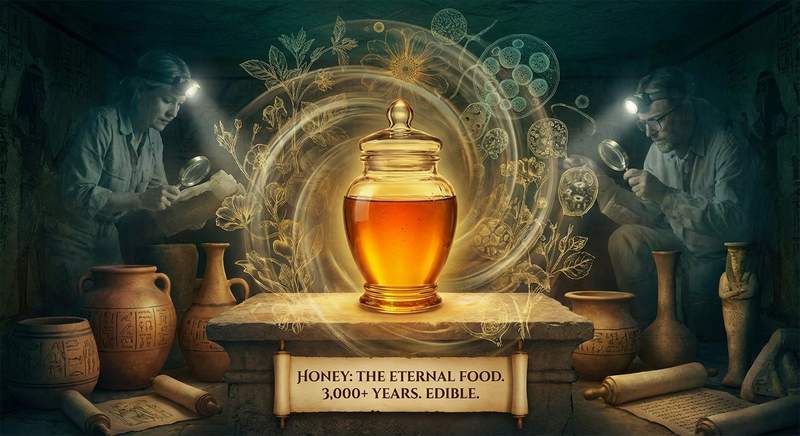
“Honey is the only food that never spoils. Archaeologists have discovered pots of honey in ancient Egyptian tombs that are over 3,000 years old and still perfectly edible.”
Honey has one of the best reputations in food science: it can remain edible for astonishingly long periods. Smithsonian’s shelf-life explainer points to the famous reports of ancient honey found in Egyptian tombs still preserved after thousands of years. That story persists because it captures something real. Honey is unusually resistant to microbial spoilage, and modern research explains why.
The chemistry is the star. The microbiology review in PMC says the water activity of ripened honey is too low to support the growth of most organisms and describes honey as hostile to microbes because of hygroscopicity, hyperosmolarity, acidity, peroxide content, and related factors. The later review on antibacterial activity gives similar ranges, noting that honey’s water activity is far below the level favored by bacterial growth and that its acidic pH also works against spoilage. In plain English, honey is sugary, dry, acidic, and chemically armed.
That combination matters because spoilage is not magic. Most foods go bad because bacteria, yeasts, or molds can grow in them. Honey makes that difficult. Smithsonian’s article explains that honey contains very little water in its natural state, while the 2007 PMC review notes that the organisms found in honey are often inactive because the environment is so inhospitable. Even when microorganisms are present, they usually cannot thrive unless moisture rises enough to change the balance.
That last clause is the first big caveat. Honey does not have mystical invulnerability. It has conditions. The microbiology review explicitly notes that spoilage yeasts can grow in honey with higher water content, which is why fermentation can occur under the wrong conditions. Smithsonian makes the same practical point in simpler language: as long as the container stays sealed and excess water is not introduced, honey can keep extraordinarily well. Once moisture gets in, the famous immortality becomes much less immortal.
This is also why crystallized honey is often misunderstood. Crystallization looks like decay, but it usually is not. Honey commonly changes texture, granulates, or separates over time. Those are physical changes, not necessarily spoilage. People sometimes throw away perfectly safe honey because it no longer looks smooth and golden. The chemistry that protected it may still be doing its job.
The phrase “the only food that never spoils” is a different problem. Smithsonian’s article itself notes that other substances such as salt, sugar, and dried rice can also keep for extremely long periods in raw form. Honey is special because it can remain directly edible and pleasant without much processing, but saying it is uniquely alone among all foods is more slogan than strict taxonomy. Food preservation depends on how broadly you define “food,” “spoil,” and “edible.”
Even the ancient-Egyptian example deserves a little humility. Reports of old honey found in tombs are plausible and widely repeated, but the viral version often adds dramatic details such as archaeologists casually tasting it on the spot. The strongest part of the claim is not the anecdote itself; it is that honey’s chemistry really can preserve it over extraordinary timescales when sealed. The anecdote is memorable because it aligns with what the microbiology literature predicts.
Researchers are interested in honey for more than kitchen trivia. The 2022 review in PMC surveys why honey’s antimicrobial properties attract scientific attention in wound care and therapeutic products. The earlier review likewise discusses honey as both a microbial reservoir and an inhibitory agent. In other words, honey is not just shelf-stable; it is biologically interesting because it creates a chemical environment that suppresses many microbes instead of feeding them.
That helps explain why the myth became so durable. Honey does not merely avoid rapid decay; it actively resists many of the microbial pathways that wreck other foods. The Smithsonian explainer translates that chemistry into ordinary language, while the two PMC reviews show that the reputation is rooted in measurable properties rather than folklore.
So the right conclusion is pleasantly balanced. Properly stored honey really can remain edible for extremely long periods because of its low water activity, acidity, sugar concentration, and antimicrobial chemistry, as described by the PMC review and this one. Smithsonian’s explanation captures why that fascinates people. But “never spoils” works best as shorthand for “astonishingly durable when sealed,” not as a law of the universe. Honey is amazing. It is still chemistry, not magic.