Honeybees have five eyes—but not a literal magnetic GPS
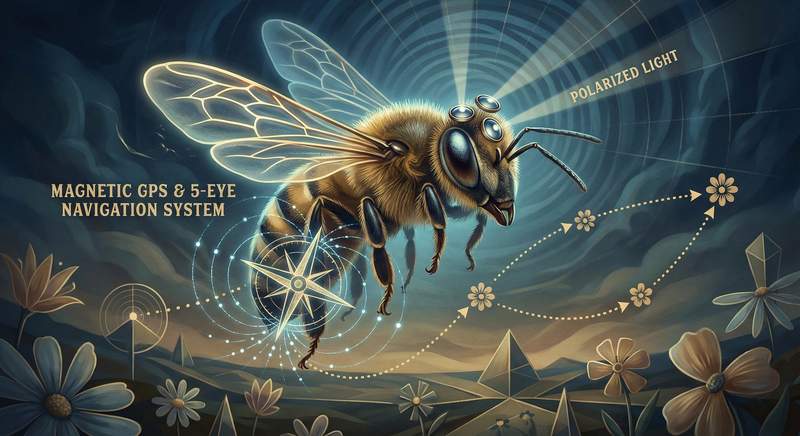
Honeybees do have two compound eyes plus three simple ocelli, and experiments suggest they can sense Earth's magnetic field. But the catchy 'magnetic GPS' claim oversells the evidence: bees navigate by combining sun position, polarized light, landmarks, optic flow, and possibly magnetic information.
Published
Filed under
Byline
 Brainblast archive
2026-03-03-12-14-00-honeybee-magnetic-navigation.png (source: app assets)
The fact
“Honeybees have five eyes and a built-in magnetic GPS system. In addition to two large compound eyes for detecting motion, shapes, and colors, honeybees have three tiny 'ocelli' eyes on top of their heads arranged in a triangular pattern that specifically detect light intensity and polarization patterns in the sky. But even more remarkably, researchers discovered that honeybees can sense Earth's magnetic field and use it for navigation—a built-in biological compass. They have magnetic iron grains in their abdomens and antennae that detect magnetic fields, allowing them to navigate precisely even on cloudy days when they cannot see the sun. Recent studies from the University of Freiburg show that individual honeybees fly personally chosen routes with incredible precision, returning to the exact same flowers in the same order day after day using this combined navigation system of visual landmarks, sky polarization, and magnetic field detection.”
The first half of the claim is solid: honeybees really do have five eyes. Two are the large compound eyes most people notice, and three more are simple eyes called ocelli on the top of the head. Michigan State University's honey bee anatomy guide explains that the compound eyes are made of thousands of ommatidia and are especially good at detecting motion, while the ocelli do not form detailed images and instead provide information about light intensity Michigan State University. So if someone says a honeybee has five eyes, they are not being poetic. They are just counting correctly.
Where the viral version goes off the rails is the phrase "built-in magnetic GPS system." Bees are excellent navigators, but they do not carry anything equivalent to an electronic GPS receiver. Their navigation is a layered sensory toolkit. Classic bee research shows that foragers use the sun's azimuth, patterns of polarized light in the sky, visual landmarks, and optic flow during flight. A review in the Bulletin of Entomological Research places magnetoreception inside that broader navigation picture and makes an important point: even if bees can sense magnetic fields, the biological mechanism and behavioral role are still not fully resolved Cambridge review.
The eye count itself is worth unpacking because the five eyes do different jobs. The two compound eyes dominate the sides of the head and help bees detect motion, orientation, and patterns in the environment. The three ocelli sit near the top of the head and are much simpler. They are especially useful for sensing brightness and helping stabilize orientation during flight, not for producing a miniature second set of high-resolution images. That distinction matters because people sometimes imagine a bee's five eyes as five interchangeable cameras, when insect vision is more specialized than that. The Michigan State anatomy page explicitly describes the ocelli as simple light-sensitive structures rather than focused image-forming eyes.
So what about magnetoreception? Here the evidence is suggestive and substantial enough to be interesting, but not so clean that we should turn it into a cartoon slogan. The research article "Magnetoreception System in Honeybees (Apis mellifera)" reviews decades of behavioral evidence showing that honeybee orientation and comb-building can be altered by extra magnetic fields, that bees can be trained to respond to magnetic anomalies, and that tiny magnets attached near the abdomen can interfere with magnetic discrimination. That same study examined iron-containing granules in honeybee cells and proposed a magnetite-based transduction pathway involving the cytoskeleton and calcium signaling.
Those results are exciting because they point to a real sensory system rather than a vague superstition about animals "feeling" north. But even the stronger studies do not justify the GPS analogy. GPS means a satellite-based positioning system that computes precise location from external timing signals. Bees do nothing like that. At most, the evidence suggests that magnetic information may act as one cue among several, possibly helping with orientation when other cues are weak or conflicting. The Cambridge review is careful on exactly this point: magnetoreception may be important, but how it integrates with vision and other senses remains a central open question.
There is also a mechanistic debate. One long-standing idea is that bees use magnetic particles, especially magnetite, somewhere in the body as a compass-like receptor. Another idea, discussed in the Cambridge review, is a radical-pair mechanism linked to photochemistry and vision, a model also studied in birds. The 2007 PMC paper supports the magnetite side by examining superparamagnetic material and cellular responses to magnetic fields, but the review literature makes clear that the field has not closed the case. That uncertainty is not a weakness of bee biology; it is simply where the science currently stands.
Another useful nuance is that "precise navigation" does not prove any single cue. Bees can return to profitable flowers and communicate route information with spectacular efficiency, but that performance emerges from cue integration. A bee on a sunny day can lean heavily on the sun compass and polarized skylight. In cluttered landscapes it can use landmarks. During flight it can estimate distance through optic flow. Magnetic sensitivity, if present and behaviorally important in that context, likely supplements those other channels instead of replacing them. The magnetoreception study itself frames magnetic information as part of a complex orientation system rather than the whole story.
So the durable version of the fact is a little less flashy and a lot more accurate. Honeybees have five eyes, yes. They also appear capable of sensing magnetic fields, yes. But calling that ability a built-in magnetic GPS turns an active research topic into an overconfident meme. The real biology is better anyway: a small animal with multiple visual systems, rich sensory antennae, and a navigation strategy assembled from sunlight, sky polarization, landmarks, motion cues, and perhaps geomagnetism. That is not gadgetry. It is evolution doing systems engineering in six legs and a pair of wings.