Opiorphin Is Real—But “Six Times Stronger Than Morphine” Needs Context
Human saliva does contain a peptide called opiorphin, and early research found analgesic effects in animal pain models. The catchy “six times stronger than morphine” line refers to specific experimental comparisons, not to ordinary saliva acting as a super-painkiller in everyday human use.
Published
Filed under
Byline
 Brainblast archive
2026-03-05-21-38-00-human-saliva-opiorphin.png (source: app assets)
The fact
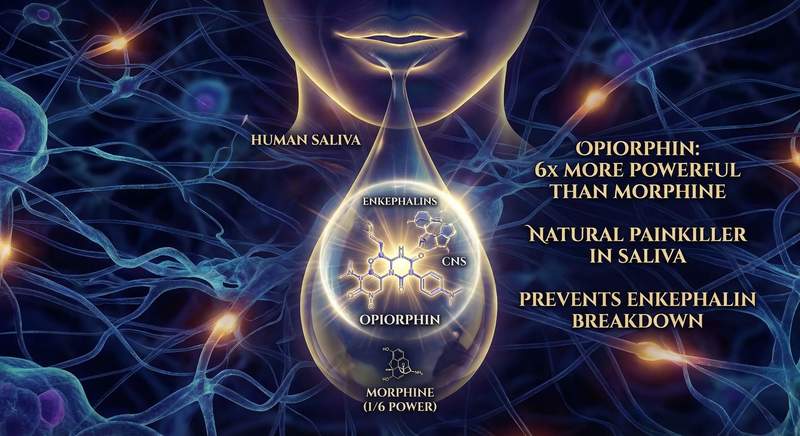
“Human saliva contains a natural painkiller called opiorphin that is technically six times more powerful than morphine. This potent molecule works by preventing the body from breaking down its own natural pain-relieving chemicals, called enkephalins, specifically in the central nervous system. While it exists in very small quantities, researchers are studying opiorphin as a potential foundation for new, non-addictive painkillers that could mimic the effectiveness of traditional opioids without the dangerous side effects.”
The foundation of the claim is real: human saliva contains a peptide called opiorphin. The 2006 paper hosted at PMC describes opiorphin as a human physiological inhibitor of enkephalin-inactivating enzymes and says it was identified in human saliva. In plain English, it helps preserve some of the body’s own natural pain-modulating signals instead of acting like an injected opioid from outside the body. That alone is already interesting enough without meme inflation.
The trouble begins with the phrase “six times stronger than morphine.” That makes it sound as if a mouthful of saliva is a pharmaceutical weapon. But the original paper does not say that ordinary saliva, as such, is casually six times more powerful than morphine in humans. It reports that opiorphin showed potent analgesic activity in animal pain models and says its pain-suppressive potency was as effective as morphine in a behavioral rat model of acute mechanical pain. That is a much narrower and more scientifically defensible statement.
The University of Bradford explainer helps translate the mechanism. It explains that enkephalins are the body’s own opioid peptides and that opiorphin works by preventing enzymes from breaking them down too quickly. That means opiorphin is not simply “natural morphine hidden in spit.” It is a modulator of the body’s own pain-control pathways. That difference matters, because it changes what kind of drug candidate or biological signal researchers are actually talking about.
The catchy “six times stronger” comparison usually comes from secondary reporting that compresses dose comparisons from animal studies into one dramatic line. The Bradford article discusses the excitement around using opiorphin-inspired compounds as possible analgesics, but it does not present this as a ready-made human painkiller sitting on your tongue. The original paper is similarly exciting but cautious: it identifies a peptide, characterizes how it inhibits certain enzymes, and reports analgesic effects in model systems.
That caution is even more important when moving from biochemical discovery to medicine. Lots of molecules show promise in vitro or in animals and never become safe, effective, approved human drugs. The 2006 PMC paper says opiorphin may have therapeutic implications, which is exactly how scientists talk when something is promising but early. The Bradford explanation also frames the idea as future-oriented rather than settled clinical practice.
Later work shows that opiorphin remained scientifically relevant, but not in the meme’s simplistic way. The 2023 Scientific Reports meta-analysis describes opiorphin as a pentapeptide present in human saliva with reported analgesic and anxiolytic effects, and it studies opiorphin as a biomarker in orofacial conditions. That is a useful update because it shows opiorphin is not a one-paper curiosity. At the same time, it also shows how the field matured: researchers are studying levels, associations, and mechanisms, not announcing that humanity forgot to bottle its own super-opioid.
Another important caveat is dosage and delivery. Even if purified opiorphin or opiorphin-inspired compounds have interesting analgesic properties, that does not mean the concentration naturally present in saliva gives people morphine-like pain relief whenever they bite their cheek. The original paper concerns a defined peptide and its activity in experimental systems. The Nature meta-analysis treats salivary opiorphin as a measurable biological factor, not as a proof that saliva itself is an everyday anesthetic.
It is also telling that later literature often discusses opiorphin as a biomarker or therapeutic lead rather than as a miracle substance people are already using unknowingly. The Bradford explainer frames it as inspiration for future painkillers, and the Nature review treats its salivary presence as clinically informative rather than magically sufficient.
The meme also tends to flatten the distinction between “more potent in a specific experimental setup” and “stronger overall.” Potency depends on model, dose, route, endpoint, and mechanism. The Bradford explainer makes clear that opiorphin works indirectly by preserving endogenous enkephalins, while the 2006 paper compares analgesic effects within particular animal tests. That is very different from a universal leaderboard where saliva simply defeats morphine.
So the repaired fact is still pretty cool. Human saliva really does contain opiorphin, as shown in the original research paper. Researchers have taken it seriously enough that later reviews and meta-analyses still discuss its analgesic potential and biomarker value, and the Bradford explainer shows why scientists found it exciting. The honest version is not “your spit is six times stronger than morphine.” It is “human saliva contains a peptide that can modulate pain pathways, and early lab studies found striking analgesic effects under specific experimental conditions.”