Everest Still Wouldn’t Clear the Mariana Trench
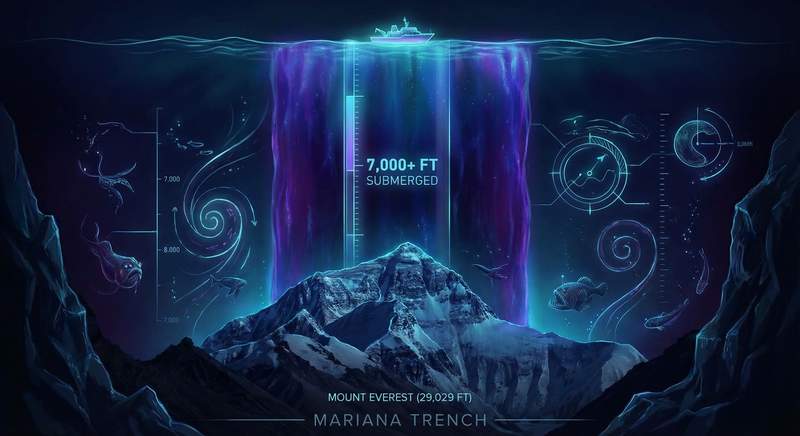
If you dropped Mount Everest into Challenger Deep, its summit would still remain underwater. The comparison is real, but the exact leftover depth depends on which accepted measurements you use, because both Everest’s height and the trench’s depth have been refined over time.
Published
Filed under
Byline
 Brainblast archive
2026-03-02-23-14-00-everest-mariana-trench.png (source: app assets)
The fact
“If Mount Everest (29,029 feet tall) were placed at the bottom of the Mariana Trench, the deepest point on Earth at approximately 36,201 feet below sea level, its summit would still be submerged by over 7,000 feet (more than 1.3 miles or 2 kilometers) of water. The total vertical range from Earth's highest point to its lowest is only about 12.3 miles—a surprisingly small distance on a planet with a diameter of nearly 8,000 miles.”
The easiest way to make Earth’s deepest ocean point feel real is to compare it with Earth’s tallest mountain. According to Britannica’s Mount Everest overview, Everest rises roughly 29,000 feet above sea level, while Britannica’s Challenger Deep entry and NOAA’s Mariana Trench explainer show that the deepest part of the trench drops to around 10.9 kilometers below sea level. Put those together and the viral claim holds up: if Mount Everest were set on the floor of Challenger Deep, the top would still be underwater.
NOAA phrases the comparison memorably in Planet Postcard: The Mariana Trench: cut Everest off at sea level, place it on the bottom of Challenger Deep, and there would still be over a mile of water above the summit. That is the part people remember, and it is not exaggeration. It captures how surprisingly modest Earth’s total surface relief is compared with the size of the planet itself. Our highest peak and deepest ocean point are dramatic to us, yet they occupy only a thin skin on a world almost 8,000 miles across.
The numbers shift a bit depending on which survey you use. Challenger Deep | Depth, Expeditions, & Facts notes multiple measurements gathered by different expeditions, and NOAA’s Mariana Trench page highlights a 2010 multibeam sonar survey that measured the deepest point at 10,994 meters, plus or minus 40 meters. Everest’s height has also been refined over time, which is why older facts often quote 29,029 feet while newer official values are slightly higher. So the most careful version of the claim is not one exact leftover number, but that the summit would remain submerged by well over a mile or by a bit more than two kilometers.
That caveat matters because “deepest” and “highest” are not as simple as they sound. Everest is the highest mountain above mean sea level, but Mauna Kea in Hawaii is taller if measured from its underwater base. Likewise, the deepest ocean point is not a static hole measured once forever. Ocean depths are estimated with sounding lines, pressure instruments, crewed dives, and increasingly precise sonar surveys, and each method has uncertainty. The broad comparison survives all of that, but the exact decimal place should be treated with humility.
There is also a geological lesson hidden in the stunt. Challenger Deep exists because of subduction, the process described in NOAA’s Mariana Trench overview, in which one tectonic plate bends and plunges beneath another. Everest exists for almost the opposite reason: crust was compressed and pushed upward as the Indian and Eurasian plates collided, a story summarized in Britannica’s Mount Everest entry. The comparison is fun not only because one number exceeds another, but because it pairs two different products of plate tectonics—one made by crust descending, the other by crust rising.
It also helps explain why deep-ocean exploration remains so hard. Mountains are dangerous, but at least climbers can breathe. The bottom of the Mariana Trench sits under crushing pressure and total darkness. NOAA’s page emphasizes how few humans have visited it compared with the many thousands who have climbed Everest. The trench is not just deeper than Everest is tall; it is dramatically less accessible to human bodies and machines.
Popular retellings sometimes turn the comparison into “Earth’s highest and lowest points are only 12 miles apart.” That is directionally true if you stack the measurements from Everest’s summit to Challenger Deep, but it should not be mistaken for a straight-line physical path on the planet. The two points are far apart geographically, and their exact vertical separation depends on which accepted measurements you adopt. What the line really communicates is scale: Earth’s topographic extremes are enormous in human terms and still tiny relative to the planet’s radius.
So the headline survives scrutiny. Using the values summarized by Britannica on Everest, Britannica on Challenger Deep, and NOAA’s Mariana Trench explainer, Everest would not poke out of the deepest trench. It would vanish beneath more than a mile of seawater. The viral image is dramatic, but the science behind it is sturdier than most internet scale comparisons.