Alexia Lopez’s “Big Ring” Is Real as a Candidate Structure—Its Meaning Is the Debate
In 2024, PhD student Alexia Lopez reported the discovery of a giant ring-like large-scale structure about 9.2 billion light-years away. The careful version of the fact is not that cosmology was overturned overnight, but that a statistically unusual ring-like pattern was identified and argued to be hard to reconcile with standard expectations.
Published
Filed under
Byline
 Brainblast archive
2026-03-04-01-30-00-big-ring-galactic-clusters.png (source: app assets)
The fact
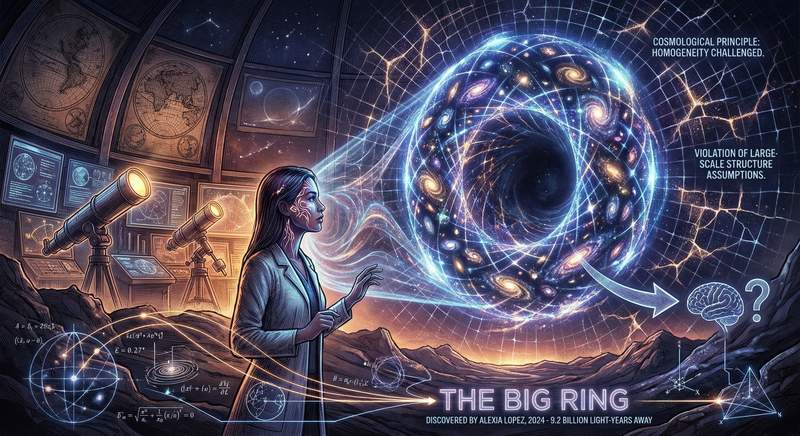
“In 2024, PhD student Alexia Lopez discovered the Big Ring—a massive circle of galactic clusters located 9.2 billion light-years away that challenges our understanding of cosmic evolution. This enormous structure spans an area so large that it violates the cosmological principle—the assumption that the universe is homogeneous at large scales.”
The core of the claim is real. In 2024, PhD student Alexia Lopez reported what she called “A Big Ring on the Sky,” a huge ring-like large-scale structure seen through MgII absorber data. The University of Central Lancashire’s news release says the structure is about 9.2 billion light-years away, roughly 1.3 billion light-years across, and about 4 billion light-years in circumference. The arXiv abstract for Lopez’s paper likewise presents the Big Ring as a striking annulus-like structure and notes that the paper was accepted for publication in JCAP.
Where the viral version gets slippery is the phrase “discovered the Big Ring” being used as if astronomers all instantly agreed on a giant literal circle that definitively broke cosmology. What Lopez reported, according to the arXiv abstract, is a ring-like ultra-large large-scale structure identified using several statistical methods. The same abstract says the feature reaches departures from random expectations of up to 5.2 sigma in the analyzed catalogues. That is a serious claim. It is not the same thing as saying the universe now comes with a clean neon hoop hanging in space.
Even Lopez’s own public explanation includes nuance. UCLan’s write-up says the Big Ring appears almost perfect on the sky but that further analysis suggests it has more of a coil shape than a simple geometric ring. That matters because social-media retellings often turn any ring-like pattern into a literal cosmic hula hoop. The actual scientific language is more careful: ring-like, annulus-like, and possibly part of a more complex larger configuration.
The reason astronomers care is scale. The UCLan article emphasizes that such a large structure is difficult to explain in the standard picture of the cosmos and may challenge assumptions related to the Cosmological Principle, the idea that the universe should look statistically similar on sufficiently large scales. The arXiv abstract similarly frames the Big Ring as an extraordinary ultra-large structure that may have implications for cosmology and even prompts discussion of possibilities such as cosmic strings.
But “challenge” is not the same as “destroy.” That is probably the most important caveat. Cosmology regularly encounters tensions, anomalies, and unexpectedly large structures. Some later hold up strongly, some weaken after better data or alternative analyses, and some turn out to depend heavily on how the sample was selected. The arXiv abstract is upfront that the result comes from a specific method applied to MgII absorber catalogues and that the significance is being assessed through several statistical tools. That is real science, but it is still a stage of investigation, not a final engraved verdict.
The Big Ring is also part of a larger context. UCLan’s release notes that Lopez had previously reported the Giant Arc and that the two structures appear near each other on the sky at similar redshift. The arXiv abstract says this proximity raises the possibility that together they form an even more extraordinary cosmological system. That makes the discovery more interesting, but it also means interpretation becomes more complicated. Two unusual features near each other can point to deep physics, selection effects, or statistical weirdness that still needs untangling.
Another nuance is the difference between “found” and “seen directly.” Nobody is looking through an eyepiece at a glowing ring. The structure is inferred from patterns in absorber catalogues and mapped statistically. The arXiv paper page makes that clear through its discussion of MgII absorbers and significance tests, while UCLan’s explanation translates the result into plain language. So the discovery is genuine, but it belongs to modern survey cosmology, not to old-fashioned visual astronomy.
This is exactly why the fact became so popular: it combines a dramatic shape, an enormous size, and a human-scale protagonist—a PhD student—into one irresistible package. Yet the best science version remains a little less cinematic. Alexia Lopez did report a massive ring-like structure in 2024. That structure is about 9.2 billion light-years away and on the order of 1.3 billion light-years across according to UCLan, and the paper abstract presents it as a statistically significant ultra-large structure.
So the corrected takeaway is strong enough without hype: yes, Alexia Lopez really did report the Big Ring in 2024, and the candidate structure is enormous and scientifically provocative. But the careful claim is not “cosmology is finished.” It is that a published-or-accepted analysis identified a ring-like large-scale feature that its discoverer’s university says is difficult to explain under standard assumptions. That is impressive, and it is exactly why astronomers are still arguing about what it means.