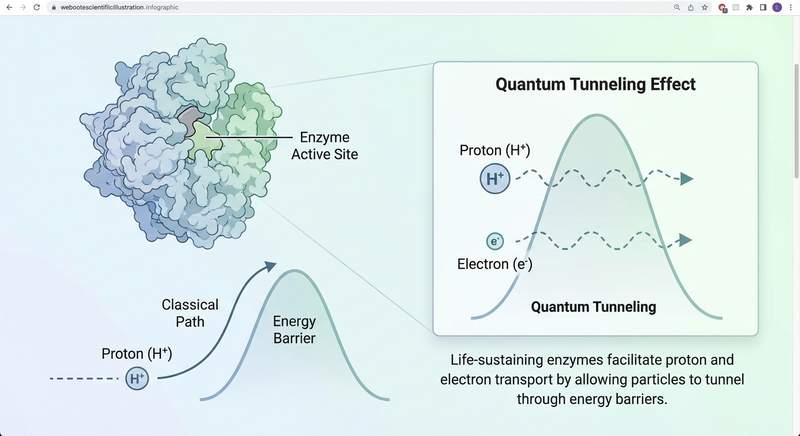
Many life-sustaining enzymes utilize quantum tunneling to allow protons and...
Quantum tunneling is well supported in some biologically crucial hydrogen-transfer and electron-transfer reactions, but the careful version of the claim is that certain enzymes and redox proteins exploit quantum behavior rather than that all of biology runs on literal particle teleportation.
Published
Filed under
Byline
 Brainblast archive
2026-03-06-16-45-41-fact.png (source: app assets)
The fact
“Many life-sustaining enzymes utilize quantum tunneling to allow protons and electrons to bypass energy barriers by "teleporting" through them rather than climbing over them classically. This quantum shortcut accelerates vital biochemical reactions by factors of up to 10^15, turning processes that would take millions of years into events completed in milliseconds. This phenomenon proves that the fundamental machinery of life depends on quantum mechanical effects to function at biological speeds.”
If you strip away the sensational phrasing, the underlying fact is solid: some of the chemistry of life really does rely on quantum-mechanical tunneling. But the careful version is narrower than the meme. Scientists are not claiming that every enzyme in every cell works by spooky “teleportation,” nor that biology routinely ignores ordinary chemistry. What the evidence shows is that in certain crucial reactions—especially transfers of hydrogen, protons, hydrides, and electrons—particles can cross energy barriers by tunneling rather than only by climbing over them classically. In enzymology, that matters because tiny differences in transfer rates can separate a viable metabolism from a hopelessly slow one.
One of the clearest early experimental cases came from yeast alcohol dehydrogenase. In a 1989 Science paper, researchers measured isotope effects that did not fit a simple semiclassical picture and argued that the reaction coordinate included a significant contribution from hydrogen tunneling (https://www.science.org/doi/10.1126/science.2646716). That did not instantly prove that all enzymes are quantum machines, but it helped push the field away from the older assumption that transition-state theory plus minor corrections could explain everything important.
Later reviews made the case much more broadly. Judith Klinman and Amnon Kohen’s Annual Review of Biochemistry article argues that quantum-mechanical hydrogen tunneling provides a useful window into the relationship between protein dynamics and catalysis, especially for enzymatic C–H bond cleavage (https://www.annualreviews.org/doi/10.1146/annurev-biochem-051710-133623). Their point is not just that a light particle sometimes tunnels. It is that proteins appear to sample conformations that help place donor and acceptor atoms at distances and electrostatic arrangements favorable for tunneling. In other words, the enzyme is not passively watching quantum mechanics happen; its structure and motions can help set the stage.
That matters because tunneling is exquisitely sensitive to distance. Move a donor and acceptor slightly farther apart and the probability can crash. Move them into a more favorable geometry and the transfer can become much faster. The modern picture is therefore more interesting than “enzymes break the rules.” They follow the rules of quantum chemistry, and evolved protein motions can exploit those rules.
Electron transfer adds another layer. Biological redox chains often move electrons over distances that would be surprisingly awkward if chemistry were limited to direct, short-range contact. A major review in Chemical Reviews explains that respiration and other energy-transduction pathways depend on long-range electron transfer through proteins, and that most of those reactions involve quantum tunneling between weakly coupled redox cofactors embedded inside folded protein structures (https://pmc.ncbi.nlm.nih.gov/articles/PMC3005815/). This is especially important in systems that build proton gradients and ultimately support ATP synthesis. The review also discusses proton-coupled electron transfer, where electron motion and proton motion are linked in protein redox machines.
So the strong version of the claim is not just about one obscure enzyme. It is that some biologically central reactions—including parts of metabolism and bioenergetics—use quantum transfer processes because electrons and hydrogen nuclei are light enough, and because proteins can hold reactants in configurations where tunneling becomes significant. That is a real scientific conclusion, not pop-science garnish.
Still, there are caveats. First, “quantum tunneling” in biology does not mean large-scale quantum weirdness of the sort people invoke in loose conversations about consciousness. These are local chemical events in warm, wet systems, not whole cells existing in superposition. Second, even in enzymes where tunneling is important, it is usually part of a larger catalytic story that includes electrostatics, active-site organization, conformational sampling, and ordinary thermodynamics. Tunneling is one contributor, not a magic override switch.
Third, the claim that tunneling can speed reactions by fantastically huge factors is easy to oversell. Enzymes themselves can produce enormous rate enhancements relative to uncatalyzed reactions, but not all of that enhancement should be assigned specifically to tunneling. The Annual Review article is careful on this point: hydrogen tunneling offers insight into catalytic optimization and protein dynamics, but it is woven into a broader mechanistic framework rather than acting as the sole explanation for enzymatic power (https://www.annualreviews.org/doi/10.1146/annurev-biochem-051710-133623).
The wording “many life-sustaining enzymes” is also fuzzier than it first appears. There are certainly life-sustaining enzymes and protein complexes in which tunneling is well supported. Yet biochemists would be more comfortable saying that tunneling is important in a substantial class of biologically essential transfer reactions than saying life in general would instantly stop without quantum shortcuts in every enzyme family.
That more careful phrasing does not make the fact less impressive. It makes it truer. Living systems did not escape physics; they learned to work with its deepest rules. In some enzymes, a proton or hydride does not need to crest an activation barrier in a wholly classical way. In some respiratory and photosynthetic proteins, electrons do not need to lumber through space by direct contact alone. The machinery of life can be arranged so that quantum transfer becomes chemically useful.
So yes: biology really does contain bona fide examples of quantum tunneling in action. The right takeaway is not that life is secretly made of magic. It is that the same quantum rules governing atoms and materials also help power ordinary metabolism, one exquisitely tuned chemical step at a time.