Oxford Is Older Than the Aztec Empire—With a Caveat
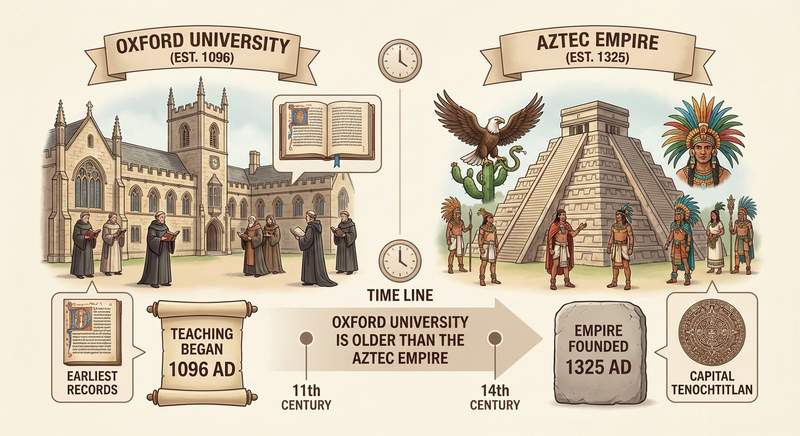
Oxford really is older than the Aztec Empire by any normal chronology, but the viral version usually mixes up the founding of Tenochtitlán in 1325 with the later rise of the Aztec imperial alliance in 1428. Oxford, meanwhile, had teaching in place by 1096 but no single tidy founding day.
Published
Filed under
Byline
 Brainblast archive
2026-03-06-16-43-36-fact.png (source: app assets)
The fact
“Oxford University is older than the Aztec Empire; teaching at Oxford existed as early as 1096, whereas the Aztec Empire was founded in 1325.”
The headline is true, but the best version has a footnote attached. According to Oxford’s official history page, teaching existed in Oxford in some form by 1096. That is centuries before the dates usually given for the Aztec world in popular comparisons. Britannica’s quick fact on Oxford and the Aztecs says the Aztec capital Tenochtitlán was founded about 1325, which already makes Oxford older by more than two hundred years.
But there is a subtle problem hiding inside that sentence. Tenochtitlán is not exactly the same thing as “the Aztec Empire.” As Britannica’s page on the establishment of the Aztec empire explains, the empire took shape later, under Itzcóatl, when Tenochtitlán allied with Texcoco and Tlacopan and became the dominant force in central Mexico in 1428. So the meme is true even under a stricter historical definition, but many retellings use the city’s founding date while calling it the empire’s founding date.
That caveat actually makes the comparison stronger, not weaker. If you compare Oxford’s documented teaching by 1096 to 1325, Oxford is clearly older. If you compare Oxford to the imperial alliance that began in 1428, Oxford is older by an even wider margin. The main thing to avoid is pretending that “Aztec Empire” and “Tenochtitlán” are interchangeable labels. They are closely related, but not identical.
Oxford itself also deserves some nuance. Oxford’s own chronology says there is “no clear date of foundation.” That matters. Oxford was not founded with a ribbon-cutting ceremony on a universally agreed day. Instead, it emerged gradually as a medieval center of teaching, then developed rapidly after 1167 when Henry II banned English students from attending the University of Paris. In other words, Oxford’s age is real, but it is based on evidence of teaching and institutional development, not a neat single founding charter.
This is one reason the comparison feels so surprising to modern readers. We often compress anything premodern into one mushy category called “ancient.” But the past was as layered as the present. Cleopatra was not the same distance from the Great Pyramid that a medieval scholar was from the Roman Empire, and the Aztec imperial state was not contemporary with Europe’s earliest universities. Britannica’s Oxford fact page works because it snaps those layers back into focus with one clean contrast.
It also reminds us that universities and empires are different kinds of institutions with different timelines. A university can grow incrementally out of schools, scholars, and charters over generations. An empire is more likely to be dated from a conquest, alliance, or political transformation. That difference helps explain why Oxford has fuzzy beginnings while the Aztec Empire is often tied more specifically to the 1428 rise of the Triple Alliance described by Britannica’s empire overview.
Another reason the meme sticks is that both sides of the comparison are culturally oversized. Oxford symbolizes old European learning; the Aztecs symbolize a powerful Mesoamerican civilization cut short by Spanish conquest. When people hear that the first predates the second, they suddenly realize how late many familiar historical states actually are. The same medieval centuries that saw Oxford’s early growth were still long before the Aztec imperial system consolidated in central Mexico.
The comparison also works because Oxford’s continuity is institutional rather than architectural. Oxford’s history page does not claim a single original campus frozen in place from 1096 onward; it describes a teaching community that expanded into colleges, statutes, and a recognizable university over time. Britannica’s Oxford fact page turns that long development into a compact fact, but the real historical picture is richer than one old building versus one later empire.
So the cleanest phrasing is this: Oxford is older than the Aztec Empire, and it is even older than Tenochtitlán. The numbers behind that claim come from Oxford’s own institutional history, Britannica’s Oxford-versus-Aztec comparison, and Britannica’s account of the empire’s establishment in 1428. The viral version gets the spirit right. The fully audited version just bothers to distinguish a city from an empire and a teaching tradition from a formal founding date, which makes the claim sturdier rather than less impressive overall.