Sharks Really Are Older Than Trees—Sort Of
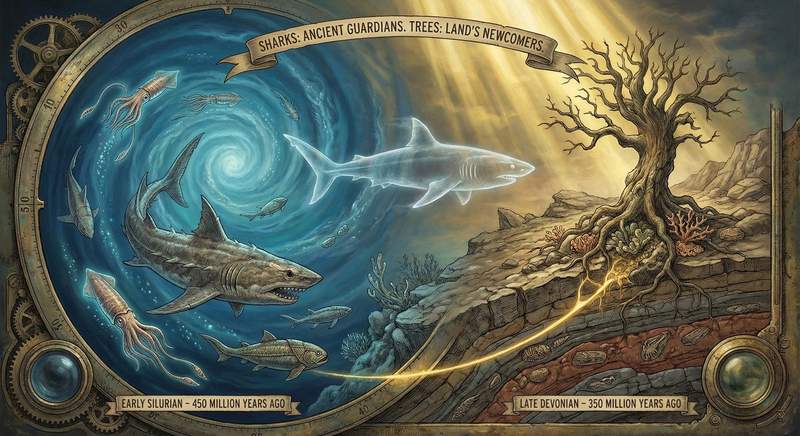
The slogan works because shark ancestry reaches back roughly 450 million years, while forests and tree-sized plants appeared later, around 385 million years ago. The caveat is that the comparison is between early shark-line cartilaginous fishes and the first true trees, not between modern shark species and modern-looking forests.
Published
Filed under
Byline
 Brainblast archive
2026-03-03-02-14-00-sharks-older-than-trees.png (source: app assets)
The fact
“Sharks are older than trees. The earliest shark ancestors appeared in the oceans around 450 million years ago during the Late Ordovician period—before the first dinosaurs, before Saturn's rings formed, and roughly 100 million years before trees evolved on land around 350-360 million years ago. Sharks have survived all five major mass extinction events, including the Permian-Triassic extinction that wiped out 96% of marine species and the asteroid impact that ended the age of dinosaurs 66 million years ago. Their remarkable evolutionary success comes from a simple, adaptable body plan that has needed surprisingly little modification over nearly half a billion years.”
“Sharks are older than trees” sounds like one of those internet facts designed to break your sense of time, and in broad terms it is true. The Natural History Museum’s shark evolution timeline places the origin of shark-like ancestors roughly 450 million years ago. By contrast, a 2022 Nature Communications paper on the rise of forests describes the emergence of forested ecosystems at around 385 million years ago in Low atmospheric CO2 levels before the rise of forested ecosystems. If you compare those benchmarks, shark ancestry predates trees by tens of millions of years.
The first caveat is that this is a lineage comparison, not a claim that the great white shark is older than an oak. “Sharks” here means early members of the cartilaginous-fish branch that eventually gave rise to modern sharks, rays, and their relatives. “Trees” means the earliest true tree-forming plants and the first forests, not every woody stem that ever poked above Devonian mud. The slogan survives those qualifications, but they matter.
The shark side of the timeline is complicated because early cartilaginous fishes are not preserved as neatly as we might like. Teeth, scales, and spines often outlast the rest of the body, so paleontologists reconstruct early shark evolution from fragmentary evidence. The NHM overview explains that ancient shark relatives began appearing long before the familiar body forms of modern sharks emerged. Likewise, the Nature study Shark genomes provide insights into elasmobranch evolution and the origin of vertebrates notes that sharks and rays descend from a lineage that diverged from other jawed vertebrates around 450 million years ago.
That point is useful because it shifts the conversation from individual fossils to evolutionary branching. Even if you debate which fossil deserves to be called the first “true shark,” the cartilaginous-fish line is unquestionably ancient. Long before flowering plants, dinosaurs, birds, or mammals existed, early members of that lineage were already in the sea.
The tree side is ancient too—just less ancient. The Nature Communications paper at nature.com/articles/s41467-022-35085-9 discusses the emergence of forests around 385 million years ago, a transformation that reshaped Earth’s carbon cycle, soils, weathering, and habitats. That means the first real forests rose on land after shark ancestry was already established in the oceans. So if you could time-travel to the interval between those two milestones, you could have shark-line vertebrates without anything we would recognize as a forest.
This also explains why the fact feels so weird. Trees seem ancient to us because human history is tiny beside them. But vertebrate evolution in the oceans goes much farther back than many people intuit. Land ecosystems with towering woody plants are comparatively late arrivals. Our brains are better at comparing things in the same environment than across radically different ones, so “ocean predators predate forests” lands with extra force.
There is another caveat worth making: modern sharks are not unchanged fossils from the Ordovician. The lineage is old, but it has diversified, gone extinct in part, and reworked itself many times. The sixgill sharks, hammerheads, reef sharks, and makos we know today are not identical to the earliest shark-like animals. The NHM timeline makes this clear by walking through successive groups rather than pretending a single shark blueprint remained frozen for 450 million years.
Even so, sharks do illustrate evolutionary endurance. Their broader lineage has survived multiple mass extinctions and huge planetary changes, while the rise of forests transformed the surface of Earth after sharks were already part of its story. That is why the slogan keeps getting repeated: it compresses a deep-time lesson into a single jolt.
So yes, sharks are older than trees—but the accurate version is better than the meme version. Early shark-line cartilaginous fishes appeared around 450 million years ago, as reflected in the NHM timeline and in genomic work such as the Nature Ecology & Evolution paper. Forested ecosystems rose later, around 385 million years ago, according to Nature Communications. Once you phrase it that way, the comparison is not just catchy. It is geologically sound.