The Sloth-Moth-Algae Story Is Real—and Debated
Sloth fur can host moths, algae, and other organisms, and one influential study argued that this forms a three-way mutualism tied to the sloth’s risky ground defecation. The association is real, but some parts of the nutrient-benefit story remain contested rather than universally settled.
Published
Filed under
Byline
 Brainblast archive
2026-03-02-08-18-00-sloth-mutualism.png (source: app assets)
The fact
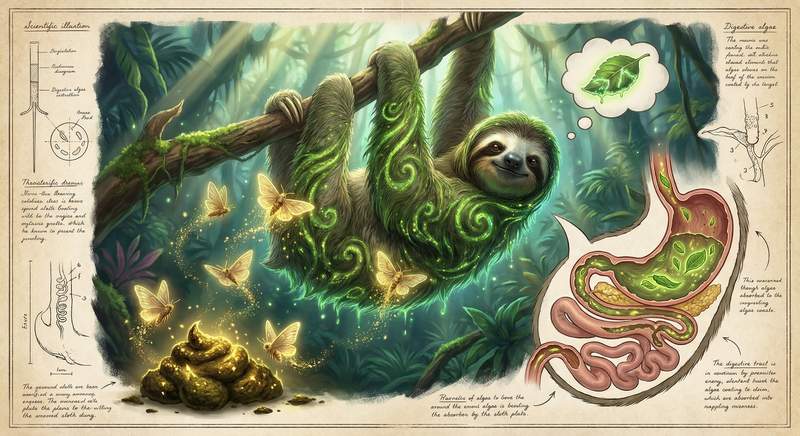
“Sloths have a three-way mutualistic relationship with moths and algae living in their fur. The moths transport nutrients from sloth dung to the sloth's fur, fertilizing algae growth. The algae is digestible and lipid-rich, providing a nutritional supplement to the sloth's leafy diet. To maintain this system, three-toed sloths make a dangerous weekly descent from their tree to defecate on the ground—an energetically costly behavior that costs 8% of their energy budget and exposes them to predators—all to fertilize the moth life cycle that feeds them.”
The classic version of the story goes like this: sloths descend from trees to defecate, moths use the dung to reproduce, the moths enrich the sloth’s fur with nutrients, algae flourish there, and the sloth then eats the algae as a dietary supplement. That version comes from the widely cited study A syndrome of mutualism reinforces the lifestyle of a sloth, and the Royal Society’s summary of the work presents it as a linked three-way mutualism among sloths, moths, and algae.
The biology behind the idea is genuinely fascinating. Sloth fur is not just dirty hair; it is a habitat. The 2014 paper describes how sloths host a community of organisms in their fur, including phoretic moths and algae. The researchers reported that three-toed sloths carried more moths, more inorganic nitrogen, and more algal biomass than two-toed sloths. They also found that moth density correlated positively with nitrogen and algal abundance, suggesting a nutrient pathway that could help explain why sloths maintain such an odd lifestyle.
That odd lifestyle is the part people notice first. As the Royal Society overview emphasizes, descending to the forest floor is dangerous and costly for a slow arboreal mammal. The behavior exposes sloths to predators and consumes precious energy. If a sloth could simply defecate from the canopy, why climb down? The mutualism paper proposed that the descent helps complete the moth life cycle, which in turn sustains the fur ecosystem and its nutritional benefits.
The most eye-catching extension of that argument is the algae-as-food claim. The 2014 study reported that sloths consumed fur algae and that the algae were digestible and lipid-rich. That made the whole loop elegant: sloths ferry moths to dung, moths return and contribute nutrients, algae grow in the fur, and sloths gain supplemental nutrition from the algae garden they helped cultivate.
But this is where the modern caveat enters. Why sloths defecate on the ground: rejection of the mutualistic model argues that the evidence for the mutualistic explanation is not as strong as many popular retellings suggest. That review contends that some assumptions behind the model remain weakly supported and proposes that ground defecation may instead be an ancestral behavior that persisted because selection against it has not been strong enough. In other words, the association between sloths, moths, and algae is real, but the full adaptive explanation may not be settled.
That does not mean the original study was meaningless. Quite the opposite: the 2014 paper documented a genuine ecological relationship and offered a coherent hypothesis linking behavior, fur ecology, and nutrition. What the later critique at Scielo shows is that elegant ecological stories still need repeated testing. The difference between “these organisms are associated” and “this association explains the behavior” is where many animal-fact memes get sloppy.
That nuance actually makes the sloth story more interesting. Nature is full of interactions that are partly mutualistic, partly opportunistic, and partly historical leftovers. The moths clearly benefit from sloth dung as a reproductive site, and sloth fur clearly houses algae and other organisms. The open question is how much the sloth itself gains, how consistently it gains it, and whether those gains are enough to explain such a risky weekly trip.
It is also worth noting that the relationship may differ between sloth groups. The original study found stronger signals in three-toed sloths than in two-toed sloths, which fits the idea that not all sloths should be treated as ecologically identical. Popular summaries often flatten them together, but species and lifestyle differences matter when evaluating any grand claim about mutualism.
So the headline should be handled with both excitement and restraint. Sloths really do host moths and algae in their fur, and the influential Proceedings B paper proposed a three-way mutualism reinforced by ground defecation, a view echoed in the Royal Society summary. But the later critical review argues that the full explanatory model remains unproven. The honest version is not “myth busted” or “myth confirmed.” It is “real ecological partnership, still under debate.”