Tardigrades Are Tough—But Not Magical
Tardigrades can survive astonishing conditions, including exposure to space, but the strongest claims usually apply to dehydrated cryptobiotic states and to particular species. Their fame is deserved; it just needs the usual biological footnotes about timing, temperature, radiation, and whether the animal is active or dried into a tun.
Published
Filed under
Byline
 Brainblast archive
2026-03-02-05-03-00-tardigrade-space.png (source: app assets)
The fact
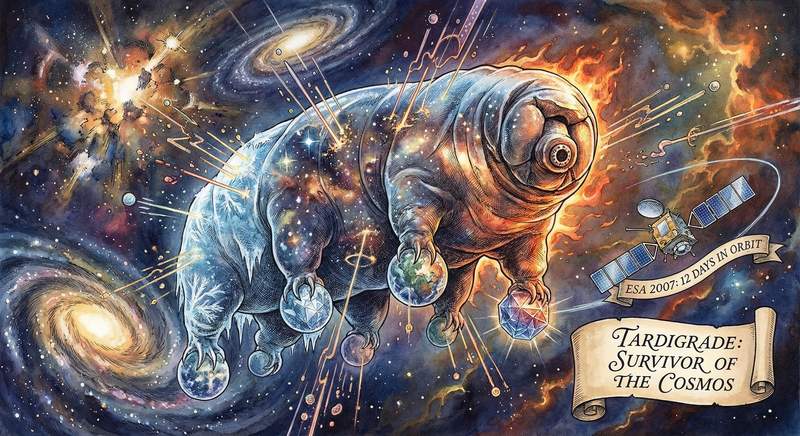
“Tardigrades, also known as water bears, are microscopic animals that can survive the vacuum of space, temperatures from near absolute zero to 150°C, and radiation levels 1,000 times higher than what would kill a human. In 2007, European Space Agency experiments proved they could survive direct exposure to outer space for 12 days.”
Tardigrades, or water bears, have a reputation that sounds exaggerated even when it is true. They can survive freezing, desiccation, radiation, and even exposure to space under some conditions. ESA’s report on the 2007 Foton-M3 mission announced the most famous result: tardigrades became the first animals known to survive direct exposure to space. The original experiment is summarized by Current Biology’s paper on survival in low Earth orbit, and the later review in PMC explains why these animals became astrobiology celebrities.
The crucial caveat is that tardigrades are not indestructible in their everyday active state. Much of their extraordinary toughness depends on cryptobiosis, especially anhydrobiosis, a dehydrated survival mode often called the tun state. The review in PMC explains that when terrestrial tardigrades dry out, metabolism drops to an extremely low level and a suite of protective mechanisms helps stabilize proteins, membranes, and other cellular machinery. In other words, the superpower is often less “being tough while living normally” and more “being able to suspend ordinary life processes until conditions improve.”
That distinction matters when you see viral lists claiming tardigrades survive near absolute zero, 150°C heat, crushing pressure, and cosmic radiation as though one cheerful water bear could casually stroll through all of those at once. ESA’s summary does cite dramatic ranges, and those ranges are grounded in real experiments. But they do not usually describe one individual enduring every extreme simultaneously for long periods while active and reproducing. Different species, states, durations, and protocols matter.
The space result is a good example of how nuance improves rather than weakens the story. In Tardigrades survive exposure to space in low Earth orbit, researchers showed that exposure to vacuum alone was not a serious problem for the two species tested. Some individuals even recovered after combined exposure to vacuum and solar radiation, though ultraviolet radiation sharply reduced survival. So the right takeaway is not “tardigrades laugh at space,” but “some tardigrades in the right state can survive aspects of open space that are lethal to most animals.”
That is still astonishing, because animals are multicellular and structurally complex. The PMC review emphasizes why tardigrades are scientifically valuable: they combine extreme tolerance with a body plan far more elaborate than that of bacterial spores or other simple extremophiles. They are small, but they are still animals with tissues, organs, nervous systems, and development. Their success therefore raises deeper questions about how multicellular life can stabilize itself against severe damage.
Researchers do not fully agree on the exact molecular recipe. The review discusses possible roles for protective sugars, heat-shock proteins, LEA proteins, antioxidant systems, and specialized tardigrade proteins. The point is not that one magic molecule explains everything. It is that tardigrade survival seems to depend on multiple overlapping strategies for preventing, tolerating, and repairing damage during drying and rehydration.
The public fascination also sometimes drifts into bad sci-fi. Tardigrades are hardy, but they are not immortal, not invulnerable, and not evidence that animals can casually thrive on the Moon or Mars. ESA’s report and the Current Biology paper are about survival after exposure, not permanent space lifestyles. Recovery, fertility, and long-term function can all differ from mere survival.
Even with those caveats, tardigrades remain one of the most extraordinary groups of animals known. Their ability to dry out, wait, and return to life is already bizarre. Add in resistance to vacuum, radiation, and temperature extremes documented across the literature summarized in PMC, and their reputation stops sounding like hype. It starts sounding like good field reporting from a very weird corner of evolution.
So the best version of the fact is this: tardigrades really can survive conditions that would kill most animals, including exposure to the vacuum of space under experimental conditions, as shown by ESA and Current Biology. But the extreme claims usually refer to particular species, particular durations, and especially to animals in a dehydrated cryptobiotic state, as explained in the review article. They are amazingly tough. They are not cartoon-proof.