Krakatoa Probably Was the Loudest Widely Documented Sound in Modern History—But “Recorded” Needs a Footnote
The 1883 eruption of Krakatoa produced an astonishingly powerful blast heard thousands of miles away, and pressure waves from the eruption were tracked worldwide. The careful version of the fact is that it is commonly described as the loudest sound in modern or recorded history, but this refers to documented witness and instrument reports from the 19th century, not to an audio recording or a perfectly comparable decibel measurement in the modern sense.
Published
Filed under
Byline
 Brainblast archive
2026-03-06-02-33-00-krakatoa-loudest-sound.png (source: app assets)
The fact
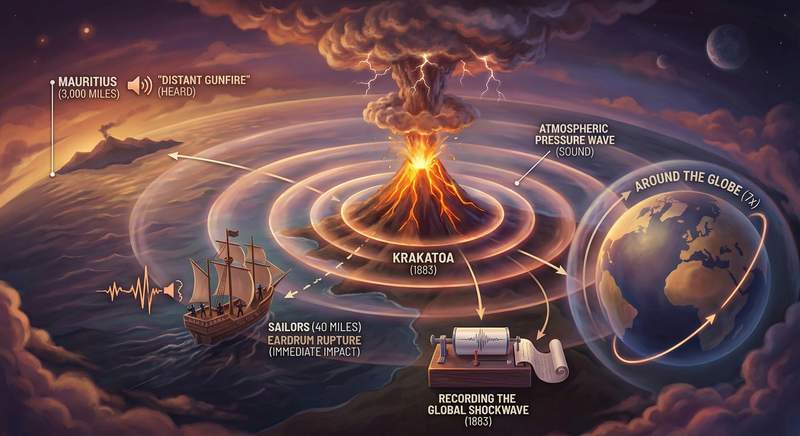
“The 1883 eruption of Krakatoa produced the loudest sound ever recorded in history, with the pressure wave traveling around the globe seven times. The blast was heard over 3,000 miles away in Mauritius as "distant gunfire" and was powerful enough to rupture the eardrums of sailors forty miles from the volcano.”
The 1883 eruption of Krakatoa really does belong in the conversation about the loudest sound ever documented by humans. NOAA’s National Centers for Environmental Information page on Krakatau says the final explosion produced “the loudest sound ever recorded in modern history,” heard across more than 10 percent of Earth’s surface. A USGS Volcano Watch article likewise says the noise ranks as the loudest and farthest-traveled sound in recorded history. So the headline claim is not just folklore.
But the word “recorded” needs a small but important footnote. There were no modern microphones in 1883 making audio files of Krakatoa. What existed were witness reports, pressure measurements, ship logs, and barometric records. NOAA says instruments measured sudden spikes as far away as Great Britain and America, while USGS emphasizes how widely the sound was heard. So “recorded” here means documented in the historical and instrumental sense, not captured in a way directly comparable to a modern stadium decibel meter.
Even with that caveat, the scale is hard to overstate. NOAA says reports compared the sound to distant gunfire from Australia and Mauritius, more than 2,800 miles, or about 4,600 kilometers, from the volcano. USGS gives a similar sense of range, saying Krakatau lay nearly 5,000 kilometers, about 3,000 miles, from places where the explosion was heard. That is absurdly far for a sound perceived by people rather than merely by sensitive instruments.
The eruption was not a single isolated bang either; it was part of a catastrophic sequence. NOAA describes the northern two-thirds of the island collapsing beneath the sea, generating ash flows, immense tsunamis, and darkness lasting days. USGS says the eruption blew roughly 25 cubic kilometers of material into the stratosphere and nearly erased the island. When people talk about the loudness, they are talking about an event that also destroyed coastlines and killed tens of thousands. The sound is memorable, but it was only one expression of a much larger planetary disaster.
The atmospheric consequences were global. NOAA says ash rose about 50 miles, covered roughly 800,000 square kilometers, drifted around the globe, and helped cool global temperatures by as much as 0.5°C for years afterward. The same page says pressure waves traveled several times around the world within hours. That is one reason Krakatoa remains such an iconic event: the eruption did not merely devastate nearby islands, it visibly and measurably perturbed the entire planet.
The loudness claim also survives because of the human testimony. NOAA says witnesses in faraway places heard what sounded like distant artillery. USGS repeats that the sound was heard nearly 5,000 kilometers away and ranks as the farthest-traveled sound in recorded history. Those descriptions matter because they show the event was not only inferable from barometers; it was experienced directly by people who had no idea, at first, what they were hearing.
What should be avoided is overprecision without context. You will sometimes see exact decibel figures passed around online as if someone placed a calibrated sensor next to the volcano in 1883. But the more authoritative sources in hand, NOAA and USGS, emphasize witness range, pressure effects, and historical ranking rather than pretending we have a simple modern-style readout. That is the better way to tell the story.
It is also worth remembering that “loudest sound in history” is not a category scientists can define perfectly across all eras and all causes. Ancient eruptions, impacts, or events before global instrumentation may have been comparable or larger; we just do not have equivalent documentation. That is why NOAA phrases it as the loudest sound ever recorded in modern history and why USGS frames it as ranking as the loudest and farthest-traveled sound in recorded history. The wording is strong, but it still acknowledges the limits of comparison.
So the repaired fact is satisfying and sturdy: the 1883 Krakatoa eruption almost certainly produced the loudest widely documented sound in modern history, with reports heard thousands of miles away and pressure waves measured worldwide, as described by NOAA and USGS. Just do not picture a Victorian MP3 file. This is a historical, instrumental, and eyewitness record—not a perfectly standardized modern sound test. Which, frankly, is still terrifying enough.