The sea slug that steals chloroplasts from algae
Elysia chlorotica becomes brilliantly green by retaining chloroplasts from the alga Vaucheria litorea, allowing months of photosynthetic activity inside an animal's cells. Yet it is not simply a plant-animal hybrid: scientists still debate exactly how those stolen plastids remain functional for so long.
Published
Filed under
Byline
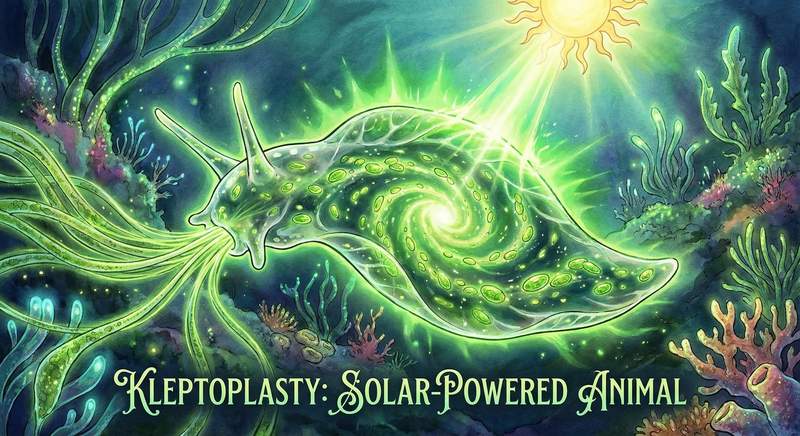 Brainblast archive
2026-03-03-11-14-00-solar-powered-sea-slug.png (source: app assets)
The fact
“The eastern emerald elysia sea slug (Elysia chlorotica) is a 'solar-powered' animal that steals chloroplasts from the algae it eats and incorporates them into its own cells—a phenomenon called kleptoplasty. After consuming its obligate food plant Vaucheria litorea, the sea slug extracts and preserves the algae's chloroplasts, turning itself bright green and allowing it to perform photosynthesis like a plant. Remarkably, it can survive for up to 10 months on these stolen chloroplasts without eating again. While most animals that practice kleptoplasty only maintain stolen chloroplasts for days or weeks, E. chlorotica has uniquely evolved to keep them functional for extended periods, making it one of the few animals on Earth that can directly convert sunlight into energy.”
Elysia chlorotica is one of those animals that sounds made up even when the basic facts are true. This sacoglossan sea slug can feed on the yellow-green alga Vaucheria litorea, keep the alga's chloroplasts inside cells lining its digestive tract, and then remain green and photosynthetically active for months. That process is called kleptoplasty: literally, the theft of plastids. A modern review of the phenomenon describes long-term kleptoplasty in sacoglossan sea slugs as a rare animal trait and a major biological puzzle PMC review.
The first thing to get right is what the slug is actually stealing. It is not swallowing whole algal cells and turning itself into a plant. During feeding, the slug pierces the alga, sucks out cellular contents, digests most of them, and selectively retains chloroplasts. Those captured chloroplasts, now called kleptoplasts, end up housed in the slug's tissues. In a foundational study from the 1990s, researchers showed that chloroplast genes continued to be expressed inside starved slugs and that the plastids could remain structurally intact for many months under light and carbon dioxide availability PNAS study. That was a major reason the animal became famous as a "solar-powered" sea slug.
The phrase is catchy, but it needs careful handling. Photosynthesis in Elysia chlorotica is real, yet the slug is not simply a leaf with a nervous system. The kleptoplasty review emphasizes that the biological benefits of stolen chloroplasts are still being sorted out and that photosynthesis can contribute to survival and metabolism without making the animal fully autotrophic. In plain English: the slug can harvest useful energy and fixed carbon from sunlight through the borrowed plastids, but it still begins life as an animal that must feed to acquire those plastids in the first place.
That distinction matters because the most viral versions of the fact say the slug can live for ten months on sunlight alone. There is a kernel of truth there, but it is easy to overstate. The classic PNAS paper documented long persistence of functional plastids in laboratory-starved animals, and later work on photoprotection notes that E. chlorotica has one of the longest functional examples of kleptoplasty known, lasting over several months Scientific Reports. Still, longevity depends on conditions such as light regime, temperature, the slug's feeding history, and the physiological state of the plastids. "Months" is robust. A universal "ten months on sunlight alone" is a simplification.
Scientists have spent years asking how the stolen chloroplasts keep working at all. Chloroplasts normally rely on extensive support from genes in the nucleus of the plant or alga they came from. Once separated from their original cell, they should be hard to maintain for long. One proposed answer was horizontal gene transfer: perhaps the slug had imported algal genes into its own genome and used them to service the plastids. That hypothesis got enormous attention because, if true, it would have sounded almost like the early stages of a new plant-animal merger.
But later evidence complicated that story. A genome-focused study of Elysia chlorotica eggs found no evidence that algal genes had been stably transferred into the slug's germ line, and the authors argued that horizontal gene transfer was not the primary explanation for the long-term maintenance of photosynthesis in the animal genome analysis. The broader review article likewise treats the mechanism as unresolved rather than solved. So one of the most repeated claims about the slug—that it permanently borrowed algal genes and became part plant at the DNA level—has been substantially weakened by later work.
If not horizontal gene transfer, then what helps the plastids endure? Part of the answer may lie in the chloroplasts themselves and in the biology of the source alga. The Scientific Reports study examined photoprotection and found that Vaucheria litorea plastids and E. chlorotica retain a functional xanthophyll cycle and a reversible non-photochemical quenching response, features that help dissipate excess light energy and reduce photo-damage. In simpler terms, the stolen chloroplasts are not just passive batteries; they come with some built-in stress-management machinery. That may help explain why plastids from this algal source last longer than plastids taken by some other sacoglossan species.
Even that is not the whole explanation. The review literature makes clear that long-term kleptoplasty likely depends on multiple factors at once: plastid robustness, protection from reactive oxygen species, animal behavior that limits light stress, and cellular handling by the host PMC review. The slug is therefore remarkable not because it solved photosynthesis in the same way a plant does, but because it found a narrower, temporary, and still mysterious workaround.
That makes Elysia chlorotica more interesting, not less. It is a genuine example of an animal co-opting photosynthetic organelles for extended use, but it is not a clean fusion of kingdoms, and it is not proof that animals can casually become plants. The accurate wonder is subtler. A sea slug feeds once on the right alga, turns green, and for months carries functional chloroplasts through animal tissue while biologists argue about exactly how the trick works. Nature did not make a leaf with a face. It made a specialist thief with excellent taste in cellular machinery.