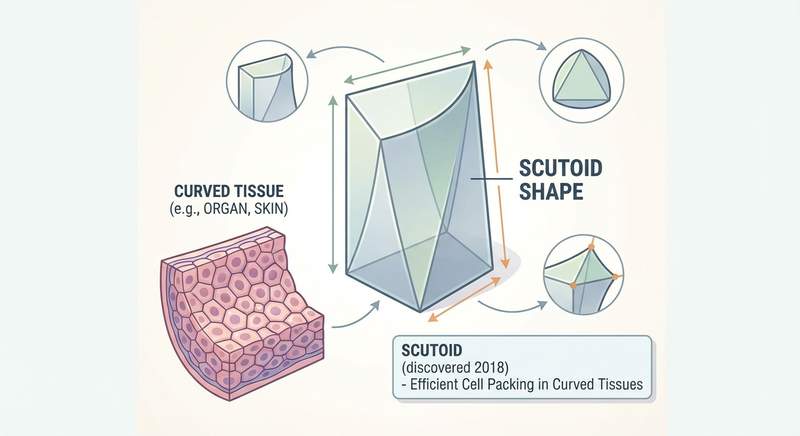
The scutoid is a geometric shape discovered by scientists in...
The scutoid is a real cell-packing geometry described in 2018 for curved epithelia, helping explain how tightly packed cells can change neighbors along their height while keeping tissues stable and energetically efficient.
Published
Filed under
Byline
 Brainblast archive
The fact
“The scutoid is a geometric shape discovered by scientists in 2018 that explains how nature packs cells efficiently into curved tissues like organs and skin. This complex solid resembles a prism with a slanted side and an extra vertex, allowing cells to stay tightly packed while the tissue bends and twists. Before this discovery, it was assumed that epithelial cells were shaped like columns or bottles, but those shapes would leave gaps or require too much energy to maintain during growth. By adopting the scutoid shape, cells can minimize their energy consumption and maximize stability, which is essential for the development of complex embryos. This shape is so fundamental to life that it can be found in the salivary glands of fruit flies and the skin of many vertebrates. The identification of the scutoid has profound implications for tissue engineering and the creation of more realistic artificial organs.”
The scutoid is real, but it is often introduced as if mathematicians suddenly discovered a totally new Platonic solid hiding inside your organs. The more accurate version is that biologists and modelers described a previously unrecognized cell-packing geometry that appears when epithelial tissues bend and curve in three dimensions. In 2018, researchers argued that cells in curved epithelia can adopt scutoid-like shapes that allow efficient packing, neighbor exchanges along their apical-basal axis, and lower-energy organization in developing tissues (https://www.nature.com/articles/s41467-018-05376-1).
That is already pretty wonderful without the exaggeration. Epithelial tissues are the sheets of cells that form skin-like coverings and line organs, vessels, and many internal surfaces. In embryos, these tissues bend, fold, narrow, widen, and wrap into tubes and other complex structures. For a long time, textbook sketches often treated the cells as if they were mostly column-like prisms, cubes, or bottle-shaped frusta. Those shapes work reasonably well in simple diagrams, but they become awkward when a tissue curves strongly and cells still need to stay tightly packed without leaving gaps.
The 2018 Nature Communications paper tackled exactly that problem. The researchers combined computational geometry, biophysical modeling, and experimental observations, and concluded that curved epithelia often require cells to exchange neighbors at different heights. That topological rearrangement gives rise to scutoids, shapes in which the polygonal layout of a cell changes from one surface to another and includes a characteristic extra vertex or slanted face arrangement (https://www.nature.com/articles/s41467-018-05376-1).
Lehigh University’s summary of the work captures why it mattered so much: as tissues bend during embryonic development, epithelial cells need a geometry that minimizes energy use while preserving stable packing, and scutoids provided a previously undescribed solution (https://news.lehigh.edu/study-reveals-the-scutoid-a-new-geometric-shape-used-by-nature-to-pack-cells-efficiently). The point was not merely “look, a funny shape.” It was that geometry helps explain how real tissues organize themselves while developing complex three-dimensional forms.
One reason the discovery landed so hard in public culture is that it seemed delightful and accessible. New particles require accelerators; new exoplanets require telescopes; but a new shape sounds like something schoolchildren should have found in a pencil case. That reaction is understandable, though a bit misleading. Scutoids are not just abstract shapes floating in a vacuum. They emerged from the specific biological and physical constraints of epithelial packing in curved surfaces.
That is also why calling the scutoid a “new geometric shape” is only partly right. In the mathematical sense, many possible polyhedral forms can be imagined or generated. The novelty here was the biological identification and formal characterization of a shape class that solves a real morphogenetic packing problem. Nature was not waiting for humans to invent scutoids before embryos could develop. Cells had been using these geometries all along; scientists finally recognized and named them.
Another caveat is that not every epithelial cell in every tissue is a perfect textbook scutoid. The original work argued that scutoids are one of nature’s solutions for curved epithelia, especially where neighbor relationships change with depth, not that every animal tissue is made entirely of one rigid canonical solid (https://www.nature.com/articles/s41467-018-05376-1). Real tissues are noisy, dynamic, and variable. Cells deform, divide, migrate, and respond to forces, so biological geometry is usually a family resemblance rather than a pile of exact Euclidean toys.
Still, the concept matters because it bridges biology, physics, and engineering. If tissue engineers want to grow realistic organoids or artificial tissues, they need more than lists of genes. They need to understand how cells arrange themselves mechanically in three dimensions. The scutoid result suggests that curvature, topology, and energy minimization shape tissue architecture in ways that simple prism models miss (https://news.lehigh.edu/study-reveals-the-scutoid-a-new-geometric-shape-used-by-nature-to-pack-cells-efficiently).
It also corrects a subtle methodological bias. The paper notes that many earlier studies effectively used the apical surface of an epithelium as a proxy for full three-dimensional cell shape. That shortcut was partly driven by technical limits. Once researchers looked more carefully at the full 3D organization, they found cells contacting different neighbors at different depths and realized the old prism/frustum picture was incomplete (https://www.nature.com/articles/s41467-018-05376-1).
So the durable fact is accurate: scientists in 2018 described scutoids as a real geometric solution used by epithelial cells in curved tissues. The claim becomes misleading only when it is inflated into “biology discovered an impossible new shape” or “all cells are secretly scutoids.” The better phrasing is that scutoid-like packing helps explain how curved epithelia can remain tightly organized, stable, and energetically efficient.
That is a lovely kind of discovery. It does not replace biology with geometry or geometry with biology. It shows that if you want to understand how living tissues fold themselves into organs, sometimes the universe answers with a new shape name and the quiet reminder that embryos have been doing advanced packing problems long before humans started drawing diagrams.