Yes, Earth Has More Trees Than the Milky Way Has Stars
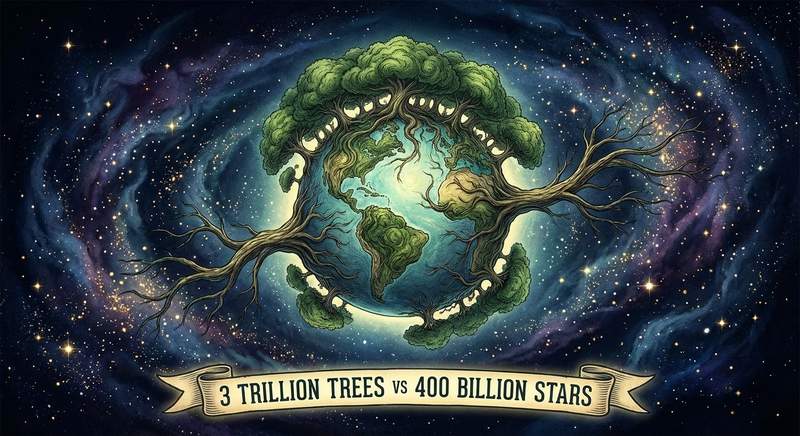
This comparison is one of the rare internet scale facts that basically holds. Earth is commonly estimated to host about three trillion trees, while NASA’s broad estimate for stars in the Milky Way is roughly 100 to 400 billion. The caveat is that both numbers are estimates, especially the tree count.
Published
Filed under
Byline
 Brainblast archive
2026-03-01-13-31-00-trees-vs-stars.png (source: app assets)
The fact
“There are more individual trees on Earth (approximately 3 trillion) than stars in the entire Milky Way galaxy (100–400 billion).”
This comparison feels backwards at first, because stars seem infinite and trees feel countable. But the numbers really do come out that way. NASA’s Milky Way explainer says our galaxy probably contains about 100 to 400 billion stars. On the tree side, the Crowther Lab’s discussion of trillion-tree research says that in 2015 its team found Earth is home to about three trillion trees. Three trillion easily exceeds even the high end of NASA’s star estimate, so the broad fact checks out.
That tree number was not produced by someone counting every trunk with a clipboard. The Crowther Lab page for “Mapping tree density at a global scale” identifies the underlying 2015 Nature paper, while the lab’s later trillion-trees explainer summarizes the result in plainer language. The estimate combined field measurements, satellite information, biome-specific relationships, and statistical extrapolation. In other words, “three trillion” is a scientific estimate built from multiple data layers, not a literal census.
The galaxy number is also an estimate. NASA’s Milky Way page uses the range of 100 to 400 billion stars because astronomers cannot simply look from outside the galaxy and count every point. Dust obscures regions, faint stars are hard to tally, and population modeling fills in the gaps. So the fact is not “3,000,000,000,000 trees versus exactly 237,418,992,413 stars.” It is “a few trillion versus a few hundred billion.”
That difference in uncertainty does not threaten the conclusion very much. The tree estimate would have to be wrong by a huge factor, or the star estimate would have to be far beyond NASA’s stated range, for the relationship to flip. Since three trillion is more than seven times 400 billion, the comparison has comfortable room to survive normal revision. That is one reason this fact is sturdier than many viral scale claims.
The more interesting part is what the tree number says about Earth rather than the galaxy. The Crowther Lab’s trillion-trees page emphasizes not only that Earth currently hosts about three trillion trees, but also that humans have already removed vast numbers over our species’ history. The lab’s work became famous partly because it quantified both abundance and loss. So the cheerful comparison to stars sits on top of a less cheerful ecological lesson: trees may be numerous, but they are not inexhaustible.
It also helps to notice the unit mismatch. Trees are discrete organisms spread across a single planet. Stars are luminous objects spread across one galaxy among perhaps trillions of galaxies in the observable universe. The statement is careful to compare trees on Earth to stars in the Milky Way, not stars in the universe as a whole. If you broaden the astronomical side beyond our galaxy, the trees lose by a ridiculous margin.
That qualifier matters because people often repeat the meme incorrectly. “More trees on Earth than stars” is false if you mean all stars everywhere. “More trees on Earth than stars in the Milky Way” is the version that works. NASA’s galaxy explainer is doing essential guardrail work there by naming the relevant galaxy explicitly.
The fact is also a reminder that large natural systems can be wildly counterintuitive. A galaxy feels like the biggest thing most people can picture, yet its star count can still be beaten by the number of medium-to-large woody plants on one temperate, tropical, and boreal world. That is partly because stars are far apart. The Milky Way is vast in volume, not infinitely packed. Earth, meanwhile, has had hundreds of millions of years for forests and woody ecosystems to cover land in dense, repeating patterns.
There is a quiet methodological lesson here too. The Crowther Lab’s mapping page shows that global ecological totals can improve dramatically when field plots and remote sensing are combined thoughtfully. NASA’s Milky Way page reflects the same spirit on the astronomy side: even huge, uncertain systems can still be estimated well enough to support a robust comparison.
So yes—the meme survives audit. Using NASA’s estimate of 100 to 400 billion Milky Way stars and the Crowther Lab’s three-trillion-tree estimate, supported by the cited 2015 mapping study page, Earth does appear to have more trees than our galaxy has stars. The only fix needed is to keep the word “Milky Way” in the sentence and remember that both sides are estimates, not exact inventories.