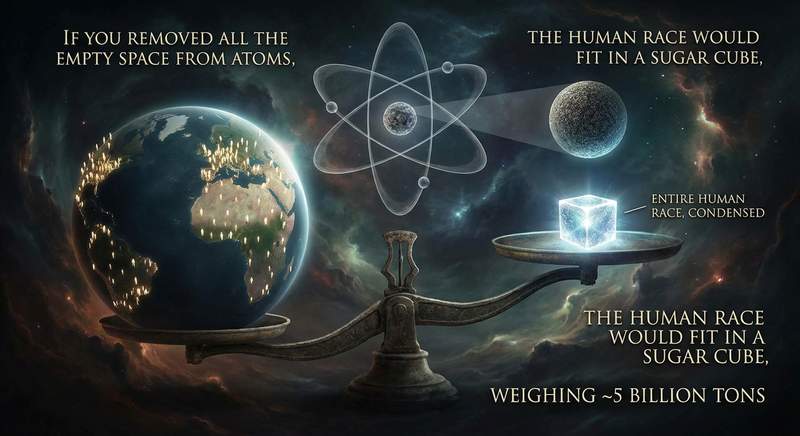
The Neutron-Star Teaspoon Is a Density Thought Experiment
A teaspoon of neutron-star matter really would correspond to roughly a billion tons by common NASA-style estimates, but the figure is an order-of-magnitude teaching tool rather than a kitchen measurement. Different neutron stars have different densities, and the material would not remain an ordinary teaspoonful once removed from the star’s crushing gravity.
Published
Filed under
Byline
 Brainblast archive
2026-03-01-07-31-00-neutron-star-teaspoon.png (source: app assets)
The fact
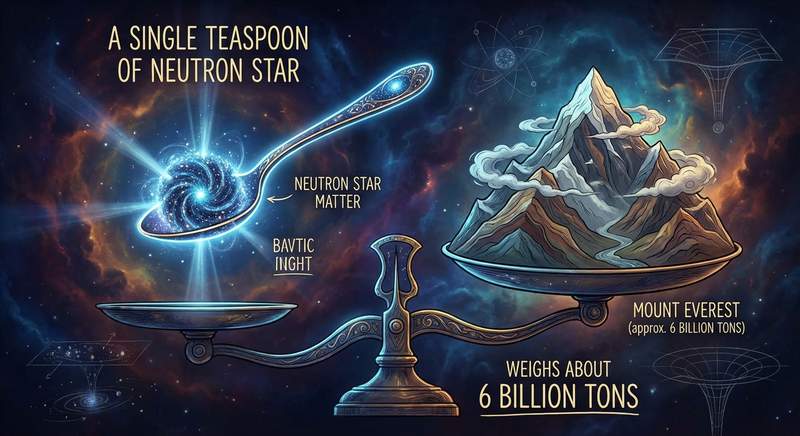
“A single teaspoon of a neutron star would weigh about 6 billion tons—roughly the weight of Mount Everest.”
The teaspoon comparison is one of astronomy’s best reality checks. According to NASA Science’s magnetar explainer, one teaspoon of neutron-star material would weigh as much as a billion tons on Earth. NASA’s Imagine the Universe page on neutron stars gives a closely related version: one sugar cube of neutron-star material would weigh about 1 trillion kilograms, or 1 billion tons. Those are slightly different kitchen metaphors, but they are pointing at the same basic truth—neutron stars are absurdly dense.
The reason is scale compression. A neutron star forms when the core of a massive star collapses after a supernova. Imagine the Universe describes the result as roughly a sun’s worth of mass squeezed into an object only about 20 kilometers across. Britannica’s neutron-star overview likewise describes neutron stars as compact stars composed mainly of neutrons, with densities approaching that of atomic nuclei. That is the key point: this is matter packed to a regime far beyond anything familiar on Earth.
Once matter is compressed that tightly, tiny volumes become grotesquely heavy. A teaspoon is a trivial amount of soup, but not of neutron-star matter. The famous “billion tons” line works because it translates a difficult concept—nuclear-density matter—into a household image. It tells you that neutron stars are not just dense the way lead is dense. They are dense in a category where everyday materials stop being useful comparisons.
Still, the number deserves some care. You will see different versions: one billion tons, several billion tons, a mountain’s mass, Mount Everest squeezed into a spoon, and so on. That variation is not evidence that the fact is fake. It reflects two normal uncertainties. First, “teaspoon” and “sugar cube” are not identical volumes. Second, actual neutron stars differ in mass, radius, and internal structure, which means their average density differs as well. Britannica notes typical sizes and masses, but not every neutron star is built from the exact same equation of state.
There is an even bigger caveat: a teaspoon of neutron-star matter is not something you could literally scoop up and bring home. The phrase is a teaching device, not a practical sampling plan. Outside the star’s enormous gravitational pressure, matter in that state would not calmly remain a neat lump in a measuring spoon. The physics of neutron-star interiors depend on extreme pressure, extreme density, and exotic behavior of matter. Remove the supporting conditions and the sample would not behave like stable kitchenware cargo.
That is why astronomers use these comparisons carefully. They are not saying neutron stars contain magical matter immune to normal physics. They are saying the matter is normal physics under utterly abnormal conditions. NASA’s magnetar article uses the teaspoon figure while discussing starquakes and giant flares. Imagine the Universe uses the sugar-cube analogy to explain why these stellar remnants are among the densest directly observable objects known. The comparison is a bridge between intuition and astrophysics.
It also explains why neutron stars matter scientifically. If you want to study how matter behaves when crushed to near-nuclear density, Earth is not the place to do it directly. Neutron stars are natural laboratories for nuclear physics, gravity, magnetism, and relativity. Their sizes, masses, spins, and magnetic fields all help astronomers test models of matter that cannot be fully recreated in terrestrial labs. The teaspoon line is memorable, but it points toward a deeper question: what exactly happens to matter when gravity pushes it to the edge of collapse?
Even the wording “matter of a dead star” can be misleading. Neutron stars are remnants of dead stars, but many are far from inactive. Some pulse radio waves, some emit X-rays, and magnetars can produce spectacular high-energy outbursts, as NASA Science’s article on magnetars and gold production explains. In other words, “dead” here means the original star’s fusion life has ended, not that the leftover object is inert.
So the headline survives scrutiny. A teaspoon of neutron-star material really does correspond to something like a billion tons by standard educational estimates, as shown by NASA Science, Imagine the Universe, and Britannica’s neutron-star overview. The only fix needed is conceptual, not numerical: it is a vivid density analogy, not a promise that anyone could ever fill an actual teaspoon with stable neutron-star matter.