Why “Humanity in a Sugar Cube” Is Only Approximate
The sugar-cube claim is a back-of-the-envelope estimate based on compressing human matter toward neutron-star-like density, not literally vacuuming a little emptiness out of atoms. Using today’s world population and rough average body-mass figures, the volume really does fall into the few-cubic-centimeter range, but only under wildly unearthly conditions.
Published
Filed under
Byline
 Brainblast archive
2026-03-01-08-31-00-human-race-sugar-cube.png (source: app assets)
The fact
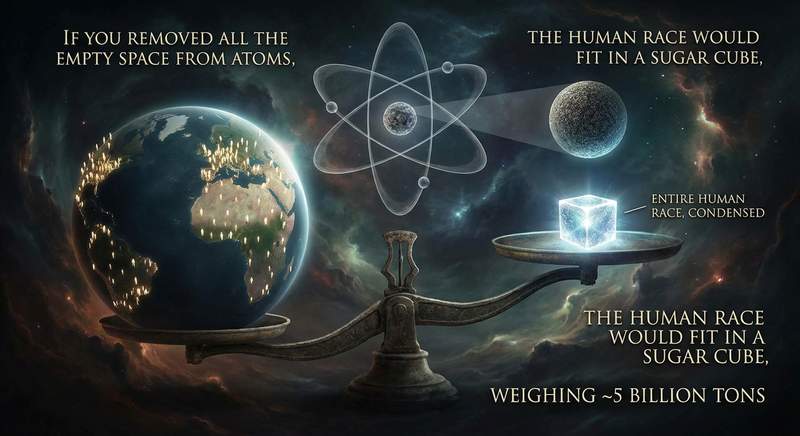
“If you removed all the empty space from the atoms that make up every human on Earth, the entire human race would fit inside a single sugar cube, though it would be incredibly dense and weigh about 5 billion tons.”
The viral claim says that if you removed all the empty space from the atoms in every human, the entire species would fit inside a sugar cube. That sounds like a cartoon, but the rough scale is not crazy. The modern version of the calculation starts with population and biomass. The U.S. Census Bureau’s 2026 World Population Day page says the world population is now about 8.2 billion. The study “The weight of nations” estimated a global average adult body mass of 62 kilograms. Combine a population on the order of billions with a typical body mass on the order of tens of kilograms, and the total human mass becomes enormous.
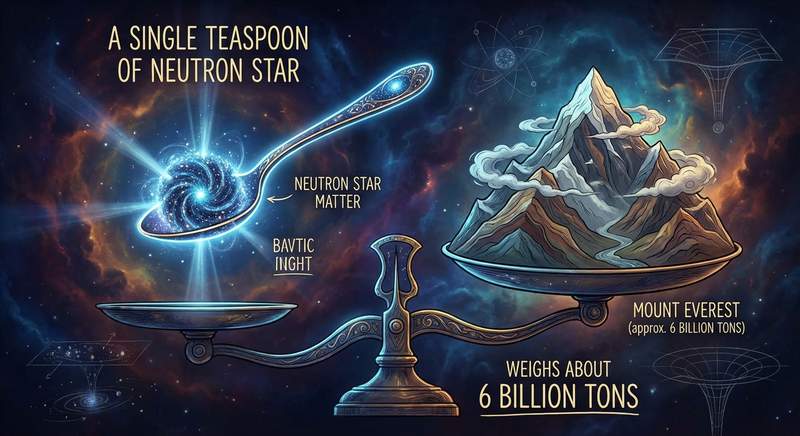
Now add the second ingredient: neutron-star-like density. NASA’s Imagine the Universe explainer says a sugar cube of neutron-star material would weigh about 1 trillion kilograms. That implies that matter compressed to this regime occupies tiny volumes for huge masses. If you take humanity’s combined mass—on the order of a few times 10^11 kilograms—and divide by a density on the order suggested by the neutron-star comparison, you land in a volume of only a few cubic centimeters. That is indeed in the neighborhood of a sugar cube or a teaspoon.
So the meme survives as an order-of-magnitude estimate. But it needs almost every word translated. “Removing empty space from atoms” is a loose popular shorthand, not a literal description of a simple mechanical process. Atoms are not little solar systems waiting to be compacted by a hand press. Compressing ordinary matter that far means forcing electrons and protons into radically different states. The nearest real-world analogue is the kind of extreme compression associated with neutron stars, not a harmless geometry trick.
That matters because the phrase “empty space” itself can mislead. In everyday language, atoms are mostly spread out in the sense that the nucleus is tiny compared with the full atom. But the rest is not meaningless nothingness, and the structure of matter is enforced by quantum rules, electromagnetic interactions, and exclusion principles. You cannot casually squeeze those away the way you squeeze air out of a sponge. The popular image gets the scale lesson right while badly oversimplifying the physics.
Even the mass side of the estimate has caveats. The Census page counts everyone, while the biomass study reported an average adult mass based on adult data. Children lower the average; rising body mass in some populations can raise it; different reference years change the result. That means the final answer should not be treated as “exactly one sugar cube.” A few cubic centimeters, perhaps a little smaller or a little larger depending on assumptions, is the honest framing.
Still, the estimate is useful because it teaches two things at once. First, human beings are mostly spread-out matter in atomic terms. Second, mass and volume are not the same kind of quantity. The combined human species can weigh hundreds of billions of kilograms while still, under fantastically extreme compression, occupying a volume small enough to sit on a spoon. The result feels paradoxical only because our everyday experience never encounters nuclear-density matter.
The connection to neutron stars is doing almost all the heavy lifting here. Imagine the Universe explains that neutron stars pack roughly a solar mass into an object about the size of a city. That means the “all humans in a sugar cube” fact is not really a human fact at all. It is a neutron-star-density fact applied to humans. Humanity is just the memorable passenger in an astrophysical calculation.
There is also a rhetorical trap worth avoiding. Some retellings say the sugar cube “would still weigh five billion tons” as though the compression changes mass. It does not. Compressing matter changes volume and density, not total mass. The reason the cube would remain staggeringly heavy is precisely that all the original mass is still there, only concentrated into a microscopic space. If anything, that unchanged mass is the whole point of the comparison.
And of course, nobody is proposing a real machine for the job. Under normal conditions, ordinary human matter cannot be compacted into a neat cube of neutron-star material and left sitting on a table. The pressures required are astrophysical, and the matter’s state would be profoundly altered. The thought experiment is educational, not engineering.
So the clean version of the fact is this: using a world population of about 8.2 billion from the Census Bureau, a rough average body mass from the biomass study, and neutron-star density intuition from NASA’s Imagine the Universe, all humanity could plausibly occupy only a few cubic centimeters if compressed to an extreme nuclear-density state. That is close enough to a sugar cube to make the meme memorable—just not literal enough to skip the physics footnotes.