The Big Bang seems to have left too much matter—and physicists still don't know why
Modern physics strongly suggests that the early universe should not have ended up with such an overwhelming dominance of matter over antimatter. Observations imply a tiny excess of matter survived annihilation, and explaining that small leftover is one of the central unsolved problems connecting particle physics with cosmology.
Published
Filed under
Byline
 Brainblast archive
2026-03-06-07-33-00-baryon-asymmetry.png (source: app assets)
The fact
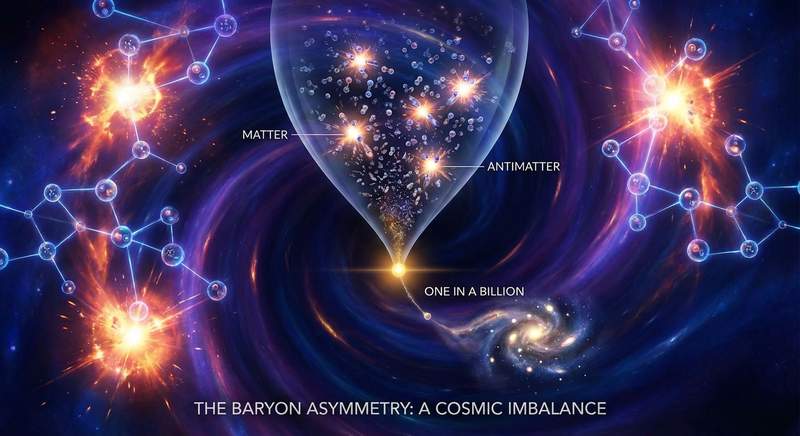
“According to the laws of physics, the Big Bang should have produced equal amounts of matter and antimatter, which would have instantly annihilated each other and left the universe empty of everything but energy. However, a tiny imbalance—roughly one extra particle of matter for every billion particles of antimatter—allowed a small fraction of matter to survive and form the stars and galaxies we see today. This fundamental mystery, known as Baryon Asymmetry, means that the entire observable universe is essentially the 'leftover' material from a near-perfect cosmic cancellation.”
The catchy version of the fact is that the Big Bang “should have” made equal amounts of matter and antimatter, so the universe ought to contain almost nothing but radiation after mutual annihilation. That shorthand points at a real problem, but it needs a caveat: equal matter and antimatter is not a magical law written on the sky. It is the simple expectation from a hot early universe unless some asymmetry-producing physics intervened. The Reviews of Modern Physics article on the origin of matter-antimatter asymmetry and the Annual Review article on baryogenesis both frame the puzzle that way: observations demand an asymmetry, but the mechanism behind it remains unresolved.
The observation is not subtle. Stars, planets, gas clouds, and you are made of matter, not antimatter. The Fermilab explainer “What happened to the antimatter?” says the Big Bang and its aftermath almost certainly produced particles and antiparticles in equal numbers unless an imbalance developed very early. If no such imbalance had appeared, matter and antimatter would have annihilated into photons and neutrinos, leaving no cosmic structures behind. The visible universe testifies that something tipped the balance.
And yet the imbalance was tiny. That is what makes the problem so devilish. Cosmologists do not need a universe that started with matter beating antimatter by a mile; they need only a small excess that survived after almost all matter-antimatter pairs annihilated away. Popular summaries often phrase this as about one extra matter particle for every billion matter-antimatter pairs or, equivalently, a baryon excess of roughly one part in a billion relative to the radiation background. The Reviews of Modern Physics review treats explaining that tiny asymmetry as one of the key unsolved links between particle theory and cosmology.
Why is that hard? Because physics is full of symmetries, and many of the simplest reactions treat matter and antimatter very similarly. The Fermilab neutrino CP-violation explainer lays out the intuition in accessible terms: if nature handled particles and antiparticles identically at all relevant stages, the early universe would not have kept leftover matter. So any successful explanation needs processes that favor matter over antimatter, however slightly.
That basic insight was formalized by Andrei Sakharov in 1967. As the Fermilab neutrino page summarizes, three ingredients are needed: processes that violate baryon number, violations of charge and parity symmetries so matter and antimatter are not treated exactly the same, and conditions out of thermal equilibrium. The Annual Review article and the Reviews of Modern Physics article both revolve around those criteria because they sharply constrain what early-universe physics could have done.
An important twist is that the Standard Model is not completely helpless here. We already know CP violation exists in quark processes. The problem is scale. The Fermilab antimatter explainer says current knowledge of CP violation is incomplete and insufficient by many orders of magnitude to account for the observed matter domination. The Fermilab neutrino page makes the same point: the quark-sector CP violation we have measured is not enough to explain the matter-rich universe around us.
That is why baryogenesis remains a live research program rather than a solved chapter in a textbook. The Annual Review paper surveys several major ideas, including grand-unified-theory baryogenesis, electroweak baryogenesis, leptogenesis, and Affleck-Dine scenarios. The Reviews of Modern Physics review likewise discusses multiple plausible mechanisms rather than endorsing one established winner. In some scenarios, an asymmetry first appears in leptons and is later converted into baryons; in others, new high-energy physics tied to phase transitions or beyond-Standard-Model particles does the job.
Neutrinos are especially interesting because they may provide new sources of CP violation. The Fermilab neutrino explainer says that if neutrinos and antineutrinos oscillate differently, that could help point toward the origin of the cosmic imbalance. This does not mean neutrinos have solved the case; it means they are a promising place to look. Experiments such as NOvA and DUNE are motivated by this question.
One more caveat helps keep the statement honest. Saying “according to the laws of physics, the Big Bang should have produced equal matter and antimatter” is useful shorthand, but physicists would phrase it more carefully: according to our simplest expectations and our current incomplete Standard Model understanding, we do not yet have an adequate explanation for why matter won. The Reviews of Modern Physics article is explicit that the origin remains unknown. The Annual Review article is explicit that several scenarios are still in play.
So the repaired fact is this: the universe contains a tiny but crucial excess of matter over antimatter, and explaining that excess is one of modern physics’ deepest unsolved problems. The Fermilab antimatter explainer captures the cosmological stakes, the Fermilab neutrino page summarizes the Sakharov conditions and the CP-violation angle, and the APS and Annual Reviews papers show that no single explanation has yet won. Matter’s one-in-a-billion edge was enough to give us galaxies, chemistry, and ourselves.