The 'Oh-My-God particle' was astonishingly energetic—but several details need caveats
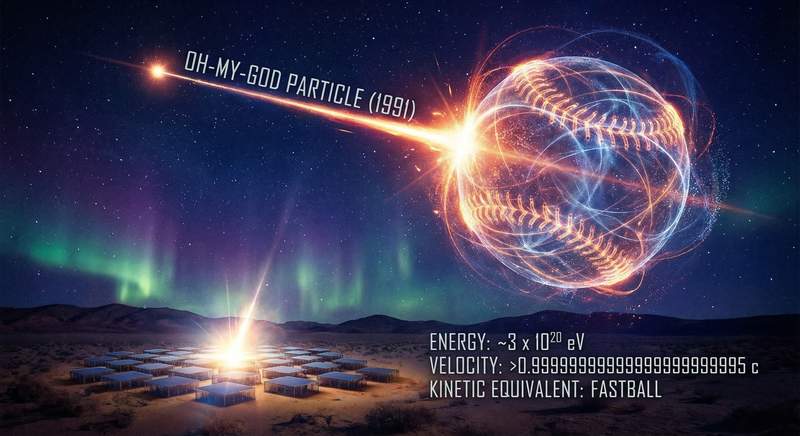
In 1991, the Fly’s Eye detector in Utah recorded the most energetic cosmic-ray event ever observed, with an estimated energy of about 3.2 × 10^20 electron volts. The durable version of the fact is that it was an ultra-high-energy cosmic ray detected indirectly through the air shower it created, and although it was almost certainly moving extraordinarily close to light speed, its exact identity and origin remain uncertain.
Published
Filed under
Byline
 Brainblast archive
2026-03-06-04-33-00-oh-my-god-particle.png (source: app assets)
The fact
“In 1991, astronomers detected a single subatomic particle, dubbed the "Oh-My-God particle," traveling at 99.99999999999999999999951% the speed of light. This proton carried the same kinetic energy as a professional baseball pitched at 60 miles per hour, which is roughly 40 million times the energy of the most powerful particles ever produced in the Large Hadron Collider. Because of extreme relativistic time dilation, the particle would have experienced only a few seconds during its multi-billion-year journey across the observable universe.”
In 1991, the Fly’s Eye detector in Utah saw something so extreme that the event earned one of the most honest nicknames in science: the “Oh-My-God particle.” The University of Utah’s retrospective on the event explains that what the instrument actually detected was an enormous air shower in Earth’s atmosphere. Researchers then worked backward from that shower to infer the energy of the incoming cosmic ray. The Pierre Auger Observatory’s “Big Events” page gives the headline number: about 3.2 × 10^20 electron volts, still the highest-energy cosmic ray ever observed.
That number is absurdly large on particle-physics scales. The Pierre Auger FAQ notes that the highest-energy cosmic rays are around 10^20 electron volts, while even major human-made accelerators sit far lower. The Auger “Big Events” page says the Fly’s Eye event carried about 300 million times the energy of protons accelerated at Fermilab’s Tevatron. Put in everyday units, that works out to tens of joules for a single particle-scale event—remarkably close to the kinetic energy of a pitched baseball. That comparison is dramatic, but it is mathematically real.
Still, a few popular retellings oversell the certainty. First, scientists did not directly catch and hold a lone proton in a bottle. They observed the atmospheric cascade created when one ultra-high-energy cosmic ray slammed into the upper atmosphere. The University of Utah account describes this as a miles-long explosion of streaming particles. The Auger page likewise explains that detectors infer the original particle’s properties from the shower of secondary particles and fluorescence it triggers. So when people say astronomers “detected a single subatomic particle,” that is true in a reconstructed sense, not in the sense of watching one beadlike object fly by.
Second, the particle’s identity is not fully settled. It is often casually called a proton, but the Pierre Auger Observatory’s “Big Events” page explicitly says the composition of the primary particle was not known with certainty. Its best guess on that page is that it may have been a moderate-mass nucleus rather than a simple proton. That matters because the exact speed, Lorentz factor, and storytelling flourish about how little proper time the particle “experienced” depend on what kind of particle it actually was and where it came from.
Even so, the speed was almost unimaginably close to the speed of light. Any cosmic ray with an energy in the 10^20-electron-volt range is ultra-relativistic. That means the usual factoid that it traveled at “99.99999999999999999999951% of light speed” is in the right spirit, but it should be treated as a derived estimate under simplifying assumptions, not as a laboratory-style direct measurement printed on the detector. The real measured quantity emphasized by the Utah account and the Auger pages is the event’s enormous energy.
The deeper mystery is not merely speed but origin. According to the University of Utah article, scientists were shocked because the inferred energy seemed to exceed what they thought nature should easily deliver. The Pierre Auger FAQ describes the GZK cutoff, a predicted suppression above roughly 6 × 10^19 electron volts caused by energy losses from interactions with the cosmic microwave background over vast distances. In plain English: particles this energetic should be hard to make, and if they travel too far through the universe, they should also lose energy before reaching us.
That is why the event remains famous more than three decades later. It was not just a big number; it was a challenge to astrophysical explanation. The Auger “Big Events” page says researchers had believed such energetic particles could not persist because of collisions with background radiation left over from the Big Bang. The Utah article adds that later observatories found additional ultra-high-energy events, which helped confirm that the 1991 detection was not an instrument glitch.
There is also a subtle wording issue with the claim that the particle traveled for billions of years and “experienced only seconds.” Relativity does allow enormous time dilation at these energies, but the exact figure depends on assumptions about the particle’s mass, identity, and source distance. Since the Auger page says the composition was uncertain and the Utah page says the source is still unknown, that poetic line should be treated as an illustration, not a measured historical biography of the particle.
So the cleaned-up fact is even better than the meme version. In 1991, scientists detected the most energetic cosmic-ray event ever recorded, with an inferred energy around 3.2 × 10^20 electron volts, as described by the University of Utah and the Pierre Auger Observatory. It was an ultra-high-energy cosmic ray observed indirectly through its atmospheric air shower, not a neatly labeled particle photographed in flight. It moved extraordinarily close to light speed, but its exact identity and birthplace remain unsettled. Which is to say: the “Oh-My-God particle” was real, but the biggest honest conclusion is still that the universe has not fully explained itself yet.