Oklo: the natural nuclear reactor beneath ancient Gabon
In deep time, uranium-rich ore bodies at Oklo reached natural criticality and sustained self-regulating fission with groundwater acting as a neutron moderator. The site remains the only confirmed natural reactor complex on Earth and a valuable test case for isotope geochemistry and long-term nuclear waste behavior.
Published
Filed under
Byline
 Brainblast archive
2026-03-03-17-02-00-oklo-natural-reactor.png (source: app assets)
The fact
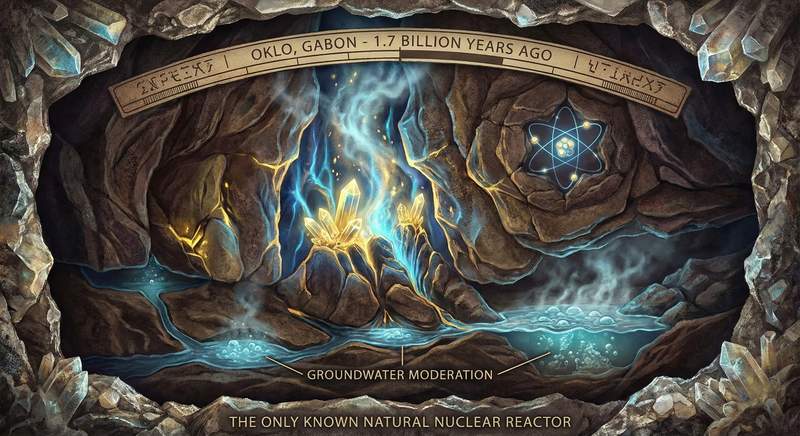
“Approximately 1.7 billion years ago, a uranium deposit in Oklo, Gabon, naturally reached 'criticality' and functioned as a self-sustaining nuclear fission reactor for hundreds of thousands of years. The process was moderated by groundwater that slowed down neutrons, allowing the reactor to cycle on and off for millennia as water boiled away and returned. This site is the only known natural nuclear reactor on Earth and offers a remarkable blueprint for the long-term containment of nuclear waste in geological formations.”
Oklo sounds like science fiction: a place where rocks ran a nuclear reactor all by themselves. But the site in Gabon is real, and it remains the only confirmed natural nuclear reactor complex known on Earth. What happened there was not a single explosion or a hidden alien machine. It was a natural convergence of uranium concentration, water, geometry, and deep time. When those ingredients lined up, self-sustaining nuclear fission began without any human engineering, a story summarized by the IAEA overview of Oklo.
The modern discovery began in 1972, when scientists processing uranium ore noticed that some material from Oklo had an abnormally low proportion of uranium-235. That isotope is the fissile one, the version of uranium especially important for chain reactions. Natural uranium today has a very consistent isotopic composition, so the anomaly stood out immediately. The IAEA account notes that ordinary natural uranium contains about 0.720% uranium-235, whereas the unusual Oklo sample came in slightly lower. That small discrepancy mattered because it looked exactly like the signature you would expect if some uranium-235 had already been consumed by fission.
Follow-up work showed that the anomaly was not a measurement fluke. The USGS publication page describes measurements on Oklo ore and reports uranium-235 abundances in some samples around 0.54%, far below the normal value. It also emphasizes why this was a fossil signal rather than an ongoing process: enough time had passed since the reactions ended for daughter products in the uranium series to return to near secular equilibrium. In other words, the rocks still carried the isotopic fingerprints of ancient fission even though the reactor itself had long gone cold.
Why was natural fission possible then, but not in a random uranium deposit today? The answer begins with radioactive decay. Uranium-235 decays faster than uranium-238, so if you look far enough back in time the natural fraction of uranium-235 was higher than it is now. The IAEA explanation points out that ancient deposits had enough of the fissile isotope for criticality to become possible. But isotope abundance alone was not enough. The ore also had to be rich and thick enough, and it needed a moderator to slow neutrons so they were more likely to trigger additional fissions.
That moderator was groundwater. Water seeped through the uranium-rich rock and played essentially the same role moderators play in many human-built reactors: it slowed neutrons down. As the OSTI record for a classic review of Oklo explains, the properties of the phenomenon make sense in the framework of chain reactions rather than any exotic chemistry. The system could even regulate itself. When fission heated the deposit, water boiled away or circulation changed, reducing moderation and slowing the reaction. When the zone cooled and water returned, the reaction could begin again. Oklo was not just natural criticality; it was natural feedback control.
That self-regulating behavior is one reason Oklo matters so much beyond the wow factor. It gives scientists a real deep-time example of how fission products and actinides move, or fail to move, through rock and groundwater systems. The IAEA article highlights the site's value as a natural analogue for long-term radioactive waste studies, because it shows what can happen to nuclear byproducts over geologic spans instead of decades. Oklo is one of the rare cases where nature performed a billion-year containment experiment for us.
There is also an important correction hiding inside the popular version of the fact. Many summaries say "1.7 billion years ago," while others say "two billion years ago." Those are not necessarily contradictions so much as rounding choices across a long Precambrian timeline. The IAEA source uses the broader "two-billion-year-old" framing, while the historical and geochemical literature collected through OSTI and USGS is consistent with an ancient Proterozoic event usually placed around 1.8 to 2.0 billion years ago. So the catchy number is approximate, not a sharply agreed single date.
Another caveat: Oklo is the only confirmed known natural reactor complex, not necessarily the only one that ever existed. The IAEA discussion notes that similar systems may have formed elsewhere and then been erased by erosion, metamorphism, subduction, or simple failure to preserve recognizable evidence. Oklo is special partly because the geology let it survive long enough for us to notice.
What makes the site unforgettable is how unromantic the underlying ingredients are. No miracle was required. Nature merely assembled concentrated uranium, the right isotope ratio, the right rock geometry, and water in the right place at the right time. That was enough. Oklo turns nuclear physics into a geological field observation and reminds us that some of the strangest things humans build are, under the right conditions, things Earth figured out first.