Fulgurites: The Glass Fossils Made by Lightning
When lightning strikes sandy or silica-rich ground, the heat can fuse the material into hollow, glassy structures called fulgurites. They really are natural records of a lightning path, but popular claims about exact temperatures, lengths, and extreme ages should be treated as examples or upper-end estimates rather than universal facts.
Published
Filed under
Byline
 Brainblast archive
2025-03-02-fulgurite-lightning-glass.png (source: app assets)
The fact
“When lightning strikes sand, it creates fulgurites—naturally forged glass tubes formed by temperatures of 50,000°F (hotter than the surface of the sun) that instantly melt and fuse the surrounding silica sand. These delicate, hollow structures preserve the exact path the lightning bolt took underground, creating permanent glass fossils of electricity. The process happens in mere milliseconds—so quickly that it forms a glass tube before the surrounding sand can cool. Fulgurites have been found over 16 feet long, and some are over 250 million years old, preserving moments of prehistoric storms in solid glass.”
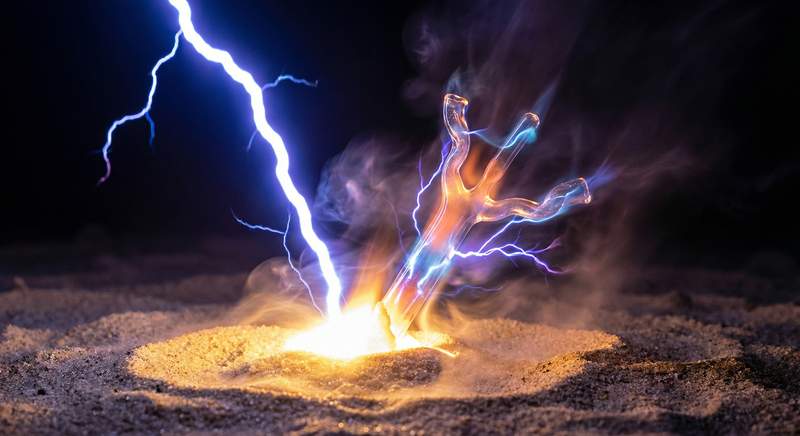
A fulgurite is what happens when a lightning strike leaves behind a piece of geology instead of only a memory. The Utah Geological Survey’s plain-language overview What are fulgurites and where can they be found? defines them as natural tubes or crusts of glass formed when lightning fuses silica-rich sand or rock. Because the electric discharge bores into the ground along branching pathways, the resulting glass often preserves the route the bolt took underground.
That is why fulgurites are sometimes called “petrified lightning,” though the phrase is metaphorical. Lightning itself is not being fossilized as a substance. What gets preserved is the thermal and electrical damage pattern left behind when an intense discharge melts surrounding material so quickly that it cools into glass. In loose sand, the classic result is a hollow tube with a rough exterior and a smoother glassy inner wall.
The temperatures involved are extreme. NOAA’s weather page notes in its lightning facts that lightning can heat the surrounding air to about 50,000°F, roughly five times hotter than the surface of the Sun. That does not mean every grain of sand around every strike reaches exactly that temperature for the same duration. It does mean lightning is more than hot enough to melt quartz-rich sediment locally and create the conditions needed for fulgurite formation.
The newer experimental paper Experimental generation of fulgurite under realistic lightning discharge conditions is useful because it addresses a longstanding question: how closely can laboratory discharges reproduce natural fulgurites? The study emphasizes that natural fulgurites are notoriously hard to reproduce under realistic conditions, partly because real lightning is a complicated, short-lived, high-energy event interacting with messy natural sediments. Even so, experiments support the core idea that rapid high-current discharge can generate the glassy structures seen in nature.
Fulgurites are valuable beyond their visual drama. A USGS study, Paleoecology reconstruction from trapped gases in a fulgurite from the late Pleistocene of the Libyan Desert, analyzed gases trapped inside a fulgurite to extract information about past environments. That means a lightning-made glass tube can sometimes act as a time capsule, preserving clues about atmosphere, soil, and surface conditions at the moment it formed. The object is simultaneously a weather artifact and a geologic sample.
The viral version of the fact often adds two extra claims: that fulgurites can exceed 16 feet in length and that some are more than 250 million years old. Those statements need caution. Fulgurites absolutely can extend for many feet and branch intricately, but size depends on sediment, moisture, strike energy, and how much survives later erosion. The age claim is even trickier. The 2023 Scientific Reports paper at nature.com/articles/s41598-023-38781-8 notes that the oldest fulgurite reported to date has been speculated to be on the order of 250 million years old, but “speculated” is doing real work there. Dating fulgurites is difficult, and many well-studied examples are much younger.
That difficulty makes sense once you think geologically. Glass is fragile. Surface environments are destructive. A fulgurite has to survive weathering, burial, chemical alteration, and the simple chance of not being broken apart. So when exceptionally old ages are proposed, they are exciting but not the sort of claim to repeat without the qualifier attached.
Even with those caveats, fulgurites remain one of nature’s best examples of a transient event leaving a solid signature. A thunderstorm lasts minutes or hours. A lightning channel itself flashes in fractions of a second. Yet if the strike hits the right material, it can create a glassy object that lasts centuries, millennia, or longer. The Utah Geological Survey page at geology.utah.gov captures the charm of that transformation nicely: sand and stone become a record of electricity.
So the headline claim is basically right, with the numbers treated carefully. Lightning striking sand can indeed create fulgurites—hollow or crusty natural glasses that map the path of a discharge. NOAA explains why the heat is sufficient in its weather overview, experimental work in Scientific Reports shows how difficult but real the process is, and USGS shows these objects can even preserve environmental information. They are not mythic objects. They are weather turned into geology.