Astatine Is Probably the Rarest Naturally Occurring Element in Earth’s Crust—But the Exact Amount Depends on How You Count
Astatine is widely described as the rarest naturally occurring element in Earth’s crust because every isotope is radioactive and short-lived, so only tiny trace amounts exist at any given time. The careful version of the fact is that estimates vary—from tens of milligrams to less than an ounce worldwide—depending on what region is counted and how the transient production-decay balance is modeled.
Published
Filed under
Byline
 Brainblast archive
2026-03-06-00-33-00-astatine-rarest-element.png (source: app assets)
The fact
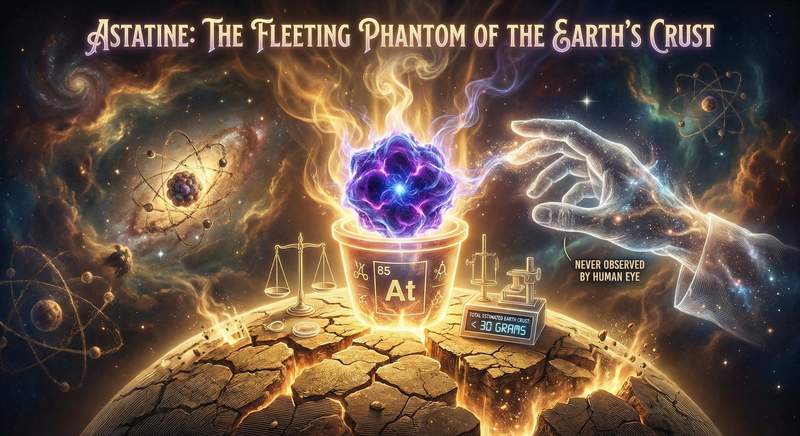
“Astatine is the rarest naturally occurring element on Earth, with less than 30 grams total estimated to exist in the entire crust at any given time. This element is so intensely radioactive that any visible amount would immediately vaporize itself from the sheer heat generated by its own decay. Because its existence is so fleeting, a macroscopic sample of the element has never been observed by the human eye.”
Astatine has one of the best résumé lines in chemistry: it is widely described as the rarest naturally occurring element in Earth’s crust. That claim is basically sound, but like many great science one-liners, it gets fuzzier when you ask for exact numbers. Britannica’s astatine entry identifies astatine as an extraordinarily rare radioactive element, Los Alamos National Laboratory’s periodic-table page says the total amount present in Earth’s crust is less than one ounce, and the University of Gothenburg news release says Earth’s crust contains only about 70 milligrams. Those numbers are not identical, but they agree on the central point: there is vanishingly little astatine around at any moment.
The reason is simple and brutal. Astatine does not hang around. Los Alamos explains that astatine occurs only in trace amounts in the decay chains of heavier radioactive elements such as uranium and thorium. It is continuously produced in tiny amounts and then disappears again by radioactive decay. Britannica likewise treats it as a short-lived radioactive element rather than something that accumulates into stable deposits. That steady-state production-and-decay balance is why Earth can keep making astatine without ever building up much of it.
This is also why estimates vary. The University of Gothenburg release gives a striking figure of 70 milligrams in the Earth’s crust, while Los Alamos uses the looser and older-sounding “less than 1 oz.” estimate. Britannica is more interested in the qualitative point—that the element is exceptionally scarce because its isotopes decay so quickly. Different totals can emerge depending on whether a source is estimating crustal inventory, global instantaneous abundance, or a broader geochemical balance. In other words, the disagreement is mostly about how tiny the number is, not about whether the number is tiny.
That tiny inventory has practical consequences. Unlike elements that can be mined, refined, and stored by the kilogram, astatine is so scarce in nature that researchers usually have to produce it artificially if they want to study it in any serious way. Los Alamos says astatine can be made by bombarding bismuth with energetic alpha particles. The Gothenburg report describes researchers using a particle accelerator at CERN to produce and investigate astatine ions because natural supplies are far too meager for convenient laboratory work.
The rarity also explains why astatine remained chemically mysterious for so long. The Gothenburg article says researchers have known very little about its chemical properties precisely because it is both rare and difficult to retain: it decays quickly and is hard to generate in useful amounts. Los Alamos notes that it behaves chemically much like other halogens, especially iodine, yet even that conclusion had to be pieced together from clever experiments rather than from somebody casually holding a lump of astatine in a vial.
A caveat worth keeping is that “rarest naturally occurring element on Earth” is a popular simplification. Chemists often mean the rarest naturally occurring element in the Earth’s crust, or the rarest naturally occurring non-transuranic element in ordinary terrestrial material. Britannica and Los Alamos both support the standard classroom version, but the phrase is still a category label, not a metaphysical truth covering every conceivable environment and definition. Science loves footnotes, and astatine invites several.
Another nuance is that rarity does not make astatine unimportant. In fact, its scarcity is part of why it fascinates researchers. The Gothenburg release frames new astatine measurements as a significant advance because understanding such an elusive element clarifies basic atomic behavior. Los Alamos also notes that isotopes such as astatine-209 through astatine-211 can be produced and separated, making them useful for research even though nature itself provides almost none to work with.
If anything, astatine is a good lesson in how scientific facts survive simplification. The viral version says: “Astatine is the rarest naturally occurring element on Earth.” The audited version says: yes, that is a fair shorthand, especially for Earth’s crust, because Britannica, Los Alamos, and the University of Gothenburg all describe it as extraordinarily rare and fleeting. But if you demand a precise worldwide mass, sources will not hand you a single sacred number.
So the best corrected fact is this: astatine is generally regarded as the rarest naturally occurring element in Earth’s crust because its isotopes are highly radioactive and short-lived, leaving only trace amounts at any one time. Depending on the estimate, that means something like tens of milligrams to less than an ounce globally, as reflected by the Gothenburg figure and the Los Alamos estimate. Tiny either way. Almost offensively tiny.