In 2009, researchers discovered that when sodium metal—normally a highly...
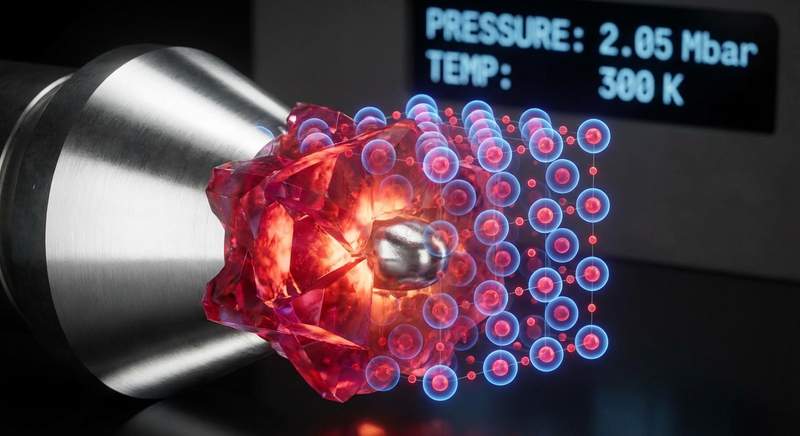
Under extreme compression, sodium can stop behaving like a textbook shiny metal and instead become transparent and insulating because its electrons localize in interstitial regions rather than moving freely.
Published
Filed under
Byline
 Brainblast archive
2026-03-06-17-33-00-transparent-sodium.png (source: app assets)
The fact
“In 2009, researchers discovered that when sodium metal—normally a highly reactive, silver-colored conductor—is subjected to pressures exceeding 2 million atmospheres, it undergoes a radical transformation into a transparent, red-hued insulator. This counterintuitive phenomenon occurs because extreme compression forces the material's valence electrons into the narrow gaps between the nuclei, effectively trapping them and preventing the flow of electricity. This discovery fundamentally challenged the long-held chemical assumption that all elements eventually become metallic and superconducting when squeezed tightly enough. By proving that a metal can be compressed until it becomes a see-through non-metal, scientists demonstrated that the rules of the periodic table are dynamic functions of their physical environment. Understanding these exotic states is critical for modeling the chemistry occurring deep within planetary cores, where immense pressures create behaviors that cannot naturally exist on the Earth's surface. This research serves as a profound reminder that even the most familiar elements can behave in ways that seem like science fiction under extreme cosmic conditions.”
Sodium is one of the most stereotypically metallic elements on the periodic table: soft, silvery, conductive, and famously reactive. That is why the 2009 result seemed so delightfully perverse. Under extreme pressure, sodium was observed to become a yellowish transparent insulator rather than a better and better metal. Argonne’s Advanced Photon Source described the result plainly: when researchers squeezed sodium to around two million atmospheres, the metal transformed into a transparent material, and by about 200 gigapascals they reached the predicted transparent phase (https://www.aps.anl.gov/APS-Science-Highlight/2009/metal-becomes-transparent-under-pressure).
That sounds like a violation of common sense because most people learn a simple rule of thumb: if you cram atoms closer together, their electrons overlap more and materials tend to look more metallic. That rule works often enough to become intuition. Sodium is the reminder that intuition is not a law. At sufficiently high pressure, the electron structure can reorganize in a way that destroys ordinary metallic behavior instead of strengthening it.
The basic explanation is that heavy compression changes where sodium’s valence electrons can live. In an ordinary metal, electrons are fairly mobile and can move through the material, which is why metals conduct electricity and reflect visible light so well. In dense sodium, however, the electrons are pushed into the spaces between the atoms and become localized there. Argonne’s 2009 summary says the atoms overlap so strongly that their outer electrons are forced into interstitial regions, localizing the charge and collapsing the metallic state (https://www.aps.anl.gov/APS-Science-Highlight/2009/metal-becomes-transparent-under-pressure).
That localization is why the material becomes transparent. Free-flowing electrons in a metal interact strongly with incoming visible light, which helps produce metallic reflectivity. Trapped or localized electrons do not behave the same way. As a University at Buffalo summary of later work explains, free-flowing electrons absorb and retransmit light, whereas trapped electrons can allow light to pass through, which helps explain sodium’s change from shiny gray metal to transparent insulator (https://www.buffalo.edu/news/releases/2023/12/sodium-high-pressure-transformation.html).
The 2010 Physical Review Letters analysis sharpened the picture further. It described transparent dense sodium as a charge-transfer insulator and reported an unusual excitonic optical response, with anisotropic absorption that could make sodium transparent in one direction while reflective in another just above the metal-insulator transition (https://link.aps.org/doi/10.1103/PhysRevLett.104.216404). So this is not just a cute phase change where sodium turns into generic clear glass. It is an exotic electronic state with directional optical behavior and electride-like character.
That last point matters because the high-pressure phase is not well described by everyday chemistry categories. Argonne’s writeup says the localized interstitial electrons behave almost like anions while the sodium nuclei-plus-core-electrons act like cations, making the compressed material resemble an elemental ionic solid or an unconventional electride (https://www.aps.anl.gov/APS-Science-Highlight/2009/metal-becomes-transparent-under-pressure). In other words, the element is still sodium, but its electrons are organized so differently that the familiar metallic identity breaks down.
This was scientifically important for more than bragging rights. The finding challenged a very old expectation that matter under extreme compression should move monotonically toward metallicity. The Buffalo summary points out that Neil Ashcroft and Jeffrey Neaton had helped overturn that assumption theoretically, showing that some materials—including sodium—could become insulating or semiconducting when squeezed hard enough (https://www.buffalo.edu/news/releases/2023/12/sodium-high-pressure-transformation.html). Transparent sodium became one of the clearest demonstrations that the periodic table’s familiar behavior is not fixed across all pressure regimes.
There are important caveats, though. First, the effect occurs only under extraordinary pressures—millions of atmospheres, far beyond anything encountered in ordinary life. Tossing table salt in a hydraulic press will not get you anywhere close. Second, the claim is not that sodium stays transparent forever as pressure keeps climbing. High-pressure phase diagrams can be complicated, and different structures can appear as compression changes. The famous 2009 result concerns a specific extreme-pressure regime, not a permanent new identity for sodium.
Third, “transparent” does not mean perfectly colorless window glass. Reports often describe the phase as yellowish or red-tinted depending on conditions and interpretation. That nuance matters because the striking part is the loss of ordinary metallic reflectivity and the emergence of insulating optical behavior, not a pristine cosmetic transparency.
Even with those caveats, the fact remains wonderfully counterintuitive and true. Under enough pressure, sodium stops behaving like the simple metal you met in chemistry class and starts behaving like an exotic insulator with localized interstitial electrons (https://www.aps.anl.gov/APS-Science-Highlight/2009/metal-becomes-transparent-under-pressure; https://link.aps.org/doi/10.1103/PhysRevLett.104.216404).
That is part of why high-pressure physics is so fun. It takes the most familiar elements and asks a rude question: what if their usual personalities are just low-pressure habits? In sodium’s case, squeeze hard enough and the shiny reactive metal answers by becoming a transparent insulator—because the electrons decide to stop acting metallic and start huddling between the atoms instead.