Diamond Rain on Giant Planets Is Plausible—But Not Literally Confirmed on Jupiter
The viral claim about diamond rain on Jupiter and Saturn comes from modeling and high-pressure physics, not from direct observation. Scientists have argued that deep giant-planet conditions could produce diamonds, and laboratory work has supported diamond formation under planet-like conditions, but the exact extent on Jupiter and Saturn remains uncertain.
Published
Filed under
Byline
 Brainblast archive
2026-03-02-07-03-00-diamond-rain-jupiter.png (source: app assets)
The fact
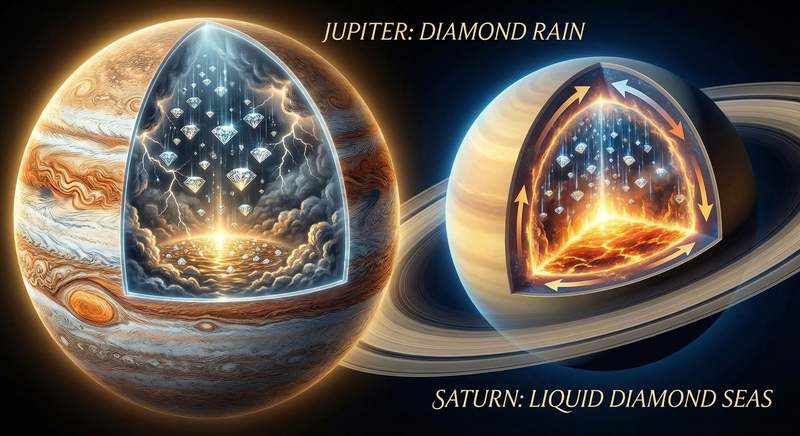
“It literally rains diamonds on Jupiter—and Saturn too. The extreme atmospheric pressure and heat on these gas giants can squeeze carbon into diamond formations. The diamonds form in the upper atmosphere and then rain down toward the core, eventually melting into liquid diamond seas. Scientists estimate that Jupiter's diamond rain could amount to millions of carats per year.”
The short answer is: maybe, but not in the cartoonish, eyewitness way the meme suggests. Astronomy’s 2013 report on planetary-interior calculations says researchers combined carbon phase data with pressure-temperature models for Jupiter and Saturn and concluded that diamond could be stable deep inside those planets. That is where the popular “it rains diamonds on Jupiter and Saturn” line comes from. It is a scientific inference about deep interiors, not a camera recording of gemstones falling through visible clouds.
The phrase “literally rains” is doing too much work. In everyday language, rain is something you can watch falling from the sky. On giant planets, the proposed process happens far below the layers we can directly observe and under pressures so extreme that familiar weather metaphors become only partly helpful. Astronomy’s write-up describes soot or graphite descending and then being crushed into diamond at great depth. That is closer to an interior phase-change scenario than to sparkly precipitation drifting past a window.
The broader physical idea is sound enough that NASA uses it in public discussions of giant planets. In NASA’s Gravity Assist episode about giant planets and “diamond rain”, Naomi Rowe-Gurney explains that pressure and temperature conditions can be so extreme that carbon atoms could be crushed into diamonds in planetary atmospheres or interiors. But that same NASA discussion is framed around Uranus and Neptune, not as a final proof that Jupiter and Saturn definitely have the exact same process to the exact same degree. That is an important clue about the state of the evidence.
The strongest experimental support in the source set also points most clearly to the icy giants. SLAC’s 2017 report on laboratory diamond-rain experiments says researchers recreated conditions similar to those inside Uranus and Neptune and observed diamond formation in the lab. That is a big deal, because it moved the concept from pure theory toward experimental support. But it still did not involve drilling into Jupiter, lowering a bucket into Saturn, or directly confirming an actual storm of diamonds there.
That distinction matters because Jupiter and Saturn are not just larger versions of Uranus and Neptune. Their temperature, pressure, composition, and layering differ in ways that affect how carbon behaves. Astronomy’s 2013 article presents the Saturn-and-Jupiter case as a modeling result based on interior adiabats and carbon phase boundaries. NASA’s discussion and SLAC’s experiment support the plausibility of diamond formation under giant-planet conditions, but they also show why planet-specific details matter.
Another caveat is scale. Viral retellings often jump from “diamonds could form” to “there must be oceans of jewelry-grade gemstones.” SLAC’s article describes nanometer-scale diamond structures forming under experimental conditions and then discusses how much larger diamonds might become inside planets over long timescales. That is not the same as saying neat cuttable crystals are casually bobbing around like treasure chests. The underlying science is more interesting and less Hollywood.
It is also worth noting that scientists use words like “predict,” “hypothesize,” and “calculate” for a reason. Astronomy’s article reports that the researchers calculated diamond stability in deep interiors. NASA’s podcast page says carbon atoms could be crushed into diamonds. SLAC’s lab report says the team observed diamond formation under simulated conditions relevant to icy giants. Those are all strong statements, but none of them mean direct confirmation inside Jupiter or Saturn.
So should the fact be called false? Not exactly. The best correction is that diamond rain is a serious planetary-science idea supported by theory and high-pressure experiments, but the cleanest evidence currently points to giant-planet interior physics in general and especially to Uranus/Neptune-like conditions. The specifically viral “Jupiter and Saturn literally have diamond rain” version is a little ahead of the certainty we actually have.
That is not a disappointing answer; it is how good planetary science usually sounds before a mission can directly sample the relevant layers. Astronomy’s report captures the boldness of the Saturn-and-Jupiter hypothesis, while NASA’s discussion and SLAC’s experimental result show why the broader concept remains scientifically credible.
The most honest version, then, is this: scientists have calculated that diamond could be stable deep inside Jupiter and Saturn; NASA openly discusses diamond formation under extreme giant-planet conditions; and SLAC researchers have experimentally observed diamond formation under interior-like conditions for icy giants. That makes the claim plausible science, not settled weather reporting.