Why Sunlight Reaches Earth Fast but Leaves the Sun Slowly
Light crosses the gap from the Sun to Earth in about 8.3 minutes, yet energy created in the solar core can take far longer to emerge. The catch is that photons do not travel straight out; they undergo a random walk through dense solar material, and published escape-time estimates vary with the model and definition used.
Published
Filed under
Byline
 Brainblast archive
2026-03-03-05-14-00-photon-journey-sun-core.png (source: app assets)
The fact
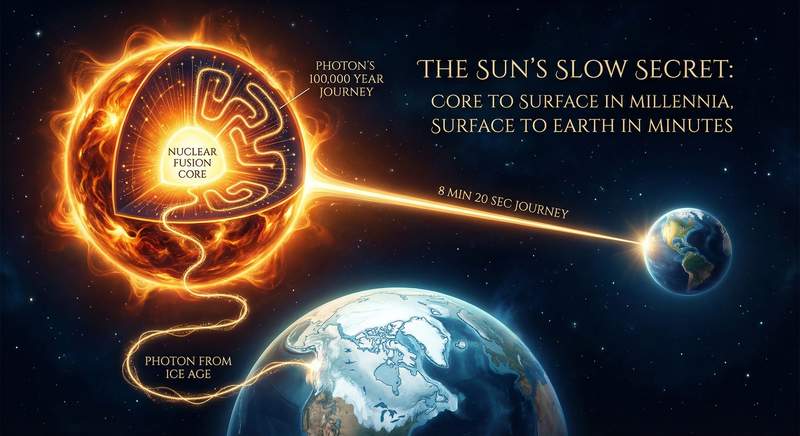
“While sunlight takes only 8 minutes and 20 seconds to travel from the Sun's surface to Earth's surface, photons created in the Sun's core through nuclear fusion can take up to 100,000 years to reach the surface due to the Sun's extreme density. A photon generated during the last ice age is only now reaching the surface of the Sun.”
The familiar part of the story is easy: sunlight takes about 8.3 minutes to get from the Sun to Earth. NASA says exactly that in its overview of solar-system light time in Chapter 1: The Solar System, and the kid-friendly All About the Sun page repeats the same basic figure. But the more surprising part is that the energy in that sunlight may have spent tens of thousands to hundreds of thousands of years inside the Sun before ever reaching the surface.
That sounds contradictory only if you imagine a photon being born in the core and then shooting outward in a straight line. The Sun does not permit that. Its interior is dense plasma full of charged particles. A photon generated by fusion in the core is quickly absorbed, re-emitted, scattered, or otherwise redirected. Instead of making one clean trip, energy performs a random walk. It advances a little, gets bumped, changes course, and advances again. Multiply that by an absurd number of interactions and the escape time balloons.
A classic paper on this question, On the Photon Diffusion Time Scale for the Sun, argued that some common textbook estimates were too short because they assumed an average step length that was too large. Using a solar model, the authors obtained an average photon step length of about 0.090 centimeters and a diffusion time scale of roughly 170,000 years for the present Sun. That number is the source of many modern summaries claiming that light from the Sun’s core can take on the order of a hundred thousand years to emerge.
Here is the crucial nuance: that figure is not a stopwatch reading on one named photon. It is a model-based diffusion timescale. In a dense radiative zone, photons are continually absorbed and recreated, so talking about “the same photon” all the way from core to surface is already a simplification. What actually migrates outward is energy. The energy packet that eventually becomes sunlight at the photosphere has been handed off again and again through radiation-matter interactions.
This is why published numbers vary so much. Depending on the solar model, the assumed path lengths, and whether an explanation is describing an intuitive random walk or a more formal transport calculation, you may see values from tens of thousands of years to several hundred thousand years. The NASA distance pages are not contradicting the astrophysics paper; they are describing different legs of the trip. Once light escapes the solar surface and enters near-vacuum, the remaining journey to Earth is fast and direct. Inside the Sun, it is anything but direct.
That difference between the interior and exterior also highlights how transparent space is compared with stellar matter. In interplanetary space, a photon can travel enormous distances without interruption. Inside the Sun, free paths are tiny. The paper at doi.org/10.1086/172103 was specifically correcting the average step length used in some older back-of-the-envelope estimates, because small changes in that microscopic distance produce huge changes in the total diffusion time.
The popular phrasing that “a photon created during the last ice age is only now leaving the Sun” is catchy, but it should be treated as a broad illustration, not a literal tracking statement. Some of the energy now reaching us may indeed have begun its outward migration on those timescales, but the interior process is statistical and messy. The safer claim is that solar-core energy typically spends an immensely long time diffusing outward before the final 8-minute sprint to Earth.
That long delay is one reason the Sun is so stable. The radiative interior acts like a deep thermal buffer. Energy is generated in the core, but it is not dumped straight into space. Instead, it percolates outward over geologic stretches of time, helping smooth variations and making the Sun a remarkably steady star on human timescales.
So the headline is true with a footnote. Sunlight reaches Earth in just over eight minutes, as NASA’s light-time explanation and Space Place’s Sun page say. But the energy behind that sunlight had a much slower childhood, diffusing through the solar interior in a wandering process whose characteristic timescale has been estimated at about 170,000 years in The Astrophysical Journal paper. Fast commute, very long upbringing.