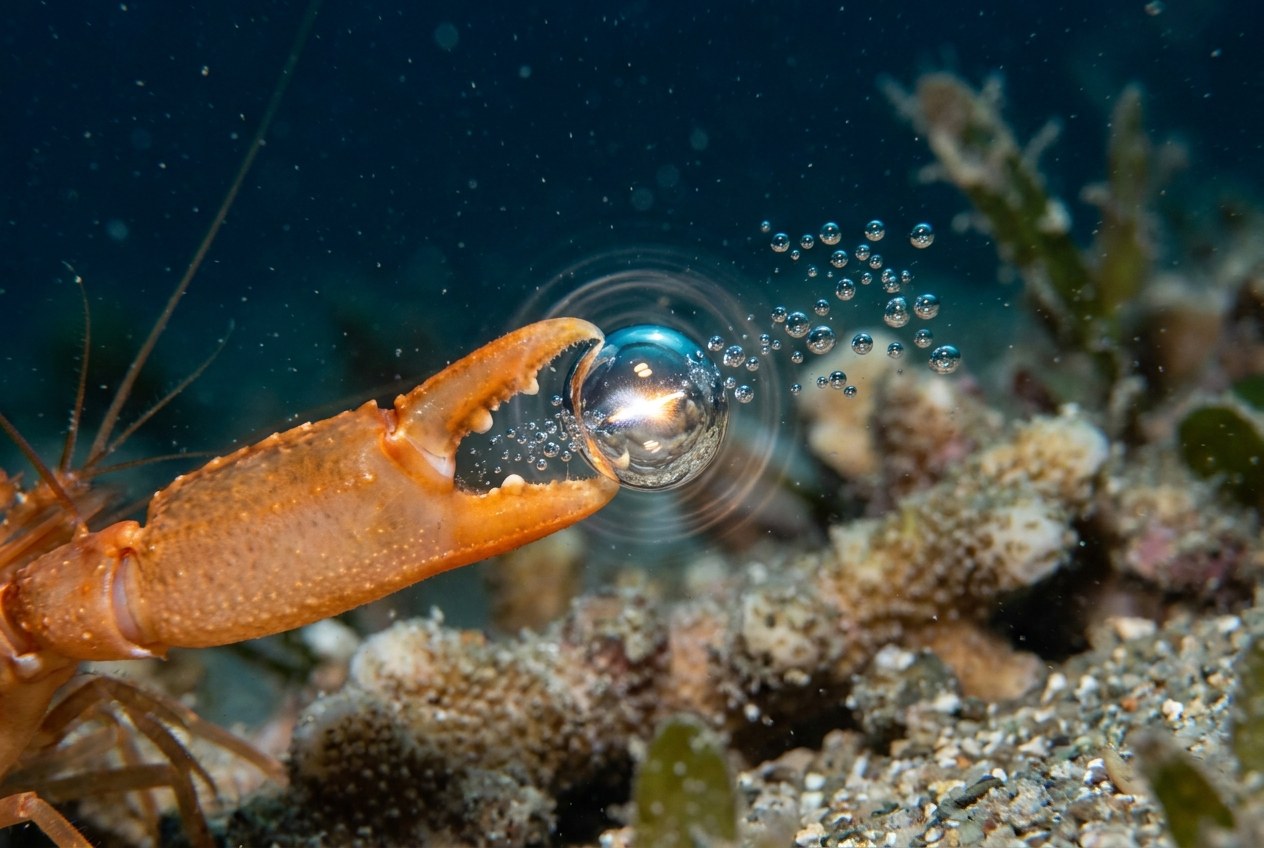
Mantis Shrimp Eyes Are Weird Even by Animal Standards
Mantis shrimp are often said to have the most complex eyes in the animal kingdom because their visual system combines many spectral channels with polarization sensitivity. That phrase is a shorthand, not a formal crown, but their eyes genuinely are among the strangest and most specialized visual systems known.
Published
Filed under
Byline
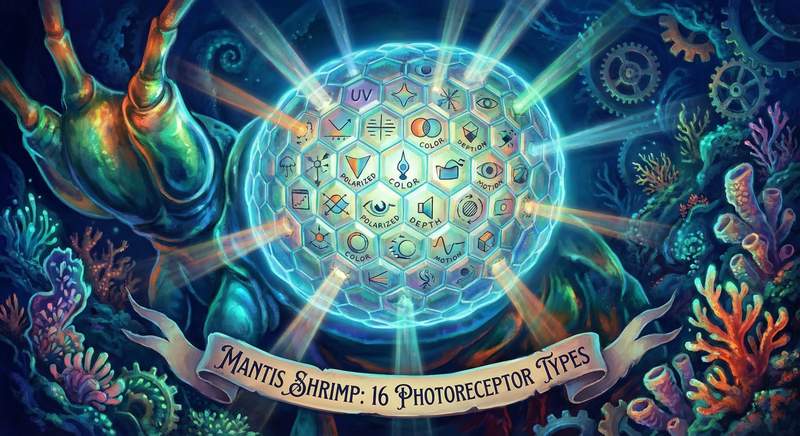 Brainblast archive
2026-03-03-02-14-00-mantis-shrimp-vision.png (source: app assets)
The fact
“Mantis shrimp possess the most complex eyes in the animal kingdom, with up to 16 different types of photoreceptors (compared to humans' 3). They can see ultraviolet light, polarized light, and six species can even detect circularly polarized light—a capability found in no other known animal. Their eyes are mounted on mobile stalks that move independently, giving them 360-degree vision. Despite having so many color receptors, research suggests they process colors as 'labels' rather than gradients. Their powerful claws strike with the force of a .22 caliber bullet, creating cavitation bubbles that reach 8,500°F and produce small flashes of light called sonoluminescence.”
Mantis shrimp are famous online for two things: punchy claws and allegedly superpowered eyes. The claw hype is deserved, but the eye story is the more scientifically interesting one. These marine crustaceans are often described as having the most complex eyes in the animal kingdom because their visual system combines many spectral channels with specialized polarization sensitivity. A Cambridge review, Evolutionary tinkering with visual photoreception, notes that mantis shrimp have an astonishing array of visual pigments, often summarized as 16 receptor classes.
That headline number already makes them sound like cartoon superheroes. Humans typically rely on three cone types for color vision. Mantis shrimp eyes divide the job differently. As the University of Queensland summarized in its overview of the system, these animals can see in many spectral bands and can distinguish forms of polarized light as well. Their eyes sit on stalks and move independently, which adds another layer of sensory flexibility.
The polarization part is especially wild. In Dynamic polarization vision in mantis shrimps, researchers showed how specialized cells in the eye help convert circularly polarized light into signals the animal can use. That matters because circular polarization is a niche visual channel. Most animals do not use it, and humans certainly do not. In mantis shrimp, however, polarization vision appears to be built directly into the eye’s optical hardware rather than bolted on as a minor feature.
So why do scientists hesitate, at least a little, when popular articles say mantis shrimp have the “best” color vision? Because more receptor types do not automatically mean finer, more human-like color discrimination. A widely discussed result in the field is that mantis shrimp may process color rapidly by categorizing signals in a way that sacrifices some fine discrimination. In other words, they may be incredibly efficient at sorting certain visual inputs without necessarily outperforming every other animal in every color task. Complexity is real; simple superiority is harder to prove.
That distinction is important because the eye is not one single trait. You can ask how many spectral channels it has, how well it detects polarization, how sharp the image is, how fast it works, how broad the field of view is, or how much neural processing is required downstream. Mantis shrimp score spectacularly on some of those dimensions, which is why the phrase “most complex” keeps surviving. But it is better understood as shorthand for “exceptionally specialized and multifunctional” than as a literal gold medal handed out by nature.
The structure of the eye helps explain the reputation. Mantis shrimp compound eyes are divided into regions, including a prominent midband with rows of ommatidia specialized for spectral and polarization tasks. The UQ article at news.uq.edu.au highlights how these channels let the animals detect visual information humans miss entirely. The Nature Communications study at nature.com/articles/ncomms12140 goes further by showing just how physically tuned the photoreceptors are for polarization analysis. Complexity here lives in both the optics and the neural shortcuts used to interpret what the eye collects.
That design probably reflects ecological pressures. Mantis shrimp are active predators, signalers, and territory holders in underwater environments where light behaves differently than it does in air. Polarized reflections, spectral contrasts, and fast visual decisions may all be valuable. Instead of building a camera that tries to maximize one human-style measure of color fidelity, evolution built a sensor suite adapted to stomatopod life in brutally competitive reefs.
So the meme is not exactly wrong. Mantis shrimp really do possess one of the most elaborate visual systems known, with receptor diversity and polarization abilities that make vertebrate eyes look conservative. But the precise version is better: their eyes are not simply “better” because they have more channels. They are better at being mantis shrimp eyes. According to Cambridge’s review, UQ’s explainer, and Nature Communications, that is plenty astonishing on its own.