The Snapping Shrimp's Shockwave: cavitation, sonoluminescence, and extreme physics.
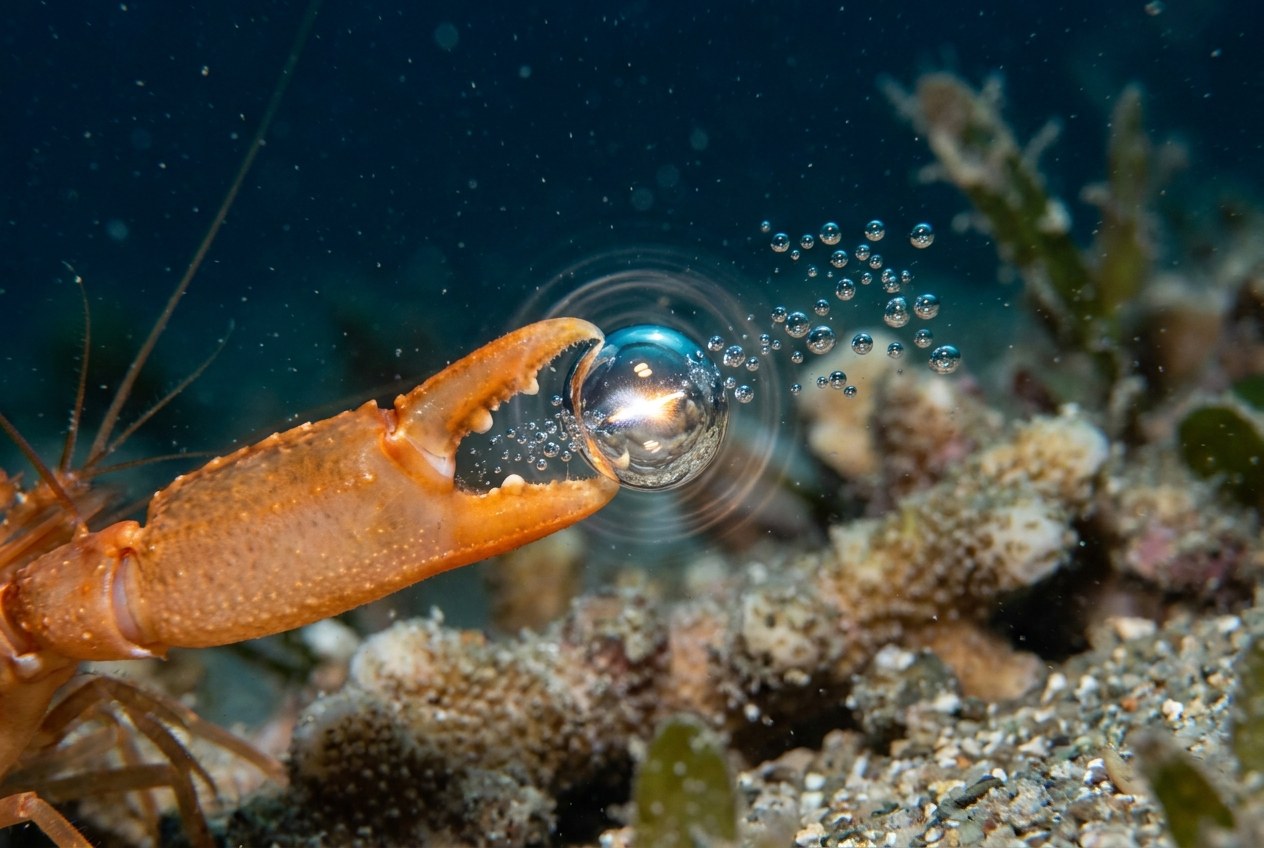
The tiny snapping shrimp Alpheus heterochaelis produces a deafening underwater snap that is actually caused by the rapid collapse of a cavitation bubble. This implosion generates shockwaves, a brief flash of light called sonoluminescence, and localized temperatures exceeding four thousand degrees Celsius, allowing the shrimp to stun or kill prey from a distance.
Published
Filed under
Byline
 Brainblast archive
AI-generated with OpenAI; reviewed by Brainblast
The fact
“The snapping shrimp does not stun its prey by clicking its claws together; instead, the physical action creates a high-velocity water jet that exceeds cavitation conditions. When this extremely fast water jet moves, it leaves a low-pressure void or vacuum bubble behind. As the surrounding ocean pressure forces this cavitation bubble to collapse, it implodes with spectacular energy. The implosion produces a loud acoustic snap exceeding two hundred decibels, a brief flash of light known as sonoluminescence, and temperatures inside the collapsing bubble that reach up to five thousand Kelvin—nearly as hot as the surface of the Sun. This intense release of heat, light, and pressure occurs in a fraction of a millisecond, creating a powerful localized shockwave that instantly paralyzes or kills small fish and crabs. This remarkable biological mechanism represents a stunning adaptation, showcasing how a tiny marine creature can harness the principles of extreme fluid dynamics and acoustic physics for survival.”
The snapping shrimp, belonging to the family Alpheidae and often referred to as the pistol shrimp, is one of the most remarkable creatures in the shallow temperate and tropical oceans. Growing to only three to five centimeters, this small crustacean possesses a disproportionately large claw measuring up to half of its body length. For decades, researchers assumed that the loud, metallic popping sound associated with colonies of these shrimp was produced by the physical contact of the two halves of their massive snapper claws striking each other. However, modern high-speed video photography and precise acoustic measurements have revealed a much more spectacular scientific truth. The deafening sound is not the result of claw-on-claw impact, but rather a violent, localized phenomenon of extreme physics known as hydrodynamic cavitation. When the pistol shrimp snaps its claw shut, it launches a high-velocity jet of water that acts as a physical projectile, tearing through the water and leaving a void of vapor in its wake. This biological mechanism demonstrates a highly sophisticated application of fluid dynamics, allowing a tiny marine invertebrate to weaponize pressure waves and harvest astronomical temperatures in the cold depths of the ocean.
At the heart of the pistol shrimp’s unique capability is a highly specialized plunger mechanism on its snapper claw. When the shrimp cocks its claw open, a latch system locks the muscle in place, storing elastic potential energy. When released, this biological spring snaps the claw shut with extreme speed, accelerating the plunger into a corresponding socket. This movement forces a stream of water out of a narrow channel at velocities exceeding twenty-five meters per second, or about ninety-seven kilometers per hour. By Bernoulli’s principle, as a fluid's velocity increases, its pressure decreases. In the case of the snapping shrimp’s water jet, the speed is so extreme that the pressure drops below the vapor pressure of seawater. This sudden localized drop in pressure causes the liquid water to rip apart, forming an expanding vapor-filled cavity or bubble. This process is known as hydrodynamic cavitation, and the resulting bubble is essentially a microscopic pocket of low-pressure vapor and vacuum. The creation of this bubble is a direct result of the shrimp's rapid claw movement, transforming mechanical muscle action into a highly kinetic hydraulic force.
As the water jet slows down and travels further from the claw, the surrounding ambient water pressure quickly overcomes the low pressure inside the bubble. This pressure differential causes the cavitation bubble to halt its expansion and begin a rapid, violent collapse. The rushing water filling the void moves inward at supersonic speeds relative to the gas inside, culminating in a violent implosion. It is this bubble collapse—and not the closing of the claw—that generates the characteristic loud snap of the pistol shrimp. Hydrophone measurements published in the journal Science (available at https://ui.adsabs.harvard.edu/abs/2000Sci...289.2114V/abstract) proved conclusively that the acoustic signature occurs exactly at the moment of bubble collapse, following the physical closure of the claw by a distinct delay. This collapse produces an intense shockwave with a peak acoustic pressure exceeding two hundred decibels, which is louder than a gunshot or a jet engine taking off. This shockwave is powerful enough to instantly stun, paralyze, or even kill small crabs, worms, and fish, allowing the shrimp to hunt prey safely from a distance.
In addition to the devastating acoustic shockwave, the collapsing cavitation bubble produces a fascinating phenomenon known as sonoluminescence, where sound waves are converted directly into light. During the final microsecond of the bubble's collapse, the gas inside is compressed so intensely that it reaches a state of high-density plasma. This extreme compression causes the pocket to emit an incredibly brief, nanosecond-long flash of light. The physical conditions inside the collapsing bubble at this exact moment are astronomical, with localized temperatures reaching up to five thousand Kelvin, which is approximately four thousand seven hundred degrees Celsius. As analyzed in Stanford University coursework on the energy physics of the pistol shrimp (found at http://large.stanford.edu/courses/2017/ph240/nag2/), this temperature is nearly identical to the effective surface temperature of the Sun. Although the flash of light is invisible to the naked eye without specialized equipment due to its microscopic scale and brief duration, it represents a remarkable instance of a living organism generating a localized plasma arc in the ocean.
The evolutionary advantage of this weapon is clear. Snapping shrimp use their shockwaves for territorial defense, communication, and hunting. When colonies of snapping shrimp gather, their collective snapping creates a constant crackling static that can completely disrupt underwater sonar communications and military submarine detection. Beyond natural history, the physics of snapping shrimp cavitation has profound applications for human technology. Engineers study these bubbles because cavitation is a major source of wear and tear on ship propellers and industrial pipes, causing severe erosion over time. By understanding how the shrimp controls this force, researchers hope to design more resilient marine components. Furthermore, medical researchers are exploring how to replicate this localized acoustic energy for non-invasive medical procedures. Controlled micro-cavitation is being studied as a potential method for targeted tumor destruction and drug delivery, showing how a tiny crustacean's survival mechanism could inspire breakthroughs in human healthcare.
Despite the astronomical temperatures generated inside the collapsing bubble, there are important material caveats to consider. The five thousand Kelvin temperature is extremely localized to the core of a microscopic bubble and lasts for less than a nanosecond. Because of this incredibly small scale and short duration, the total thermal energy released is tiny. The surrounding seawater acts as an immense heat sink, instantly dissipating the heat before it can boil the ocean or cook the shrimp's own claw. It is the physical pressure wave of the collapsing bubble, rather than the intense localized heat or the brief flash of sonoluminescence, that is responsible for stunning the prey.