According to General Relativity, massive rotating objects like Earth actually...
General relativity predicts that rotating masses drag nearby spacetime, and around Earth that tiny frame-dragging signal has been measured with orbiting gyroscopes and laser-ranged satellites.
Published
Filed under
Byline
 Brainblast archive
2026-03-06-16-46-26-fact.png (source: app assets)
The fact
“According to General Relativity, massive rotating objects like Earth actually "drag" the fabric of spacetime around with them as they spin, a phenomenon known as frame-dragging. This effect was verified by NASA's Gravity Probe B, proving that the vacuum of space behaves like a viscous fluid that gets twisted by the motion of matter. This warping of spacetime's geometry by rotation is a fundamental prediction of Einstein's theory that proves the universe itself can be "twisted" by the simple motion of a planet.”
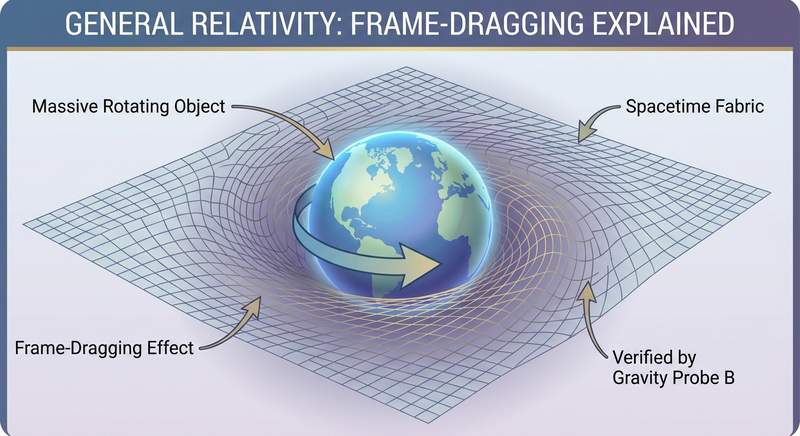
One of general relativity’s strangest predictions is that a spinning mass does not merely sit inside spacetime like a heavy bowling ball on a rubber sheet. Its rotation also drags nearby spacetime around with it. Einstein Online summarizes it cleanly: in general relativity, a mass’s rotation influences the motion of nearby objects, so the rotating mass “drags along” spacetime in its vicinity. This is the Lense–Thirring effect, often called frame-dragging (https://www.einstein-online.info/en/explandict/frame-dragging/).
That description is not just metaphor. In relativity, local inertial frames—the directions a freely moving object or ideal gyroscope “wants” to keep—are slightly twisted by the angular momentum of a rotating body. Around Earth the effect is tiny, which is why it took decades of instrument development and data analysis to test convincingly. But tiny is not the same as imaginary.
The highest-profile direct Earth test was Gravity Probe B. NASA’s summary of the mission says the spacecraft measured the precession of four exquisitely precise gyroscopes in polar orbit and, after a long and difficult analysis, reported a frame-dragging drift rate of −37.2 ± 7.2 milliarcseconds per year, compared with Einstein’s predicted −39.2 milliarcseconds per year (https://www.nasa.gov/image-article/results-implications/). That is an absurdly small motion—milliarcseconds are tiny fractions of a degree—yet it was large enough to emerge from the noise with enough care.
The accepted manuscript of the final Physical Review Letters paper gives the broader experimental context. Gravity Probe B placed cryogenic gyroscopes in Earth orbit specifically to test the geodetic and frame-dragging effects, and the final analysis reported values consistent with general relativity for both (https://link.aps.org/accepted/10.1103/PhysRevLett.106.221101). The frame-dragging signal was especially challenging because the spacecraft team had to model unexpected torques and other instrumental complications. So when people say “Earth drags spacetime around with it,” the claim is not based on a pretty theory alone. It comes with hard-won experimental numbers.
Gravity Probe B was not the only approach. Satellite laser ranging offered another route. A Physical Review Letters paper analyzing 13 years of LAGEOS tracking data reported a result with 99.8% agreement with Einstein’s theory for the relevant relativistic precession combination in Earth’s gravitational field (https://link.aps.org/doi/10.1103/PhysRevLett.105.231103). This is not identical to the gyroscope method, but that is the point: two very different experimental styles converged on the same underlying relativistic picture.
The phrase “dragging spacetime” can sound stronger than the actual local effect around Earth. Frame-dragging does not mean the atmosphere or oceans are being physically swirled by some newly discovered relativistic vortex. Newtonian gravity, fluid dynamics, and ordinary rotation dominate everyday terrestrial motion. Frame-dragging is a correction to inertial structure, not an extra hurricane engine. Around Earth, it is measurable only with exceptionally delicate instruments and long baselines.
But if the effect is so small here, why do physicists care so much? Because the same phenomenon becomes far more important near compact, rapidly rotating objects such as neutron stars, white dwarfs, and black holes. The Earth version is tiny enough to test carefully; the astrophysical version can shape accretion flows, orbital dynamics, and possibly the behavior of relativistic jets. Measuring it near Earth therefore does double duty: it verifies general relativity in a controlled setting and builds confidence in the stronger-gravity inferences astronomers make elsewhere.
There is also a useful conceptual payoff. Frame-dragging helps distinguish Einsteinian gravity from the simpler Newtonian picture. In Newtonian theory, the gravitational field of a mass does not care whether the mass is rotating. In general relativity, rotation matters. That means gravity is not just about where mass is, but also about how mass-energy moves. It is one of the reasons relativists sometimes use the analogy of “gravitomagnetism,” where moving mass plays a role loosely analogous to moving electric charge in electromagnetism (https://www.einstein-online.info/en/explandict/frame-dragging/).
Another caveat: “measured experimentally” does not mean the effect was observed with the simplicity of reading a thermometer. Gravity Probe B, in particular, became famous partly because the experiment was so difficult. The final uncertainty on the frame-dragging component was far larger than originally hoped. That does not invalidate the result; it just means the measurement was hard, subtle, and statistically constrained rather than cinematically obvious. This is normal for precision gravitational physics.
So the durable fact is accurate. According to general relativity, massive rotating bodies like Earth do drag nearby spacetime, and around Earth this frame-dragging signal has been measured using both orbiting gyroscopes and laser-ranged satellites (https://www.nasa.gov/image-article/results-implications/; https://link.aps.org/accepted/10.1103/PhysRevLett.106.221101; https://link.aps.org/doi/10.1103/PhysRevLett.105.231103).
It is one of those physics facts that somehow becomes more satisfying when the hype is reduced. Earth is not churning spacetime into a whirlpool you can feel. It is doing something subtler: twisting the local geometry of motion just enough that, with enough patience and engineering, the universe will confess that Einstein was right again.