The Large Hadron Collider is so sensitive that its operators...
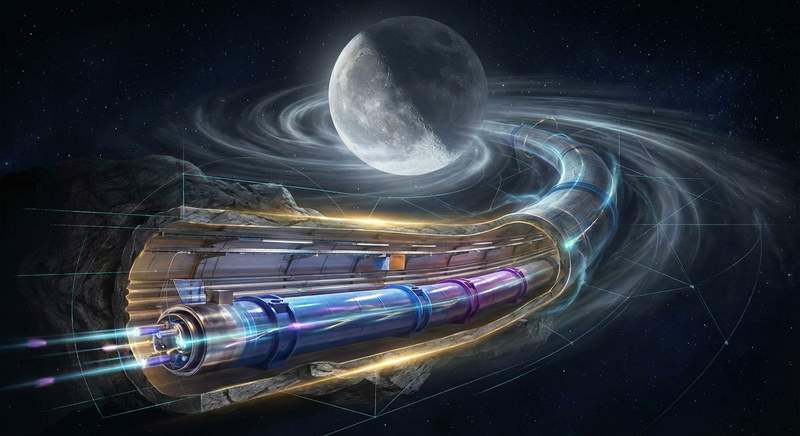
The LHC is precise enough that solid-Earth tides driven largely by the Moon and Sun subtly deform its 26.6-kilometer ring by about a millimeter, which is enough to matter for beam-energy calibration and precision measurements.
Published
Filed under
Byline
 Brainblast archive
2026-03-06-08-33-00-lhc-moon-gravity.png (source: app assets)
The fact
“The Large Hadron Collider is so sensitive that its operators must calibrate the high-energy beams to account for the Moon's gravity, which physically stretches the 27-kilometer circular tunnel by about one millimeter. This microscopic tidal distortion is enough to shift the energy levels of the accelerated stream, requiring constant adjustments to ensure the facility maintains the extreme precision necessary for research into the fundamental nature of the universe.”
The popular version of this fact is that the Large Hadron Collider is so precise that scientists have to “correct for the Moon.” That is basically true, but it needs a little tuning. What actually matters is solid-Earth tide: the slow flexing of Earth’s crust under the gravitational pull of the Moon and Sun. At the scale of a 26.6-kilometer accelerator ring, that flex is not academic. CERN’s own guide says the ground in the Geneva area can rise by about 25 centimeters during strong tidal alignments, and that this leads to a change of about 1 millimeter in the LHC’s circumference, enough to shift the beam energy measurably for precision work (https://cdarve.web.cern.ch/Publications_CD/CERN_brochure-2006-003-eng.pdf).
A millimeter sounds absurdly small compared with a machine that big. But the LHC is not a railroad loop where only rough alignment matters. It is a superconducting synchrotron that stores proton beams moving extremely close to the speed of light while magnets and radio-frequency systems keep those beams on a tightly controlled orbit. In that context, tiny geometric changes can affect orbit length, timing, and inferred beam energy. A broad review of modern colliders notes that the LHC’s orbit circumference slowly varies because of Earth tides by about 1.1 millimeters, a reminder that even the planet under the machine is part of the experimental environment (https://link.aps.org/accepted/10.1103/RevModPhys.93.015006).
This does not mean the tunnel visibly stretches like rubber every time there is a full Moon, and it does not mean lunar gravity alone is yanking proton beams off course in some dramatic way. The rock deformation is small, slow, and predictable. That predictability is the key. Precision accelerators already monitor and compensate for many effects: magnet drift, temperature changes, ground motion, power-supply fluctuations, and alignment errors. Tidal deformation is one more item on that list, but it is unusual because it comes from celestial mechanics rather than ordinary engineering noise.
The reason this matters scientifically is that some LHC measurements depend on knowing beam energy extremely well. CERN’s guide explains that the tidal change in circumference can produce beam-energy changes of a few tenths of one part in a thousand, while some measurements aim for precision an order of magnitude tighter than that (https://cdarve.web.cern.ch/Publications_CD/CERN_brochure-2006-003-eng.pdf). In other words, the effect is not large enough to shut the collider down, but it is large enough that ignoring it would blur the kind of fine-grained calibration high-energy physics cares about.
That fits with a wider accelerator-physics picture. A Physical Review D paper exploring whether circular accelerators might someday act as gravitational-wave observatories treats the LHC as a case study and casually notes that tides already deform the tunnel by about a millimeter over the course of a day (https://link.aps.org/doi/10.1103/PhysRevD.102.122006). The paper’s main subject is different, but the aside is revealing: if physicists are even discussing using accelerator timing to probe astrophysical spacetime ripples, then ordinary geophysical tides are unquestionably within the sensitivity range of the machine’s instrumentation and modeling.
It is also worth being precise about who or what is being “calibrated.” The LHC does not wait for a full Moon and then have a human operator turn a knob labeled LUNAR MODE. Instead, the accelerator is run with feedback systems, beam diagnostics, orbit corrections, and energy models that incorporate slow changes in the machine and its environment. The Moon becomes relevant because it contributes to a predictable deformation of the ground, and that deformation matters for how carefully scientists interpret the beam.
Another useful caveat: the effect is not unique to the LHC in principle. Any sufficiently large and sufficiently precise circular accelerator can feel Earth tides. The LHC is simply the most famous example because it is both enormous and extraordinarily exacting. Its ring is long enough for millimeter-level circumference changes to be meaningful, and its mission includes measurements where tiny systematic shifts matter. That combination turns a geophysical subtlety into an operational concern.
So the strongest accurate version of the claim is this: the LHC is precise enough that tidal deformation of Earth’s crust, driven largely by the Moon and Sun, changes the accelerator’s circumference by about a millimeter, and physicists must account for that effect in precision beam-energy work. That is slightly less cinematic than “the Moon stretches the collider,” but it is more impressive. It means the world’s biggest particle machine is precise enough that orbital mechanics, geology, and subatomic physics all meet in the same control problem.
Seen that way, the fact is a perfect LHC story. The collider is built to study quarks, bosons, and the deep structure of matter, yet to do that well it must also respect the slow breathing of the planet beneath Geneva. When your instrument is good enough, the universe does not stop at the edge of the tunnel.