Quantum entanglement is a profound phenomenon in physics where two...
Quantum entanglement is real and experimentally confirmed, but the careful version is that it produces correlations stronger than local hidden-variable theories allow, not a practical faster-than-light messaging channel.
Published
Filed under
Byline
 Brainblast archive
2026-03-06-20-33-00-quantum-entanglement.png (source: app assets)
The fact
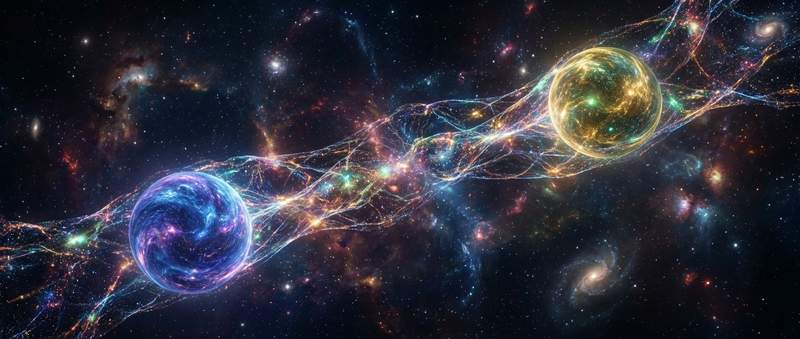
“Quantum entanglement is a profound phenomenon in physics where two subatomic particles become so deeply connected that the state of one instantly influences the other, regardless of the distance between them. This 'spooky action at a distance,' as Albert Einstein famously called it, means that information seems to be transferred faster than the speed of light, challenging our classical understanding of time and space. Even if these entangled particles are separated by billions of miles, a measurement of one will immediately determine the state of its distant partner. This fundamental property of the quantum world is the core principle behind the development of next-generation computers and ultra-secure communication networks. Scientists have successfully demonstrated entanglement between particles on the ground and those in orbiting satellites, proving that this connection persists across thousands of miles. It reveals a hidden level of interconnectedness in the fabric of the universe that remains one of the greatest mysteries in modern science.”
Quantum entanglement deserves its reputation as one of physics’ strangest ideas, but it is usually described too sloppily in pop-science one-liners. The robust claim is that two or more particles can share a joint quantum state whose measurement outcomes are correlated in ways that cannot be explained by ordinary local hidden-variable pictures. The sloppy claim is that entanglement lets one particle “send information instantly” to another across the universe. Modern physics strongly supports the first statement and rejects the second.
Caltech’s quantum explainer puts the central phenomenon plainly: when particles become entangled, measurements on them exhibit correlations that persist even when the particles are widely separated (https://scienceexchange.caltech.edu/topics/quantum-science-explained/entanglement). NASA’s overview makes the same basic point in more public-facing language, emphasizing why Einstein found it so unsettling and why it remains central to quantum science today (https://science.nasa.gov/what-is-the-spooky-science-of-quantum-entanglement/).
The reason this matters is not just that the particles appear “connected.” The deeper issue is that quantum mechanics predicts specific statistical correlations between distant measurements, and those correlations can exceed what any local realist theory would allow. That is where Bell’s theorem enters the story. Bell showed that if physical properties are predetermined in a local way, then the correlations must obey certain inequalities. Quantum theory predicts violations of those inequalities for suitably entangled systems.
Experiments have repeatedly found those violations. A landmark 2015 Physical Review Letters paper reported a significant loophole-free Bell test using entangled photons, closing the most important loopholes simultaneously and showing results incompatible with local realism (https://link.aps.org/doi/10.1103/PhysRevLett.115.250401). That is why entanglement is no longer treated as a philosophical quirk. It is an experimentally verified feature of nature.
So why do people keep saying it means faster-than-light communication? Because the correlations are immediate in the sense that once both measurements are compared, the outcomes line up in a way classical intuition does not like. If two entangled particles are measured far apart, the paired results are linked even though no ordinary prearranged hidden script can reproduce the data. That is the “spooky” part.
But spooky is not the same thing as a superluminal text message. Caltech explicitly notes that entanglement cannot be used to send faster-than-light communications (https://scienceexchange.caltech.edu/topics/quantum-science-explained/entanglement). The crucial reason is that each local measurement outcome is individually random. You cannot choose the result on your side in a way that encodes a message for the distant observer. Only later, when results from both sides are brought together through an ordinary classical channel, do the correlations become evident.
That distinction is easy to miss because the language of “one particle instantly affects the other” is a dramatic shortcut. It gestures toward the weirdness, but it can imply a mechanistic picture physicists do not actually use. In the standard view, entangled particles are described by one shared quantum state. Measurement outcomes on each side are correlated because the full state is correlated, not because a usable signal visibly shoots from A to B at the moment of measurement.
NASA’s explainer is helpful on the historical puzzle—it captures why Einstein and others were alarmed by the idea and why Bell later supplied a way to test it—but it should be paired with the clearer no-signalling caveat from Caltech if you want the careful version (https://science.nasa.gov/what-is-the-spooky-science-of-quantum-entanglement/; https://scienceexchange.caltech.edu/topics/quantum-science-explained/entanglement).
There is another common overstatement worth trimming: entanglement is not just about “two particles that always mirror each other.” Depending on the state and the measurement settings, the correlations can be subtler than simple opposite answers. What matters is the structure of the joint probabilities. Entanglement is a property of the combined quantum state, not merely a magical synchronized behavior.
It is also not fragile nonsense that exists only in thought experiments. Entanglement is now a working resource in laboratories. It underpins quantum key distribution schemes, quantum teleportation protocols, parts of quantum sensing, and the logic of quantum computing architectures. Those technologies do not work because entanglement breaks relativity. They work because quantum correlations can be harnessed without enabling faster-than-light signalling.
Even the phrase “across any distance” needs a bit of care. In principle, entanglement can persist over long distances, and experiments have demonstrated it over increasingly large separations. In practice, maintaining entanglement is technically demanding because environmental interactions cause decoherence. The effect is real, but not effortless.
So the fact survives, once translated out of sci-fi mode. Entanglement is a genuine quantum phenomenon in which separated particles can exhibit correlations that no local hidden-variable model can explain, and careful Bell tests have confirmed that nature behaves this way (https://link.aps.org/doi/10.1103/PhysRevLett.115.250401). What it does not give us is a way to send a controllable message faster than light (https://scienceexchange.caltech.edu/topics/quantum-science-explained/entanglement).
That is almost more interesting than the myth. The universe really does allow correlations that are deeper than classical common sense expects. It just refuses to let us turn that weirdness into a cosmic cheat code.