Fetal Cells Really Can Persist in Mothers for Decades—But Their Role Is More Complicated Than “Built-In Repair Kits”
Fetal microchimerism is a real and well-studied phenomenon in which fetal cells cross the placenta and can remain in the mother long after pregnancy. The careful version of the fact is that these cells have been detected in blood and multiple tissues for years or decades, but their biological effects are still being investigated and may involve immune tolerance, repair, bystander persistence, or in some cases links to disease.
Published
Filed under
Byline
 Brainblast archive
2026-03-06-01-33-00-microchimerism-fetal-cells.png (source: app assets)
The fact
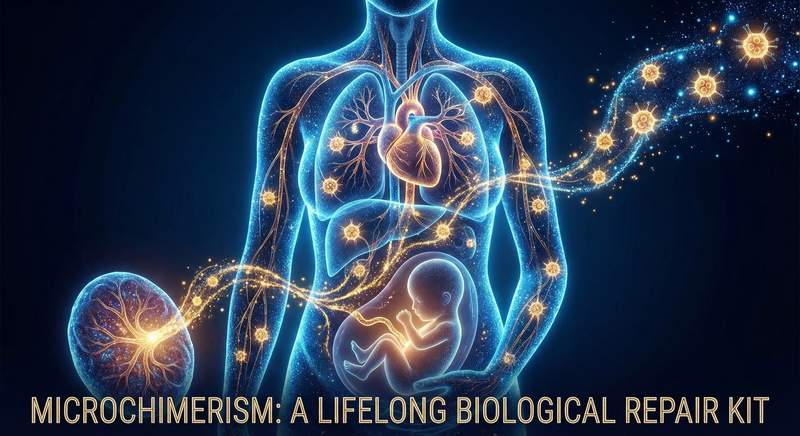
“During pregnancy, fetal cells frequently migrate across the placenta and integrate into the mother's organs, such as her heart and lungs, where they can persist for decades. Known as microchimerism, this phenomenon essentially makes mothers biological chimeras who carry their children's living cells long after birth. Research suggests these foreign cells may even migrate to sites of injury to assist in tissue repair, effectively acting as a lifelong biological repair kit from the child to the mother.”
The striking part of the claim is true: during pregnancy, fetal cells can cross into the mother’s body and some can remain there for years or even decades. Scientists call this fetal microchimerism. The review “Cell Migration from Baby to Mother” says fetal cells migrate into the mother during pregnancy, likely in all pregnancies, and can persist for decades. The classic persistence paper at PMC goes even further, reporting male fetal progenitor cells in maternal blood as long as 27 years postpartum. So the basic phenomenon is not internet fluff. It is a durable part of human biology.
What needs correction is the dramatic gloss sometimes piled on top. Viral retellings often say these cells “integrate into the mother’s organs as a lifelong repair kit from the child.” That is too confident. The 2007 review notes that fetal microchimeric cells have been found in blood, bone marrow, skin, and liver, and that in mice they have also been found in the brain. It also says these cells appear to target sites of injury. But “appear to” is not the same as “have been proven to act as a dedicated repair crew.”
The persistence itself is the most solid part of the story. The 1996 paper hosted at PMC analyzed blood samples and found evidence of male fetal cells lingering long after earlier pregnancies, including in one woman whose last son had been born 27 years before sampling. That is an extraordinary result because it shows pregnancy can establish a long-term low-grade chimeric state. In other words, a mother may continue carrying a small population of genetically distinct cells from a child long after delivery.
The term “microchimerism” is useful here because it keeps the scale honest. This is not a second body growing inside the first one, and it is not a comic-book fusion event. It is a tiny population of genetically distinct cells. The Cincinnati Children’s explainer says fetal microchimeric cells can be found in virtually all maternal tissues after pregnancy, but it also presents them as exceptionally rare and biologically puzzling. Rare is the operative word.
Why scientists care so much is that these cells may do more than merely persist. The review article says fetal cells may influence immune status, autoimmunity, tolerance, and perhaps tissue repair. Cincinnati Children’s emphasizes research suggesting persistent fetal cells may help mothers “remember” previous pregnancies so the immune system better tolerates future fetuses with paternal traits. That is fascinating, but it is still a field of active investigation rather than a fully settled user manual.
This is where the caveats matter most. Microchimeric cells have been linked in different studies to seemingly opposite possibilities: beneficial repair, harmless persistence, and potential involvement in disease. The 2007 review explicitly discusses hypotheses ranging from tissue repair to immune consequences and possible roles in autoimmune conditions. That means you cannot honestly present fetal cells as either miracle healers or clear villains. The science is more interesting because it is unresolved.
Another nuance is that not every detected fetal cell is necessarily doing the same thing. Cincinnati Children’s notes that researchers continue to investigate which microchimeric cells affect the immune system across generations and which may have other still-unexplained roles. That is a reminder that “fetal cells in maternal tissues” is not a single simple phenomenon. Different cell types may persist for different reasons and behave differently depending on tissue and context.
The placenta, meanwhile, is not an absolute wall. The review explains that small numbers of cells traffic across the placenta in both directions during pregnancy. That bidirectional exchange helps explain why pregnancy can leave a biological trace in both mother and child. Cincinnati Children’s even notes that children also carry maternal cells, which widens the story beyond the mother-only version people usually hear.
So the repaired fact is still powerful. Pregnancy really can leave fetal cells in a mother’s body for decades, as supported by the long-term persistence study and the broader review on baby-to-mother cell migration. But the careful language is that these cells may contribute to immune tolerance, injury response, or other biological effects that are still being sorted out, as Cincinnati Children’s explains. That is more scientifically honest than calling them a magical repair kit—and honestly, it is still pretty amazing.