The human liver is the only internal organ capable of...
The liver has an extraordinary ability to restore lost mass after injury or surgery, but the popular claim needs caveats: it usually regenerates by compensatory growth of the remaining tissue rather than by perfectly re-forming missing lobes.
Published
Filed under
Byline
 Brainblast archive
2026-03-06-11-33-00-human-liver-regeneration.png (source: app assets)
The fact
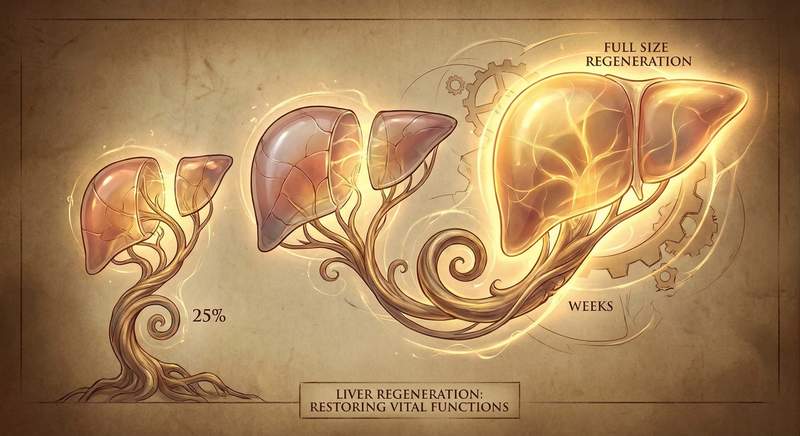
“The human liver is the only internal organ capable of complete natural regeneration, allowing it to regrow to its full size from as little as 25% of its original tissue. This remarkable process can occur in just a few weeks, as the remaining cells rapidly multiply to restore the organ's vital metabolic and detoxifying functions.”
The liver’s regenerative ability is real, but the viral version of the fact needs some cleanup. People often say the liver is “the only internal organ that can completely regenerate from 25% of itself.” The safe version is this: the liver is uniquely good among solid internal organs at restoring functional mass after injury or surgical removal, sometimes after very large losses of tissue. NIH notes that a liver can regrow to a normal size even after up to 90% of it has been removed in experimental settings, which is extraordinary by any standard (https://www.nih.gov/news-events/nih-research-matters/cells-maintain-repair-liver-identified).
But “regrow” does not always mean what people imagine. In classic liver regeneration after partial hepatectomy, the missing lobes do not literally sprout back in the same shape like a salamander regrowing a limb. A long-running clinical and biological literature describes the process mainly as compensatory hyperplasia and some transient hypertrophy: the remaining liver tissue enlarges and proliferates until total liver mass is restored (https://pmc.ncbi.nlm.nih.gov/articles/PMC3091032/; https://pmc.ncbi.nlm.nih.gov/articles/PMC5352916/). So the organ’s function and mass can come back impressively well even if the exact original architecture does not reappear lobe-for-lobe.
That distinction matters because the liver is famous partly for mythology. The ancient Greeks made Prometheus’s liver the organ that could be eaten daily and return. Modern biology does not make the story less amazing, only more precise. After a major resection, quiescent liver cells re-enter the cell cycle, divide, and rebuild tissue mass on a surprisingly fast timetable. In one review of extensive liver resection, liver size and DNA content were largely recovered within about 10 days in the rat partial-hepatectomy model, and the authors concluded that hyperplasia is the main driver of mass restoration rather than simple cell swelling (https://pmc.ncbi.nlm.nih.gov/articles/PMC5352916/).
At the cellular level, newer work has refined the picture. A 2021 Science study found that midlobular zone 2 hepatocytes are a major source of new hepatocytes during normal homeostasis and regeneration, helping settle an argument over whether rare stem-like cells or ordinary hepatocytes do most of the rebuilding (https://www.science.org/doi/10.1126/science.abb1625). NIH’s summary of that work emphasized both the liver’s unusual regenerative power and the fact that it still relies heavily on ordinary hepatocytes, not magic reserve tissue (https://www.nih.gov/news-events/nih-research-matters/cells-maintain-repair-liver-identified). That is an important update to the old “the liver just grows back” slogan: it grows back through coordinated, zoned biology.
The claim that the liver is the “only” internal organ capable of natural regeneration is also a little slippery because it depends on definitions. Many tissues regenerate to some degree: skin, blood, intestinal lining, and even some parts of other organs can repair themselves. What makes the liver stand out is the scale and reliability with which a mature solid internal organ can restore lost tissue mass while continuing to perform life-sustaining metabolic functions. In everyday language, calling it uniquely regenerative is fair. In strict biological language, it is better to say the liver is exceptional rather than absolutely alone.
There are more caveats. Regeneration is not guaranteed in every circumstance. Chronic liver disease, cirrhosis, cancer, viral hepatitis, alcohol-related injury, fatty liver disease, and toxin damage can all overwhelm or distort the process. NIH explicitly warns that the liver is not invincible and that many patients still progress to liver failure or require transplant despite this natural repair capacity (https://www.nih.gov/news-events/nih-research-matters/cells-maintain-repair-liver-identified). So the liver’s reputation should not be confused with unlimited self-healing.
The “25%” part of the popular fact is similarly context dependent. Surgeons and experimental biologists have long known that a liver remnant can be surprisingly small and still expand, provided blood supply, anatomy, and patient condition are favorable. But exact percentages vary with species, health status, and clinical context. A healthy donor in a transplant program is not the same as a patient with chronic liver disease, and neither is identical to a laboratory animal after standardized surgery. The broad truth is robust even if the meme-level number is too neat.
Why can the liver do this at all? Part of the answer is evolutionary pressure. The liver is central to detoxification, nutrient processing, protein synthesis, bile production, and metabolic buffering. Because it is constantly exposed to dietary chemicals, microbial products, and metabolic stress, organisms likely benefit from an organ that can absorb injury and still recover. Yet even with that adaptive design, regeneration requires intricate control. The liver has to know when to start proliferating, which cells should divide, how much growth is enough, and when to stop. Reviews still describe those stop-and-go signals as only partly understood (https://pmc.ncbi.nlm.nih.gov/articles/PMC3091032/).
So the best version of the fact is not that the liver is a perfect self-copying machine. It is that the liver has a remarkably strong ability to restore lost functional mass, far beyond what most solid internal organs can manage, usually through compensatory growth of the tissue that remains. That is less tidy than the one-line meme, but it is biologically sharper—and honestly, still pretty wild. If any organ deserves its mythic reputation, the liver is the one.