Plants Can Send Electrical Warnings—With Limits
Researchers have shown that touching plants can transmit stress-related electrical and chemical signals between individuals, even across species. The result is real, but it is not plant conversation in the human sense: it depends on specific experimental setups and appears to pass warning-state information rather than symbolic messages.
Published
Filed under
Byline
 Brainblast archive
2026-03-02-10-18-00-plant-electrical-signals.png (source: app assets)
The fact
“Plants can communicate with each other via electrical signals sent through their leaves—even across different species. Research from the University of Warsaw and University of Missouri demonstrates 'network-acquired acclimation' (NAA), where stressed plants emit electrical signals that trigger survival responses in neighboring plants, allowing entire plant communities to collectively prepare for threats like herbivory or drought.”
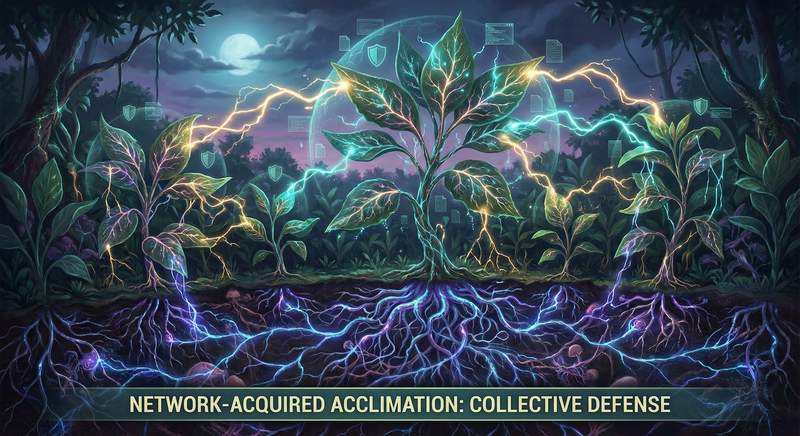
When people hear that plants “talk,” the phrase usually refers to airborne chemicals or underground fungal links. What made the 2022 study Aboveground plant-to-plant electrical signaling mediates network acquired acclimation so surprising is that it described something more direct: leaves in physical contact could transmit stress-associated signals from one plant to another. The accompanying commentary Sending out an SOS: Direct plant-to-plant communication mediates network acquired acclimation summarizes the result clearly: touching plants can pass along warning signals involving electrical activity, reactive oxygen species, and calcium-linked processes.
In the experiments, wounding or high-light stress applied to one dandelion leaf triggered a traveling response. The main paper reports that the signal did not stay confined to the injured plant. If a neighboring plant touched it under the right conditions, the response spread into that second plant, changing photosynthetic and physiological behavior there as well. Even more interestingly, the authors found that similar effects could move across a chain of connected plants, giving rise to what they called network-acquired acclimation, or NAA.
This is not just a cute metaphor. Electrical signaling in plants is already a well-established internal phenomenon. Injury, heat, and other stresses can alter ion-channel activity and create electrical waves within a plant’s tissues. The commentary article explains that the new work extends that idea outward, showing that neighboring plants can become part of a signal network when leaves are connected by touch and moisture. In some setups, the researchers even reproduced parts of the effect with a copper wire, supporting the idea that electrical signaling is central.
That said, this does not mean plants are chatting in sentences. The safest interpretation is that plants can transmit state information: danger, stress, or acclimation cues. The Missouri research summary is helpful here because it frames reactive oxygen species and related signals as indicators of plant stress rather than mystical language. A receiver plant is not hearing a detailed story. It is being pushed toward a defensive physiological state.
The conditions also matter a lot. The main paper specifically examined plants that were physically connected, often through a drop of water or humid contact at the leaf surface. That is different from claiming any two plants in a field automatically maintain a constant electrical conversation through open air. It is a proof of mechanism, not a declaration that every meadow is a silent telephone network all the time.
The finding is still impressive because it expands how we think about plant communities. Plants were already known to use volatile compounds aboveground and mycorrhizal or root-associated pathways belowground. Now the commentary at PMC suggests direct contact between leaves can add another communication route. In dense stands where leaves touch frequently, that may let stress responses ripple across neighbors faster than we once assumed.
Researchers are interested in this for more than philosophical reasons. The Missouri article connects plant stress signaling to crop losses under combined heat, drought, and flooding pressures. If scientists learn how stress signals spread and how plants maintain optimal reactive oxygen species levels, they may eventually improve monitoring or resilience in agriculture. The work does not immediately translate into smarter crops, but it sharpens the map of how plant stress biology functions.
There is also a caution against overselling it. Viral retellings often leap from “plants transmit electrical signals” to “plants feel pain” or “plants think like animals.” The study does not show that. It shows signal propagation, acclimation, and measurable responses in neighboring plants. Those are serious biological findings, but they are not evidence of human-style consciousness or language.
So the best version of the claim is both cooler and more precise. Plants can directly pass electrical and associated warning signals to neighboring plants when their leaves touch, as shown in the original study and explained in the accompanying commentary. The Missouri stress-signaling overview helps place that discovery in a broader stress-biology context. Plants are not gossiping. But they are, under the right circumstances, sharing trouble fast enough for neighbors to prepare.