The Transgenic Venus Flytrap Uses a Calcium-Based Molecular Clock to Remember and Count Prey Touches
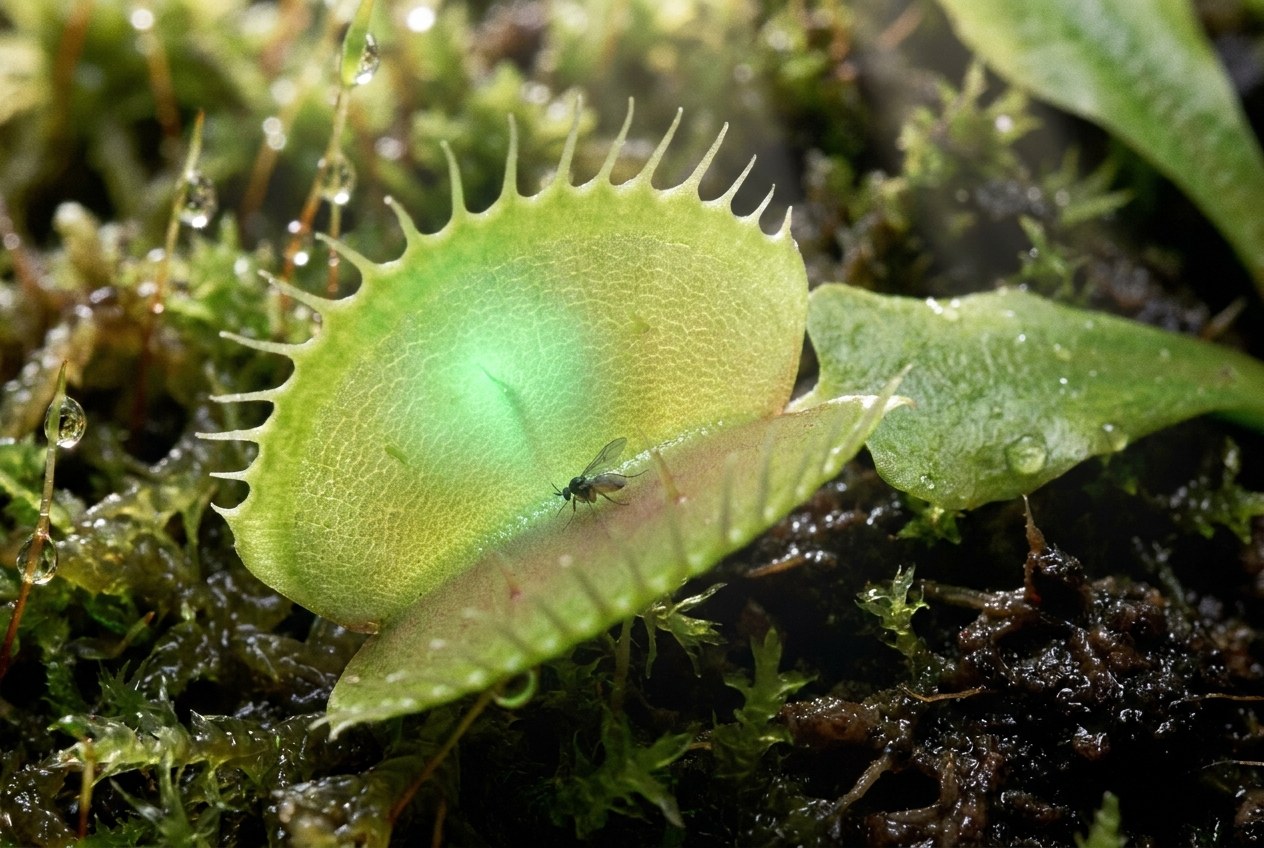
A landmark study using transgenic Venus flytraps engineered to glow in the presence of calcium reveals that the plant’s short-term memory is powered by a calcium clock. Each touch of its sensory hairs triggers a surge of calcium; if a second touch occurs within thirty seconds, the levels accumulate to cross a critical threshold, snapping the trap shut.
Published
Filed under
Byline
 Brainblast archive
AI-generated with OpenAI; reviewed by Brainblast
The fact
“The Venus flytrap (Dionaea muscipula) lacks a brain and nervous system, yet it can count to five and remember mechanical stimuli. Using transgenic flytraps engineered to produce a green-glowing sensor protein in the presence of calcium, researchers have visualized how this plant stores memories. Each time an insect brushes against one of the trap's tiny trigger hairs, it fires an electrical action potential that releases a surge of intracellular calcium. This calcium acts as a short-term molecular memory. Over the next thirty seconds, the calcium concentration slowly decays back to its baseline. If a second touch occurs before this wave subsides, the new calcium influx adds to the residual calcium, crossing a critical threshold that triggers the trap's rapid closure. If thirty seconds pass without a second stimulus, the memory is erased, and the count resets. This calcium clock ensures the plant only reacts to live, moving prey, conserving vital energy.”
Among the many wonders of the natural world, carnivorous plants occupy a uniquely fascinating niche. Lacking a brain, a central nervous system, or muscle tissues, these predatory plants have evolved sophisticated physical and chemical mechanisms to hunt, capture, and digest animal prey. The most iconic of these is the Venus flytrap (Dionaea muscipula), a small plant native to the subtropical wetlands of North and South Carolina. For centuries, scientists have been mesmerized by the flytrap's rapid-closing, jaw-like leaves, which snap shut in a fraction of a second to trap unsuspecting insects. Even more astonishing is the plant's ability to "remember" and "count" mechanical stimuli. If an insect touches a single sensory hair on the inside of the trap, nothing happens. But if the insect touches the same hair, or a different hair, a second time within about thirty seconds, the trap snaps shut. This short-term memory ensures that the plant does not waste precious photosynthetic energy by closing its trap in response to non-prey stimuli, such as falling raindrops or windblown debris.
While the behavior of this thirty-second memory window has been documented for decades, the underlying molecular mechanism has long remained an intriguing biological mystery. How can a plant without a brain store a short-term memory of an electrical stimulus and recall it to make a decision? In a groundbreaking study published in the journal Nature Plants, a collaborative research team has finally revealed the secret: the Venus flytrap’s memory is powered by a microscopic, intracellular calcium clock.
To prove this hypothesis, a team of scientists led by developmental biologist Mitsuyasu Hasebe of the National Institute for Basic Biology in Okazaki, Japan, and biophysicist Rainer Hedrich of the University of Würzburg in Germany, succeeded in genetically engineering transgenic Venus flytraps that produce a specialized green-glowing sensor protein called GCAMP. This genetically encoded calcium indicator lights up fluorescent green when the concentration of cellular calcium ions exceeds a critical threshold. By engineering this visual sensor directly into the flytrap's tissue, the researchers were able to literally watch the plant's memory in action, as reported in a detailed article by Science News.
The resulting experiments with these glowing, transgenic plants revealed a beautiful, dynamic coordination between electrical and chemical signals. When a microscopic prey insect brushes against one of the three tiny, rigid trigger hairs located on the inner surface of each leaf lobby, it converts the mechanical force into an electrical wave called an action potential. This action potential ripples outward across the entire trap structure in a flash. The transgenic sensor showed that as this electrical wave travels, it triggers a sudden, dramatic flood of calcium ions into the cells at the base of the trigger hair, which then spreads like a glowing green wave across the rest of the leaf.
However, this chemical calcium surge is a temporary phenomenon. Almost as soon as the calcium levels peak, they begin to slowly decay and fade away, returning to the plant's resting baseline over the course of about thirty seconds. If no further stimulus occurs, the calcium wave completely dies down, the memory of the first touch is erased, and the plant's internal count resets. But if a second mechanical touch occurs within that thirty-second window—while the first wave of calcium is still decaying—the trigger hair fires a second action potential. This second potential releases a new surge of calcium into the cells. Because the first calcium wave has not fully subsided, the new calcium influx is added to the residual calcium. This cumulative concentration successfully crosses a critical threshold, triggering calcium-dependent cellular processes that rapidly reshape the water pressure in the leaf cells, causing the trap to snap shut in a blink.
As explained in an official University of Würzburg Research Release, the passing action potential is essentially stored in the cells in the form of a transient calcium concentration. The calcium clock operates as a biophysical calculator, accumulating individual signals and translating them into a physiological action. Remarkably, the plant's counting ability does not stop at two. In response to subsequent action potentials from an enclosed, struggling insect, the flytrap increases the production of the hormone jasmonate. From the fifth electrical excitation onward, the plant activates genes that produce digestive enzymes to decompose the prey and synthesize transport proteins to absorb the nutrient-rich meal.
While this research provides a stunning breakthrough in our understanding of plant intelligence, material caveats remain. Although scientists have successfully mapped the calcium accumulation that controls the memory and counting mechanism, the exact mechanical link between the crossing of the calcium threshold and the physical, rapid snapping of the trap's curved leaves is still not fully understood. Furthermore, understanding the precise mechanics of how the plant continues its count from two to five remains an active area of scientific inquiry.
The discovery of the Venus flytrap’s calcium clock has profound implications beyond botany. It demonstrates a highly elegant, brainless model of information processing and memory storage. By studying how a simple plant uses transient ion concentrations to perform logical counting and decision-making, materials scientists and computer engineers are gaining inspiration for bio-inspired computing. This research could pave the way for energy-efficient, soft-robotic sensors and molecular computers that process information without relying on traditional silicon chips, demonstrating once again that nature's quietest organisms are often home to the most sophisticated engineering.