The Metallic Blue Marble Berry Uses Structural Color to Become Nature's Brightest Fruit
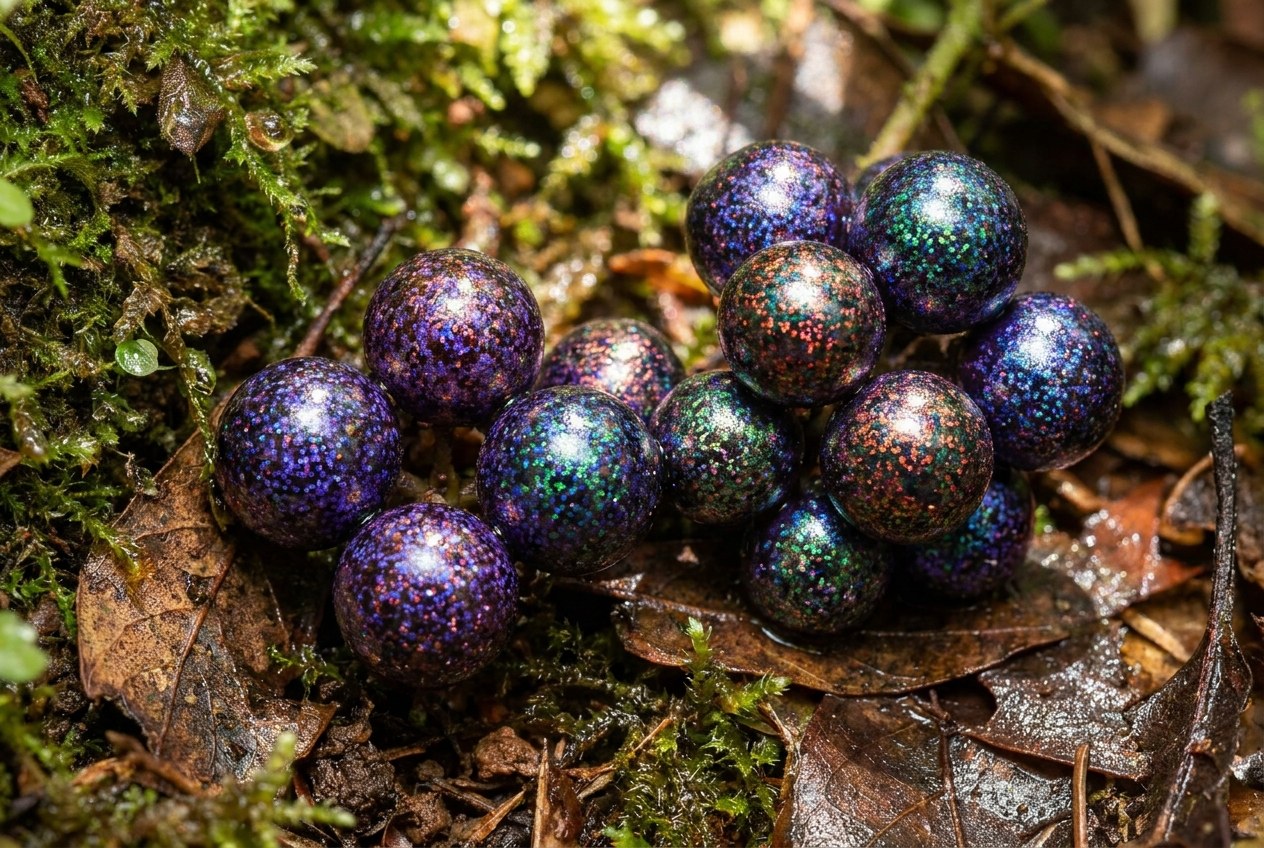
The understory African plant Pollia condensata produces marble-like berries that are the brightest biological structures known in nature. Eschewing traditional organic pigments, these fruits achieve their brilliant, metallic blue iridescence through microscopic layers of helical cellulose in their cell walls that selectively reflect intense light.
Published
Filed under
Byline
 Brainblast archive
AI-generated with OpenAI; reviewed by Brainblast
The fact
“The fruit of the perennial African herb Pollia condensata, commonly known as the marble berry, is the brightest biological material ever discovered. Unlike almost all other plants and animals, which rely on organic chemical pigments for color, this plant contains no blue pigment whatsoever. Instead, its metallic coloration is generated entirely by structural coloration, resulting from the physical arrangement of cellulose microfibrils in the epicarp cell walls. These fibrils are stacked helically in multilayered sheets that function as Bragg reflectors, selectively bouncing back intense blue light. Because this structural color is generated physically rather than chemically, it never degrades or fades over time. Researchers studying historical specimens in museum archives discovered that Pollia condensata berries collected in the nineteenth century remained just as vibrant and intensely reflective as fresh fruits grown today, demonstrating a completely permanent biological paint.”
In the dense forest understories of tropical Africa, ranging from the Ivory Coast to Ethiopia and southward to Mozambique, grows a low-key, perennial herbaceous plant called Pollia condensata. To a casual observer walking through the rainforest, the plant might seem like just another forest-floor green. However, upon closer inspection, Pollia condensata reveals a secret that has fascinated botanists, physicists, and materials scientists alike: it produces small, sphere-like, metallic blue fruits that have been scientifically verified as the brightest biological structures on Earth.
Commonly known as the marble berry, these fruits have an extraordinary appearance that looks more like polished metal or glittery beads than typical organic plant material. What makes this plant truly mind-blowing, however, is not just its sheer brightness, but the physics of how that color is generated. Virtually every color we see in the plant kingdom—from the green of chlorophyll to the deep reds and purples of anthocyanins—is the result of chemical pigments. Pigments work by absorbing specific wavelengths of light and reflecting others. But Pollia condensata contains absolutely no blue pigment. If you were to chemically extract the juices from its skin, you would find no blue dye at all.
Instead of chemistry, the marble berry utilizes pure physics to create its coloration. This phenomenon is known as structural coloration. While structural coloration is well-known in the animal kingdom—giving peacocks their iridescent feathers, chameleons their shifting skin, and morpho butterflies their brilliant wings—it is exceptionally rare and highly advanced in plants.
The secret of the marble berry's brilliance lies within the microscopic architecture of its outer cells. According to a seminal study published in the Proceedings of the National Academy of Sciences (PNAS), the outer layer of the fruit, called the epicarp, is made of cells with thick walls composed of cellulose microfibrils. These microfibrils are not laid down randomly; instead, they are arranged in parallel layers that rotate slightly with each subsequent layer. This forms a helicoidal, screw-like structure known as a Bouligand-type geometry.
When sunlight hits these layered cell walls, it undergoes a process called Bragg reflection. Because the distance between the layers is precisely matched to the wavelength of blue light, the structure acts as a natural mirror, constructively interfering with and reflecting back a highly concentrated, vivid blue beam. Furthermore, the helicoidal twist of the cellulose fibers means that the reflected light is circularly polarized—specifically, left-handed circularly polarized.
What is even more fascinating is the pointillist or pixelated nature of this color. The cell walls of the epicarp are not perfectly uniform across the entire fruit. In some cells, the cellulose layers are slightly thicker, while in others they are slightly thinner. Because the thickness of these layers dictates the specific wavelength of light reflected, individual cells actually reflect different colors. Cells with thinner layers reflect deep violet or blue, while those with thicker layers reflect green or red. When viewed with the naked eye, these individual colored pixels blend together to produce a shimmering, iridescent, pointillist effect that appears metallic and incredibly intense. This research, co-led by Dr. Beverley Glover and Dr. Silvia Vignolini, was detailed in an official University of Cambridge Research Release.
One of the most remarkable properties of structural color is its absolute permanence. Chemical pigments are organic molecules that naturally break down and degrade when exposed to sunlight, oxygen, and time. This is why a blue berry turns brown when dried or left out. However, because structural color is generated by the physical shape and layout of cellulose—a highly durable carbohydrate—it does not decay as long as the cell structure remains intact. During their research, the scientists analyzed historical samples of Pollia condensata from the Kew Gardens herbarium collections dating back to the mid-nineteenth century. They discovered that these dried specimens, over one hundred years old, were just as bright, shiny, and metallic blue as fresh berries picked yesterday.
Why would a plant invest so much evolutionary energy into creating such an elaborate, bright, and permanent coloring structure? The answer lies in its survival and reproduction strategy. The marble berry does not offer any nutritional value; it is dry and hard inside, consisting almost entirely of seeds. Under normal circumstances, plants entice animals to eat their fruit and disperse their seeds by offering them sweet, nutritious pulp. Pollia condensata has found a clever way to cheat this system. Birds are naturally drawn to bright, shiny, and metallic objects, which they often use to decorate their nests, attract mates, or display status. By mimicking a highly attractive, nutritious-looking berry, the plant tricks birds into picking and carrying the fruits away, achieving seed dispersal without wasting any photosynthetic energy on sugary flesh.
The discovery of the marble berry’s structural coloration has profound implications for human technology. By studying how nature creates intense, non-fading colors using nothing but sustainable, abundant cellulose, materials scientists are working to develop bio-inspired alternatives to toxic chemical dyes. This could lead to environmentally friendly paints, security paper that cannot be counterfeited, and non-toxic food colorings that never lose their luster, showing once again that the most advanced technologies are often already growing quietly on the forest floor.