A Blue Whale Heart Is Huge—But “Small Car” Is a Rough Analogy
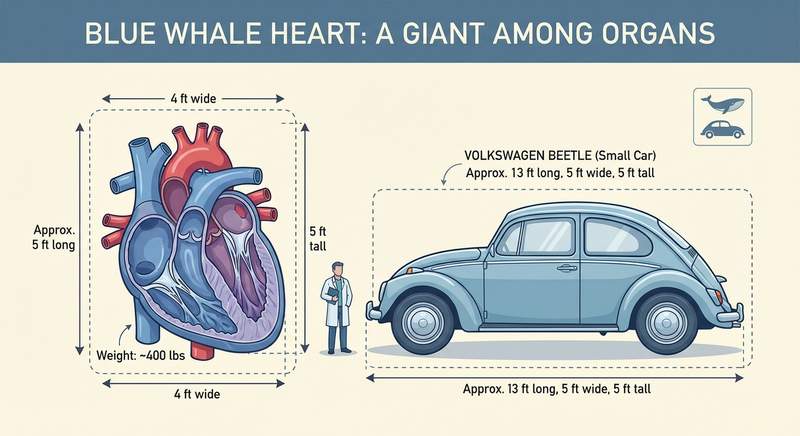
Blue whale hearts really are enormous, but the viral comparison works best as a scale metaphor, not a precise measurement. Credible educational sources put a blue whale heart at roughly 400 pounds and about 5 by 4 by 5 feet—vast, but not literally the size of a Volkswagen Beetle.
Published
Filed under
Byline
 Brainblast archive
2026-03-06-16-44-05-fact.png (source: app assets)
The fact
“A blue whale's heart is about the size of a small car—roughly 5 feet long, 4 feet wide, and 5 feet tall, comparable to a Volkswagen Beetle. It weighs approximately 400 pounds, and its arteries are so large that a human could theoretically crawl through them.”
The famous fact is basically true in spirit: a blue whale’s heart is staggeringly large. But the version people repeat online often stretches the comparison further than the evidence does. Monterey Bay Aquarium’s blue whale page says the animal has “a heart as large as a small car,” which is a fair educational shorthand for scale. National Geographic Education’s explainer gets more specific and says a blue whale heart is about 5 feet long, 4 feet wide, and 5 feet tall, weighing about 400 pounds. That is gigantic, but it is not literally the size of every car people imagine.
That distinction matters because the internet loves to turn a vivid analogy into a rigid measurement. The old “Volkswagen Beetle heart” version is especially sticky. National Geographic Education explicitly pushes back on that, noting that a Beetle is much larger and much heavier than the numbers associated with a whale heart. So the claim does not need to be debunked so much as translated: “small car” is useful as a picture in your head, not as a precision engineering spec sheet.
Even after that correction, the anatomy remains ridiculous in the best way. Monterey Bay Aquarium describes blue whales as the largest known animals ever to have lived, reaching lengths over 100 feet and weights up to 200 tons. In an animal of that scale, even a heart that makes up only a modest fraction of body mass will still be enormous by ordinary standards. National Geographic Education notes that the heart is about 1% of the whale’s body weight. One percent sounds small until the whole animal is the size of a biological submarine.
The physiology is just as impressive as the size. The PNAS paper hosted at PMC reports direct heart-rate measurements from a free-diving blue whale and found rates as low as 2 beats per minute during deep foraging dives and up to 25 to 37 beats per minute near the surface. That means the whale’s heart is not only large but also operating across an extreme dynamic range. In a sense, the “size of a car” meme undersells the more interesting story, which is that this huge organ still has to solve the ordinary mammalian problem of circulating blood efficiently through an absurdly large body.
That paper also helps explain why blue whale hearts fascinate people so much. The study discusses the unusual hemodynamic design of rorqual whales, including a highly compliant aortic arch that helps maintain blood flow during long pauses between beats. In other words, a blue whale does not simply scale up a human heart until it looks funny. Evolution had to solve structural and physiological problems that only appear when an animal reaches the edge of mammalian size.
There is another common embellishment that deserves caution: the idea that a person could casually swim through a blue whale’s arteries. Some parts of the circulatory system are certainly enormous, but viral versions often overstate what is documented. National Geographic Education treats these car-scale comparisons as a prompt for perspective, not as an invitation to imagine a traffic tunnel made of aorta. The broader point survives without the stunt casting.
It also helps to remember that there is variation. Not every blue whale is the same size, and educational numbers are usually rounded from a limited number of measurements and specimens. Monterey Bay Aquarium offers a public-friendly scale comparison, while the PNAS study focuses on heart function in one tagged whale rather than publishing a universal heart-dimension law. So any exact number should be read as approximate, not as a one-size-fits-all constant for every individual on Earth.
What makes the fact durable is that the corrected version is still astonishing. A roughly 400-pound heart measuring around 5 by 4 by 5 feet, as described by National Geographic Education, is already beyond normal intuition. Monterey Bay Aquarium is not being careless when it says “small car”; it is translating an otherwise hard-to-picture organ into something familiar. The metaphor works. It just should not be mistaken for a CAD drawing.
So the audited version is pleasantly simple: yes, a blue whale’s heart is enormous enough that “small car” is a reasonable analogy, and Monterey Bay Aquarium uses exactly that phrasing. But National Geographic Education shows the literal dimensions are closer to about 5 feet by 4 feet by 5 feet and about 400 pounds, not a full Beetle. And the PNAS heart-rate study reminds us that the real wonder is not just size—it is how such a giant heart actually works in the open ocean.