The ‘Largest Organism’ Depends on What You Mean
Oregon’s famous Armillaria fungus is a serious contender for the world’s largest organism, but only under certain definitions such as contiguous clonal individual spread across a huge area. The claim is strongest when discussed with those qualifiers instead of as a simple universal crown.
Published
Filed under
Byline
 Brainblast archive
2026-03-02-03-03-00-humongous-fungus.png (source: app assets)
The fact
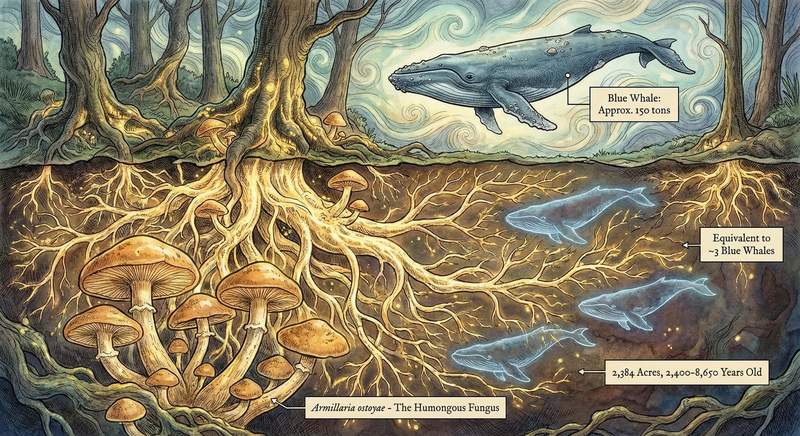
“The world's largest organism is not a blue whale—it's a fungus called Armillaria ostoyae in Oregon's Blue Mountains. This 'humongous fungus' spans 2,384 acres (nearly 4 square miles), is estimated to be between 2,400 and 8,650 years old, and weighs approximately 440 tons—equivalent to about 3 blue whales.”
When people hear “largest organism on Earth,” they usually picture an animal, which is why the answer “a fungus in Oregon” feels like trivia cheating. But Oregon’s so-called Humongous Fungus is a real biological giant. The Oregon Encyclopedia entry describes an occurrence of Armillaria ostoyae in Malheur National Forest covering about 2,385 acres, or roughly 3.7 square miles. USDA’s overview gives a somewhat rounder figure of about 2,200 acres and calls it arguably the largest living single organism on Earth.
The word “arguably” is doing important work. What is being counted here is not a towering visible mushroom but a largely underground clonal network. The Oregon Encyclopedia article explains that the fungus spreads by rhizomorphs, dark rootlike structures that move through soil, invade tree roots, and connect the whole organism across an enormous area. The mushrooms people see in autumn are just temporary fruiting bodies. The main organism is the hidden mycelial and rhizomorphic network belowground.
So why is it allowed to count as one organism? Because genetic work indicated that this sprawling patch is a single individual clone rather than a crowd of separate unrelated mushrooms. The State Library of Oregon’s archived Forest Service publication preserves the official documentation of the Malheur site and its recognition as the location of the world’s largest living organism under that clonal definition. In other words, this is not merely “lots of fungus in one forest.” It is one genetic individual spread across an astonishing amount of land.
The comparison with a blue whale therefore depends on category. A blue whale is the largest animal by mass of a single visible body. The Humongous Fungus is a contender for largest organism by area and possibly by biomass if one accepts the clonal network as a single individual. USDA’s account notes weight estimates ranging from thousands to tens of thousands of tons, but those are inferential, not the result of putting the fungus on a cosmic scale.
Age is similar. People love to quote that the organism is thousands of years old, and the broad claim is supported. The Oregon Encyclopedia article says it may be as old as 8,650 years, while USDA’s summary presents an estimated range tied to plausible radial growth rates. Those values are reasonable scientific estimates, not birthday candles based on direct annual rings the way one might date a tree.
Another caveat is taxonomic and competitive. The title “largest organism” always invites contenders, because different lineages dominate under different definitions. Clonal aspen groves such as Pando, gigantic seagrass meadows, and coral systems can all complicate the ranking depending on whether you care most about mass, area, continuity, genetic identity, or how strictly separated the body is. The Humongous Fungus remains famous because it is a particularly vivid case of one hidden clone spreading across a forest and parasitizing tree roots on a continental scale.
Its ecology is not glamorous for the trees involved. The Oregon Encyclopedia entry explains that Armillaria spreads slowly through the soil, colonizes roots, girdles host trees under the bark, and can continue feeding after trees die. USDA’s article likewise describes it as both parasite and decomposer. That double role helps explain how one organism can persist and expand for millennia.
The hiddenness of the fungus is part of why people underestimate it. We are biased toward obvious bodies: whales, elephants, redwoods. But life does not need to be compact to be singular. A fungus can be one organism while occupying a vast networked footprint that looks, to human eyes, like many scattered signs rather than one body.
So the claim is basically true with the right qualifiers attached. Oregon’s Armillaria ostoyae is a strong candidate for the world’s largest known organism when “organism” means a single clonal individual spread over thousands of acres, as described by USDA, the Oregon Encyclopedia, and the archived Forest Service publication. If you leave out those qualifiers, the fact becomes sloppy. If you include them, it becomes even cooler.