Why Wombats Really Produce Cube-Shaped Poop
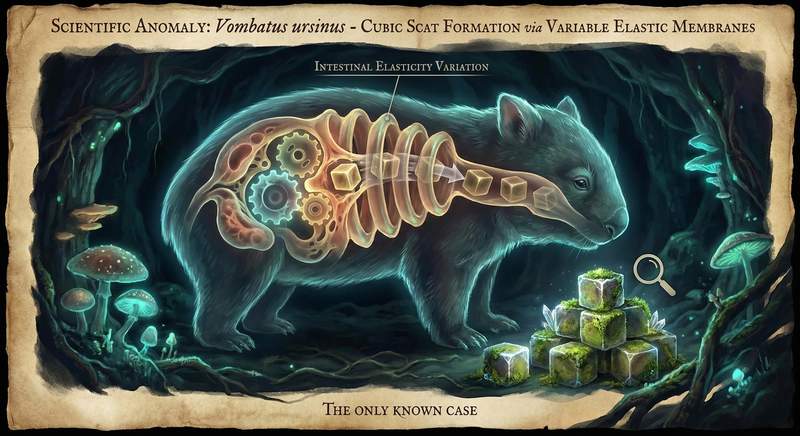
Wombats are the only animals known to produce distinctly cube-like feces, and the shape is made inside the intestine rather than at the exit. The effect comes from uneven stiffness and slow transport in the colon, while the cubes also appear useful for territorial scent-marking.
Published
Filed under
Byline
 Brainblast archive
2026-03-02-17-15-00-wombat-cube-poop.png (source: app assets)
The fact
“Wombats are the only known animals in the world that produce cube-shaped poop. Despite having round anuses like all other mammals, wombats can deposit up to 100 six-sided, 2-centimeter poop cubes per night. Georgia Tech researchers discovered this is caused by the varied elasticity of their intestinal walls—soft regions contract while stiff regions stay rigid, molding the feces into distinctive cubes. The shape serves an evolutionary purpose: wombats stack these cubes like little territorial cairns that don't roll away on uneven terrain, using them to mark territory and communicate with other wombats.”
The fact sounds like a prank from a children’s science book, but it is real: wombats produce feces with flat sides and corners. Researchers described the mechanism in Intestines of non-uniform stiffness mold the corners of wombat feces, while Georgia Tech’s write-up and the Royal Society of Chemistry summary explain why the result matters. Wombats are not squeezing cubes through a square anus. Instead, the shape is formed inside the gut.
That distinction is the entire story. For a long time, the simplest wrong guess was that the cube shape appeared right at the end, the way cookie dough might be stamped by a mold. The 2021 Soft Matter paper at doi.org/10.1039/d0sm01230k showed otherwise. The corners are generated in the distal intestine, where different regions of the intestinal wall have different stiffness. Combined with slow transport and drying of the feces, those uneven mechanical properties can transform a soft cylinder into something with edges.
The RSC summary at rsc.org puts one especially useful detail in plain language: the last 17 percent of the intestine appears to be where the geometry takes shape. That means the animal is effectively using a soft biological shaping system rather than a rigid mold. Two stiffer regions and two more flexible ones around the circumference help create the corners. It is a lovely example of how evolution can solve a geometric problem without using the obvious engineering approach.
Why would evolution bother? Because the cubes appear useful once they leave the body. The Georgia Tech article and the RSC summary both note that wombats place their scat at prominent points such as logs and rocks to communicate with one another and mark home ranges. A cube is better than a pellet for that job because it resists rolling away. On uneven terrain, a nearly cubic dropping stays where the animal put it, which is handy if your message is supposed to remain visible and smellable.
This is why the phrase “only known animal” is usually acceptable here, though it deserves the usual scientific caution. It means researchers do not currently know of another animal that regularly produces comparably cube-like feces as a normal biological pattern. It does not mean zoologists have exhaustively tested every species on Earth. Still, as Georgia Tech’s explanation makes clear, wombats are unusual enough that the discovery attracted real biomechanics interest rather than just amused headlines.
The work also had a second life in medicine and materials science. The same study described at doi.org/10.1039/d0sm01230k is not just about a cute marsupial oddity. Because feces shape depends partly on tissue stiffness, transport, and drying, the wombat system provides a model for thinking about colon mechanics more broadly. The RSC article points out that understanding how shape emerges in soft tissues could inform clinical diagnostics and new ways of shaping soft materials.
That is part of what makes the finding satisfying. It begins with a silly question—why is wombat poop cubed?—and ends in solid biomechanics. The intestine is not a passive hose. It is an active, regionally specialized mechanical environment. Wombats happen to reveal that dramatically because their product comes out looking like tiny dice. But the broader lesson is that gut geometry, tissue elasticity, and motion interact in ways we often ignore.
There is one more myth worth trimming back. Viral retellings sometimes imply that wombats intentionally manufacture mathematically perfect cubes every time. The better version is that their feces are cube-like or distinctly cubic in form, not machine-precision gaming dice. Biology is messy. But the effect is consistent enough to be recognizable, useful, and experimentally interesting, which is more impressive than a cartoon-perfect version would be anyway.
So yes, the basic fact is true. Wombats really are the only animals currently known for producing cube-shaped scat, and the shape is generated in the intestine, not at the exit, as shown in the Soft Matter paper. Georgia Tech’s account and the Royal Society of Chemistry summary help explain why those cubes matter: they stay put on rocks and logs, carrying territorial signals without rolling off into irrelevance.