The “Immortal Jellyfish” Can Reset Its Life Cycle—But It Is Not Invincible
Turritopsis dohrnii earned its nickname because damaged or stressed adults can reverse development and return to an earlier life stage. That can, in principle, let the lineage avoid ordinary senescence repeatedly, but it does not mean individual jellyfish cannot be eaten, infected, or killed by environmental shocks.
Published
Filed under
Byline
 Brainblast archive
2026-03-02-15-18-00-immortal-jellyfish.png (source: app assets)
The fact
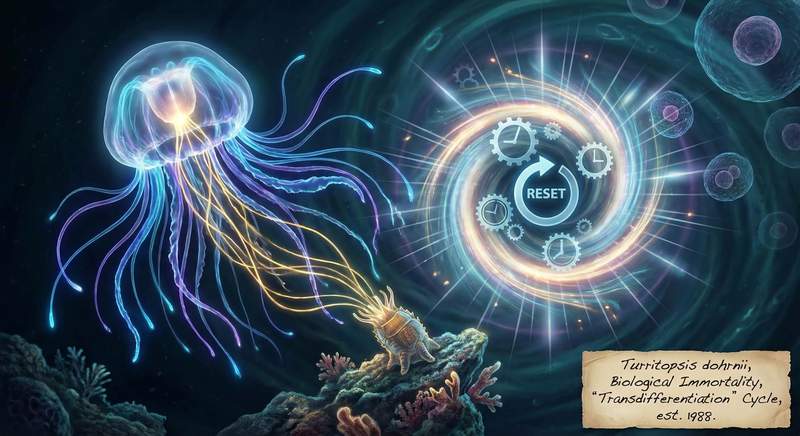
“The Turritopsis dohrnii jellyfish is biologically immortal. When injured, stressed, or starving, it can revert its cells back to their earliest developmental stage (polyp form) and begin its life cycle all over again. Discovered accidentally in the 1980s, this 'transdifferentiation' process allows the jellyfish to hit a biological reset button, theoretically repeating the cycle indefinitely.”
The nickname is flashy, but it is rooted in a real biological trick. The Natural History Museum’s explainer on Turritopsis dohrnii says this tiny hydrozoan can reverse its life cycle when it is physically damaged or stressed by conditions such as starvation. Instead of simply dying after adulthood, it can shrink, settle, and transform back into an earlier stage. A Texas A&M thesis focused on Turritopsis dohrnii describes the same phenomenon as life-cycle reversal through transdifferentiation. That is why people call it “biologically immortal.”
But “biologically immortal” is not the same as “cannot die.” The phrase means the species appears capable of sidestepping ordinary senescence under the right circumstances, not that an individual jellyfish is immune to predators, disease, toxins, or bad luck. The Natural History Museum is careful about this by saying the jellyfish may never die of old age in perfect conditions. That wording matters. Perfect conditions are doing a lot of work there.
The life cycle itself is what makes the story so weird. Most jellyfish go from fertilized egg to larva to attached polyp to free-swimming medusa, and then eventually die. The NHM article explains that Turritopsis dohrnii can interrupt that script. When stressed, the medusa reabsorbs its tentacles, loses the ability to swim, and settles as a cyst-like blob before developing again into a polyp. The Texas A&M work describes this as a whole-body transformation back to an earlier developmental stage.
The key cellular idea is transdifferentiation. That means specialized cells are reprogrammed into other specialized cell types without going back through the normal reproductive route. NHM calls the process extremely rare, and the Texas A&M thesis frames the species as a model system for studying regeneration, cellular plasticity, and aging. That is why scientists care: the jellyfish is not just trivia bait, it is a living test case for how radically some animals can reorganize their own tissues.
The mythology grows because the biological reality is already strange enough to sound made up. If a butterfly became injured and then turned back into a caterpillar, people would not need much exaggeration to call it immortal. The NHM analogy makes exactly that point. Still, the more precise interpretation is that the organism can repeatedly renew its life cycle. Immortality here refers to the potential avoidance of aging-related death, not to supernatural survival.
There is also an important species caveat. Popular retellings sometimes talk as if all jellyfish can do this, or as if every species in the Turritopsis group behaves identically. The NHM page is specifically about Turritopsis dohrnii, and the Texas A&M thesis likewise focuses on that species as a model organism. Generalizing too far turns a remarkable species-level observation into a sloppy rule about cnidarians in general.
Another caveat is that much of the fascination comes from what the jellyfish might teach us, not from a literal claim that science has discovered the fountain of youth. The Texas A&M thesis explicitly connects the species to questions about regeneration, cellular plasticity, and aging. That is exciting, but it is not the same as saying humans can borrow one trick and become immortal. Biology almost never translates that directly across species.
It is also worth noticing how conditional the reset appears to be. The Natural History Museum describes the reversal as something triggered by damage or stress, and the Texas A&M thesis frames it as a response that helps avoid death from adverse conditions or aging. That suggests a remarkable survival pathway, not an always-on guarantee.
The term can also mislead because it invites people to imagine an endless uninterrupted individual life. What actually happens is more like periodic reset and redevelopment. The Natural History Museum describes the adult medusa collapsing into a cyst and then returning to the polyp stage, after which new medusae bud off again. The Texas A&M source emphasizes that this reverse development can be triggered by damage, adverse conditions, or aging. So the “same individual forever” picture is too simple.
That said, the popular fact survives with a repair, not a demolition. Turritopsis dohrnii really is extraordinary. It can reverse development and re-enter an earlier life stage, as the Natural History Museum explains, and the Texas A&M thesis on transdifferentiation shows why researchers take that seriously. The honest version is that it is “biologically immortal” only in the narrow sense of potentially escaping old-age death through repeated reset—not in the broad sense of being unkillable.