When the Mediterranean nearly dried into a salt basin
During the Messinian Salinity Crisis, Mediterranean connections to the Atlantic narrowed enough for evaporation to outpace inflow, leaving immense salt deposits and dramatic erosion. But scientists still debate how dry the basin became, how conditions varied between sub-basins, and how abruptly Atlantic waters returned.
Published
Filed under
Byline
 Brainblast archive
2026-03-06-16-24-57-fact.png (source: app assets)
The fact
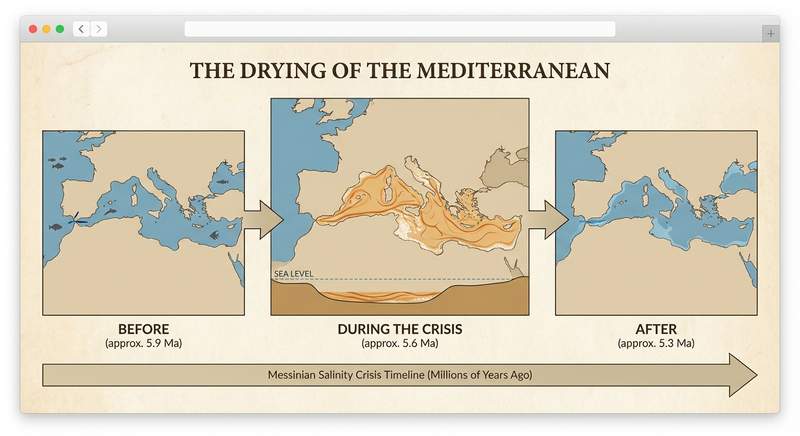
“Approximately 5.6 million years ago, the Mediterranean Sea was completely cut off from the Atlantic Ocean and evaporated almost entirely, leaving behind a massive desert basin that sat kilometers below sea level. This 'Messinian Salinity Crisis' ended when the Strait of Gibraltar breached, triggering a cataclysmic flood that refilled the entire basin in a period estimated to be as short as two years.”
The modern Mediterranean looks eternal: a blue inland sea pinned between Europe, Africa, and the Near East. Geologically, though, it has had at least one astonishing identity crisis. During the Messinian Salinity Crisis, the Mediterranean became partly isolated from the Atlantic and lost water faster than it could be replenished. The result was a basin-scale environmental convulsion that left behind enormous evaporite deposits, reorganized river systems, and set the stage for one of the most dramatic reflooding events ever proposed in Earth science. A recent Science Advances study describes the crisis as a short interval of isolation that trapped roughly a million cubic kilometers of salt.
The broad timeline is fairly well established even if many details are still argued over. According to the Science Advances reconstruction, the crisis proper began around 5.97 million years ago with widespread gypsum precipitation, entered a more extreme drawdown phase around 5.60 to 5.55 million years ago, and ended at 5.33 million years ago when open marine conditions returned. In other words, the catchy claim that the Mediterranean "evaporated" at about 5.6 million years ago is directionally right but oversimplified. The event unfolded in stages over hundreds of thousands of years, not in a single instant.
Why did it happen at all? By the late Miocene, plate motions had already narrowed most seaways linking the Mediterranean to the world ocean. Once the remaining Atlantic connection became sufficiently restricted, evaporation in the region's warm, relatively dry climate began to outcompete inflow. Salinity rose, marine ecosystems were stressed, and thick layers of gypsum and halite accumulated on the basin floor. Those salt deposits are the event's giant geological receipt. They show that the Mediterranean did not merely become saltier than normal; it entered conditions extreme enough to precipitate minerals at extraordinary scale, as summarized in the Science Advances paper.
What the salt alone does not settle is the most cinematic question: how dry did the Mediterranean actually get? Some lines of evidence point to very large sea-level drops, perhaps over a kilometer in parts of the basin, with river incision and erosion reaching far below today's shoreline. The 2025 Science Advances study argues that the crisis likely involved "kilometric" sea-level changes and proposes that river erosion around the basin helped modulate later conditions. But the same paper also highlights why the story is still contested. Shallow-water and brackish deposits known as Lago-Mare sediments appear in places that complicate any simple "empty bathtub" picture. That suggests the Mediterranean may at times have behaved as a patchwork of deep depressions, marginal lakes, and fluctuating basins rather than as a uniformly desiccated hole.
The ending is just as dramatic. For decades, some researchers favored a relatively gradual refill. Then evidence accumulated for a much faster reconnection. The University of Southampton summary of a 2025 study reports new geological features around the Sicily Sill that are consistent with a colossal Zanclean megaflood, with discharge estimates on the order of 68 to 100 Sverdrups. That is an absurd amount of water: each Sverdrup equals a million cubic meters per second. The same summary notes that some flood-duration estimates fall between roughly two and sixteen years, which is almost unimaginably fast for refilling a sea basin.
Evidence from the eastern Mediterranean strengthens that catastrophic-flood interpretation. In a research summary from Spain's earth-science institute ICTJA-CSIC, scientists describe large chaotic sediment bodies, erosion features, and a likely gateway near the Noto submarine canyon in Sicily as signs of a violent cascading flow into the Ionian Basin during the crisis termination. Their writeup argues that these deposits may represent the largest known megaflood deposit on Earth and links them directly to the return of Atlantic waters at the end of the crisis, not to ordinary marine sedimentation or slow background processes ICTJA-CSIC.
Still, scientists have not converged on every detail. "The Mediterranean largely evaporated" is safer than "the entire Mediterranean dried out completely," because the evidence supports severe drawdown and extraordinary salt deposition, but not necessarily the same conditions in every sub-basin at every moment. Likewise, "the Zanclean flood refilled it" is widely used, but the exact geometry, timing, and number of flood pulses remain active topics of study. Even the latest papers and institutional summaries frame the new evidence as compelling rather than final. That caution matters because basin history, tectonics, climate oscillations, and sedimentary records all interact in messy ways.
What is beyond doubt is the scale of the transformation. A sea that now moderates climate and supports trade, fisheries, and tourism once became a salt-producing geological machine and then reconnected so dramatically that its recovery left scars large enough to detect millions of years later. The Messinian Salinity Crisis is memorable not because it offers a single clean disaster story, but because it shows how plate tectonics, climate, erosion, and ocean gateways can combine to remake an entire region. The Mediterranean did not simply "go away" and come back. It passed through a long, complicated breakdown whose traces still define the basin today.