The "Great Unconformity" is a geological phenomenon where a massive...
The Great Unconformity is a real and widespread gap in the rock record, but geologists still debate whether its missing time mainly reflects Cryogenian glacial erosion, older tectonic exhumation, or a mix that varies by region.
Published
Filed under
Byline
 Brainblast archive
2026-03-06-18-33-00-great-unconformity.png (source: app assets)
The fact
“The "Great Unconformity" is a geological phenomenon where a massive gap in the rock record exists, spanning hundreds of millions to over a billion years of Earth's history. In some locations, such as the Grand Canyon, 500-million-year-old rocks sit directly on top of ancient basement rocks that are 1.7 billion years old. Geologists believe this represents a period of extreme erosion, potentially caused by the "Snowball Earth" glaciations that scoured the continents down to their foundations. This missing time represents a significant portion of our planet's past that has been physically erased from the stratigraphic record, leaving a mystery that remains one of the most significant puzzles in geology. It highlights the dynamic and violent nature of Earth, where entire chapters of geological time can simply vanish due to global environmental shifts. This gap is found in various locations all over the world, suggesting a global event of unprecedented scale and impact.”
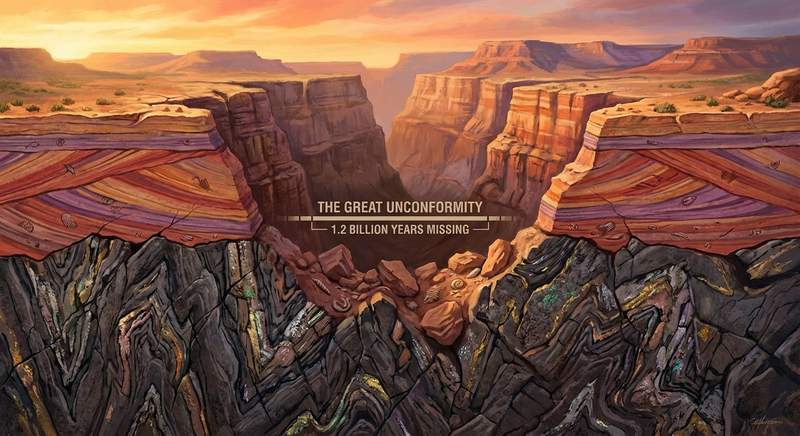
The Great Unconformity is one of geology’s most striking examples of missing time. In places like the Grand Canyon, sedimentary rocks a little over 500 million years old can rest directly on much older basement rocks that are more than a billion years older. The rocks are real, the gap is real, and the missing interval can span hundreds of millions to more than a billion years. But the careful version of the fact is not that one single mystery event neatly erased the same chapter of Earth history everywhere. The modern debate is whether the “Great Unconformity” is best explained by one mostly synchronous global erosional episode, several regionally distinct unconformities, or some combination of both.
A recent PNAS study strongly argued for a Cryogenian glacial contribution. Its authors reported thermochronologic evidence for widespread rock cooling and several kilometers of exhumation during the interval associated with Snowball Earth glaciations, especially across stable cratonic parts of North America, and concluded that glaciation remains the most plausible mechanism for broad continental-scale erosion in those settings (https://www.pnas.org/doi/10.1073/pnas.2118682119). That is the version of the story many people now hear: giant ice sheets may have scoured continents and helped carve out a globally recognizable missing chapter.
That hypothesis is attractive because it links the unconformity to a truly dramatic Earth-system event. During Snowball Earth intervals, ice may have extended to low latitudes, and widespread erosion could in principle remove large thicknesses of upper crust. If later marine flooding deposited Cambrian sediments atop those eroded surfaces, you would end up with exactly the sort of conspicuous boundary geologists now observe.
But that is not the end of the story. Another study, available through PubMed Central, examined field relationships and thermochronologic evidence from Colorado and argued that much of the erosion below that region’s Great Unconformity happened before the first Cryogenian Snowball Earth glaciation. The authors concluded that multiple Great Unconformities may have developed diachronously and that regional tectonic processes, rather than a single synchronous global event, played a major role in at least some places (https://pmc.ncbi.nlm.nih.gov/articles/PMC7229757/).
That disagreement matters because it changes what the feature means. If the Great Unconformity is mainly a Snowball Earth scar, then it records a globally coordinated planetary erosion event. If instead many local or regional unconformities formed at different times for different reasons, then the famous boundary is partly a naming convenience that groups similar-looking surfaces with different underlying histories. The two views are not completely incompatible. Earth could have experienced substantial Cryogenian erosion in some interiors while other regions were shaped more by tectonic uplift, rifting, burial, weathering, and later re-exposure.
An Eos report on the debate captured that shift in thinking well. It describes the feature as the surface separating fossil-rich younger rocks from much older largely fossil-poor rocks, while also highlighting a growing argument that geologists may be dealing with “many Great Unconformities” rather than one perfectly synchronized global event (https://eos.org/articles/the-great-unconformity-or-great-unconformities). In other words, the gap itself is not in question; the argument is over timing, cause, and how unified the phenomenon really is.
There is also an important conceptual nuance: unconformities record missing record, not necessarily one clean erosional carve-out. Some missing time reflects erosion, some reflects nondeposition, and some reflects later burial and preservation patterns. That is one reason the problem is so hard. The rocks that would tell the story directly are precisely the rocks that are gone.
The Grand Canyon example remains compelling because it makes the idea visually intuitive. You can stand at an outcrop and see a younger sedimentary package resting on much older crystalline rock. But one dramatic exposure can make the geology seem simpler than it is. The same label used in iconic canyon walls may refer elsewhere to surfaces with different histories and different amounts of removed material.
The fact’s stronger popular version also tends to imply that geologists are clueless about the whole interval. That is not quite right. Scientists know a lot about the age ranges involved, the rock types above and below, and plausible processes that could have removed or failed to deposit material. The unresolved part is how much of the missing time should be assigned to each process in each region, and whether one master explanation can cover the globe.
So the grounded takeaway is this: the Great Unconformity is indeed a major geological gap where rocks from vastly different ages meet across missing time. It is found in many places, and in some famous localities it represents an enormous break in Earth’s preserved history. But calling it one single global wound caused solely by Snowball Earth is too neat. Current evidence supports a more careful picture in which glaciation may explain broad erosion in some regions, while tectonic and regional histories likely explain others (https://www.pnas.org/doi/10.1073/pnas.2118682119; https://pmc.ncbi.nlm.nih.gov/articles/PMC7229757/).
That makes the Great Unconformity less like a single deleted chapter and more like a library in which many different chapters went missing for overlapping reasons. The rocks keep the punchline. Geologists are still arguing over the editing history.