The Electric Blue Flames of Indonesia's Kawah Ijen Volcano Are Burning Sulfur, Not Blue Lava
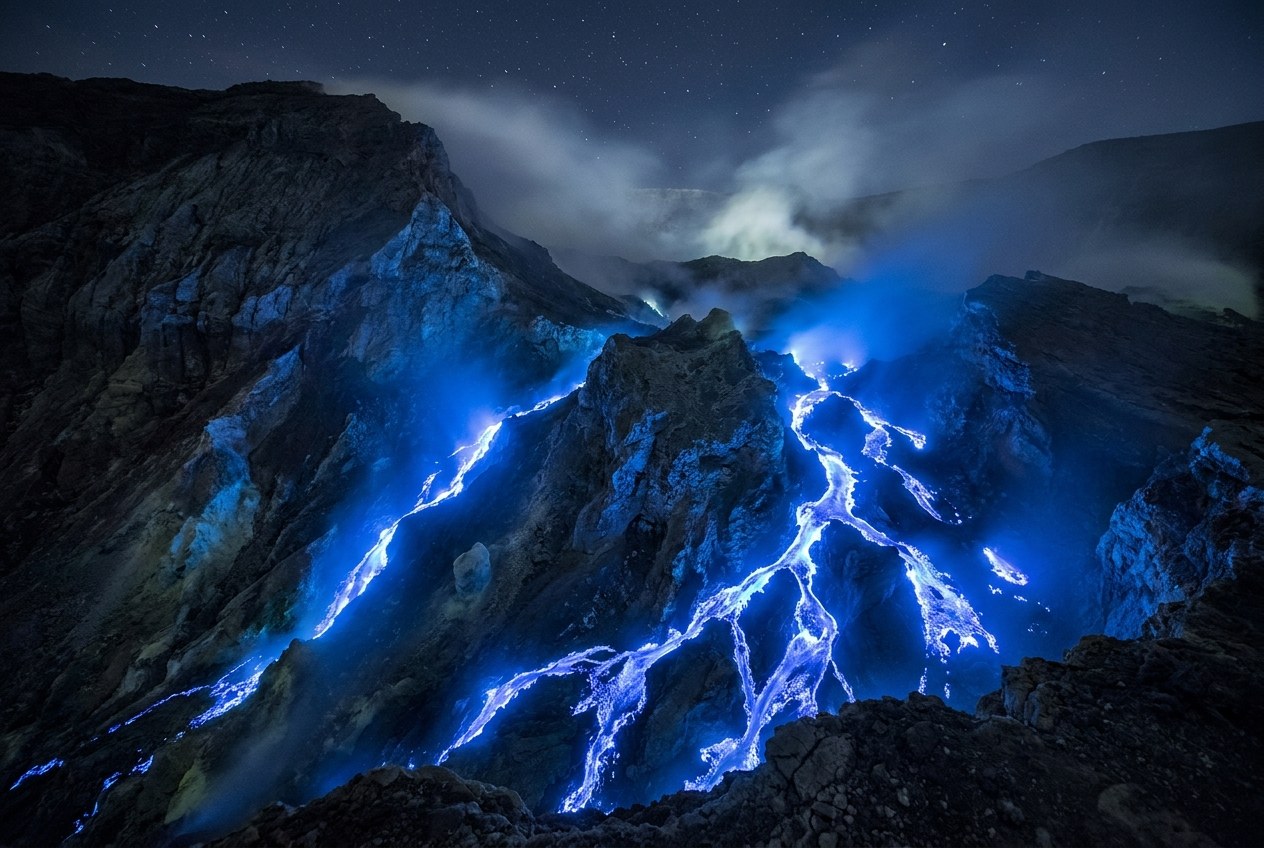
Indonesia's Kawah Ijen volcano is famous for its stunning night-time phenomenon of electric-blue streams that resemble flowing lava. However, this is not colored molten rock. Instead, superheated sulfuric gases emerge from volcanic fissures at extreme temperatures, immediately autoigniting upon contact with atmospheric oxygen to produce spectacular neon-blue flames that can flow as liquid sulfur.
Published
Filed under
Byline
 Brainblast archive
AI-generated with OpenAI; reviewed by Brainblast
The fact
“At East Java's Kawah Ijen volcano, an extraordinary nocturnal spectacle occurs: brilliant neon-blue flames that drape the slopes, often mistaken for blue lava. This phenomenon is purely chemical. Deep underground magma superheats sulfur deposits, venting elemental sulfur vapor and hydrogen sulfide gas from fumaroles at temperatures exceeding 600°C. Because sulfur's autoignition temperature is far below this, the gas ignites instantly upon contact with oxygen-rich ambient air. The bright blue color is not caused by thermal incandescence (like traditional orange-red soot-producing flames) but by electronic transitions. The high temperatures excite the valence electrons of disulfur (S2) molecules; as they decay back to their ground state, they release energy as blue-wavelength photons. Furthermore, the superheated gases condense into liquid sulfur that continues to burn as it flows downslope, creating the illusion of glowing blue rivers. This spectacular display is invisible by day, masked by sunlight, leaving only yellow mineral crusts and white plumes.”
The Electric Blue Flames of Kawah Ijen: The Chemistry of Burning Sulfur
Nestled in the East Java province of Indonesia, the Kawah Ijen volcano is home to one of the most mesmerizing natural phenomena on Earth: a spectacular nocturnal display of electric-blue flames that cascade down its slopes. For years, travel media and internet blogs have described this stunning sight as "blue lava." However, the molten rock erupted by Kawah Ijen is identical to the standard red-orange silicate lava found in basaltic volcanoes worldwide. The brilliant, neon-blue rivers of light are not molten rock at all, but the product of an intense chemical reaction—the combustion of superheated sulfuric gases reacting with atmospheric oxygen.
The Geochemical Source: Superheated Sulfuric Venting
The geological engine powering Kawah Ijen is rich in active hydrothermal systems. Deep beneath the crater, magma chambers heat and vaporize large subsurface deposits of elemental sulfur and other sulfur-rich minerals. Under immense pressure, these vaporized compounds are forced upward through fissures and vents, known as fumaroles, on the crater floor.
When these volcanic gases escape into the atmosphere, they do so at extremely high pressures and temperatures, often exceeding 600°C (1,112°F) as documented by the Smithsonian Institution. The gas mixture venting from Kawah Ijen is highly toxic, containing hydrogen sulfide ($H_2S$), sulfur dioxide ($SO_2$), and a high proportion of elemental sulfur vapor, primarily existing in polymeric forms such as octasulfur ($S_8$) and disulfur ($S_2$).
Autoignition and the Chemistry of Combustion
As the superheated gaseous mixture emerges from the high-pressure fumaroles into the open air, it undergoes autoignition. The autoignition temperature of elemental sulfur vapor in ambient air is remarkably low, ranging between 240°C and 360°C. Because the venting gases are exit-heated to over 600°C, they require no external spark to ignite. The moment these superheated gases make contact with the oxygen-rich ($O_2$) ambient atmosphere, they immediately and spontaneously combust.
The primary chemical reaction driving this combustion is the highly exothermic oxidation of elemental sulfur vapor: $$\text{S}_8(g) + 8\text{O}_2(g) \rightarrow 8\text{SO}_2(g)$$
Simultaneously, the hydrogen sulfide gas present in the volcanic discharge burns, contributing to the overall reaction: $$2\text{H}_2\text{S}(g) + 3\text{O}_2(g) \rightarrow 2\text{SO}_2(g) + 2\text{H}_2\text{O}(g)$$
These rapid, high-temperature reactions release substantial thermal energy and generate a dense plume of sulfur dioxide, creating the massive white clouds that hang over the crater during the day.
Luminescence vs. Incandescence: Why the Flame is Blue
In typical wood, candle, or hydrocarbon fires, the flame glows with a yellow, orange, or red color. This color is the result of incandescence, also known as blackbody radiation. As hydrocarbons burn, they release microscopic particles of unburned carbon, or soot. These solid soot particles are heated by the surrounding flame until they glow brightly, emitting a broad spectrum of visible light skewed toward the red and yellow wavelengths.
By contrast, the combustion of sulfur at Kawah Ijen involves no carbon and therefore produces absolutely no soot. Instead, the brilliant neon-blue color of the flames is generated through electronic transition or chemiluminescence. At the extreme temperatures of the volcanic vents, the sulfur vapor is broken down into simpler molecular species, predominantly disulfur ($S_2$), which is a triplet diradical.
The energy released by the exothermic combustion reaction excites the valence electrons of these $S_2$ molecules to higher energy levels. When these excited electrons decay back to their stable ground state—specifically transitioning from the excited $B^3\Sigma_u^-$ state to the ground $X^3\Sigma_g^-$ state—they release their excess energy in the form of discrete photons. The wavelength of these emitted photons falls squarely within the near-ultraviolet and blue-visible spectrum, typically between 390 and 450 nanometers. This precise electronic transition produces the characteristic electric-blue emission spectrum, as highlighted in reports by National Geographic.
The Flowing "Lava" Illusion
What elevates Kawah Ijen from a simple burning gas vent to an otherworldly spectacle is the illusion of flowing liquid "lava" of a bright blue hue. This occurs because of the physical properties of elemental sulfur. Sulfur has a relatively low melting point of approximately 115°C (239°F).
As the superheated sulfur gas escapes and comes into contact with the slightly cooler ambient air, a portion of the vapor condenses back into liquid elemental sulfur. Because the surrounding environment is still extremely hot, this newly condensed liquid sulfur continues to burn. It flows down the rocky slopes of the crater as a blazing, molten liquid stream, giving the striking visual impression of glowing blue lava pouring down the mountain.
Environmental Realities and Human Toll
While the blue flames of Kawah Ijen are incredibly beautiful, the environment inside the crater is exceptionally hostile. Adjacent to the active vents lies the Kawah Ijen crater lake, which is the world's largest highly acidic lake. The lake water has a turquoise-green color from dissolved metals and extremely high concentrations of hydrochloric acid, boasting a pH of nearly 0.
The crater is also the site of an active, manual sulfur mining operation. Local miners brave the toxic atmosphere daily, often without adequate protective gear, to break up solidified yellow sulfur deposits that form around the vents. They carry heavy baskets weighing up to 100 kilograms out of the crater, exposing their lungs to chronic levels of acidic gases to earn a living.
In conclusion, the blue fire of Kawah Ijen is a magnificent demonstration of chemical thermodynamics and spectroscopy. It shows how the simple combustion of sulfur under extreme volcanic conditions can bypass blackbody radiation to paint a dark landscape with the vibrant, quantum-driven light of excited disulfur molecules.