The Earth's inner core is not a static ball of...
Earth’s solid inner core appears to rotate differentially relative to the mantle and surface on multidecadal timescales, though the exact rate, pattern, and contribution of structural changes remain active research questions.
Published
Filed under
Byline
 Brainblast archive
2026-03-07-06-33-00-inner-core-rotation.png (source: app assets)
The fact
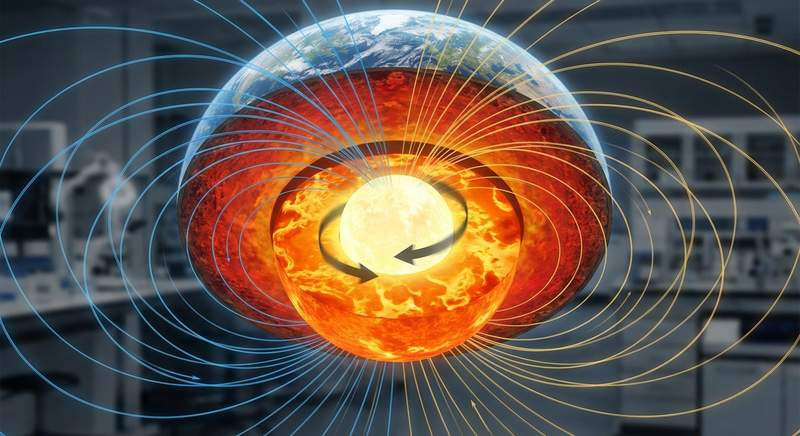
“The Earth's inner core is not a static ball of iron but is actually rotating independently and sometimes faster than the rest of the planet. This phenomenon, known as super-rotation, occurs because the liquid outer core decouples the solid inner core from the mantle, allowing it to spin at its own pace. Recent seismic data suggests that this rotation may even periodically slow down or reverse its direction relative to the surface every few decades. This internal movement is a crucial component of the geodynamo, the process that generates Earth's protective magnetic field. Understanding these subtle shifts helps scientists model how the planet’s deepest layers influence the length of a day and the stability of our magnetic poles.”
Earth’s inner core is not simply a motionless iron sphere parked at the center of the planet. For decades, seismologists have argued that it rotates differentially relative to the mantle and crust because it is separated from the rocky exterior by the liquid outer core. That basic idea is well established enough to be taken seriously, but the details are messier than many popular summaries admit. The current evidence suggests multidecadal variation, including episodes of faster relative rotation, slowing, and possible “backtracking” relative to the surface. It does not mean the core is spinning wildly backward like a loose wheel inside Earth.
The 2023 Nature Geoscience paper that reignited public attention analyzed repeated seismic waves traversing the inner core and found that paths showing temporal changes in earlier decades had exhibited little change in the recent decade. The authors interpreted that pattern as a recent pause in differential inner-core rotation and suggested that it may be part of an approximately seven-decade oscillation, with a previous turning point in the early 1970s (https://www.nature.com/articles/s41561-022-01112-z).
That paper mattered because it linked the seismic evidence to other geophysical observations, including variations in the length of day and magnetic behavior. The implied picture is that Earth’s layers exchange angular momentum and interact dynamically through gravitational and fluid coupling. The core is not isolated from the rest of the planet; it is part of a slow mechanical dance involving the inner core, outer core, mantle, and surface.
A 2024 Nature paper pushed the story further by compiling a larger set of repeating earthquakes from 1991 through 2023 and examining waveform reversals sensitive to inner-core changes. The authors concluded that the inner core had begun to “backtrack” relative to the mantle, meaning that after a period of relative eastward advance it had slowed enough to move more slowly than the surface frame (https://www.nature.com/articles/s41586-024-07536-4). That conclusion lines up with the USC summary of the work, which says the inner core began decreasing its speed around 2010 and is now moving more slowly than Earth’s surface frame for the first time in decades (https://today.usc.edu/usc-study-confirms-the-rotation-of-earths-inner-core-has-slowed/).
The phrase “reversing its rotation” makes good headlines, but it needs unpacking. Researchers are usually discussing relative motion compared with the mantle or surface, inferred from subtle changes in seismic wave travel and waveform shape. They are not saying the whole solid inner core suddenly stopped and spun the opposite way in a dramatic mechanical sense obvious to everyday intuition. The estimated changes are tiny, measured through painstaking comparison of seismic records, and their surface effects are correspondingly minuscule.
That is another key caveat: the evidence is indirect. Nobody can observe the inner core directly. Scientists infer its behavior from seismic waves generated by earthquakes or, historically, some repeated test sources. If waveforms that should follow nearly the same path through Earth change over time, one possible explanation is differential inner-core rotation. But alternative interpretations can involve structural changes near the inner-core boundary or elsewhere in the deep interior. The 2024 Nature paper explicitly addresses that broader debate while arguing its expanded data set favors the backtracking interpretation (https://www.nature.com/articles/s41586-024-07536-4).
This is why the field has seen so much disagreement. Different methods, paths, time spans, and assumptions can produce somewhat different apparent rotation rates. Earlier work often favored steady super-rotation, with the inner core inching eastward a little faster than the mantle. More recent analyses point toward oscillation and slowing. The broad consensus today is not that one simple constant rate has been measured once and for all, but that the inner core’s motion varies over time and interacts with the rest of the planet in a more complicated way than the old static-ball picture suggested.
The geodynamo connection also needs careful wording. Earth’s magnetic field is generated mainly by motions in the liquid outer core, not by the solid inner core spinning like a battery rotor. The inner core still matters because gravitational, thermal, and electromagnetic coupling among deep layers influences core dynamics. But saying inner-core rotation is “the” source of the magnetic field would be too strong.
Likewise, changes in day length linked to the inner core are tiny. The USC summary notes that any resulting effect would be on the order of thousandths of a second, far too small for ordinary human experience (https://today.usc.edu/usc-study-confirms-the-rotation-of-earths-inner-core-has-slowed/). So the fact is not that Earth’s deepest metal ball is jerking the planet around. It is that subtle rotational exchanges deep inside Earth may be measurable in principle.
The most accurate takeaway, then, is that Earth’s inner core is dynamically coupled rather than static. Seismic studies support differential rotation on multidecadal timescales, and some of the newest work indicates a slowdown or relative backtracking around the past decade (https://www.nature.com/articles/s41561-022-01112-z; https://www.nature.com/articles/s41586-024-07536-4).
That may sound less cinematic than “Earth’s core reversed,” but it is truer and arguably cooler. The center of the planet is not dead still. It is engaged in a barely perceptible, decades-long negotiation with the rest of Earth, and seismologists are learning to overhear the argument.