The Great Oxidation Event changed Earth for good—but not in one instant
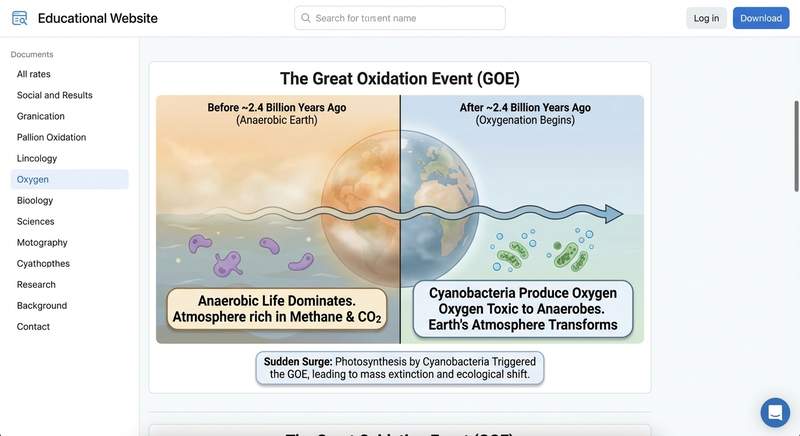
Around 2.4 billion years ago, Earth underwent the Great Oxidation Event, when oxygen became a persistent feature of the atmosphere and surface ocean. The durable version of the fact is that cyanobacterial oxygen production transformed surface chemistry and later evolution, but the transition was stepwise, involved earlier 'whiffs' of oxygen, and remains an active area of debate rather than a single clean switch being flipped.
Published
Filed under
Byline
 Brainblast archive
2026-03-06-16-44-50-fact.png (source: app assets)
The fact
“Around 2.4 billion years ago, the 'Great Oxidation Event' occurred when cyanobacteria began producing oxygen, which was toxic to the anaerobic life that previously dominated the planet. This sudden surge in oxygen reacted with atmospheric methane to trigger the Huronian glaciation—the longest and most severe ice age in history—which turned the entire planet into a 'Snowball Earth' for millions of years. This cataclysmic shift in Earth's chemistry ultimately paved the way for the rise of complex, oxygen-breathing multicellular organisms.”
Around 2.4 billion years ago, Earth crossed one of the most important thresholds in its history: oxygen stopped being a trivial trace gas and became a lasting part of the atmosphere and surface ocean. The Nature Communications paper on the Great Oxygenation Event describes this as a major planetary turning point documented by multiple geologic and geochemical signals. The broad claim is absolutely right. Without this shift, the later history of complex aerobic life would have looked very different—if it happened at all.
But the Great Oxidation Event, or GOE, was not a cinematic instant when Earth suddenly “turned on” oxygen everywhere at once. The Nature Communications review explicitly frames the event as a transition whose causes remain debated, involving changes in both oxygen sources and oxygen sinks. The NASA Astrobiology piece on “whiffs” of oxygen adds that evidence exists for short-lived oxygen appearances before the main atmospheric breakthrough. So the sturdy version of the fact is not “oxygen appeared one day,” but “oxygen became persistently important after a long and uneven buildup.”
The biological source most often credited is oxygenic photosynthesis by cyanobacteria. The PMC review on cyanobacteria and the GOE says cyanobacteria were among the most consequential organisms in Precambrian Earth history and links their activity to the rapid oxygenation of the atmosphere during the early Proterozoic. That review also stresses that cyanobacteria likely originated well before the GOE itself. In other words, making oxygen and accumulating oxygen were not the same thing. Earth may have had organisms capable of releasing oxygen long before the planet’s chemistry allowed that oxygen to pile up in the air.
That distinction is crucial. The Nature Communications article explains that oxygen levels depended on a balance between production and consumption. Early Earth had many chemical sinks eager to mop oxygen up: reduced volcanic gases, dissolved iron in the oceans, and other reduced materials in rocks and surface environments. As long as those sinks were large enough, oxygen produced by microbes could be generated locally and still fail to become a permanent atmospheric feature. The GOE represents the point when that balance shifted decisively enough for oxygen to persist.
The evidence for the shift comes from several independent geological clues. The Nature Communications paper lists classic indicators such as the decline of widespread iron formations, the appearance of red beds and sulfate minerals, the disappearance of certain detrital redox-sensitive minerals, and the loss of mass-independent sulfur-isotope signatures that are characteristic of an essentially oxygen-free atmosphere. None of those lines of evidence is just a decorative detail. Together they are why scientists treat the GOE as a real global transition rather than as a convenient storytelling label.
At the same time, the prelude seems to have been messy. The NASA Astrobiology article describes evidence for transient “whiffs” of oxygen at least 2.5 billion years ago, before the atmosphere became durably oxygen-rich. That is an important caveat because it shows the GOE was likely preceded by unstable experiments in oxygenation. Earth may have flirted with oxygen several times before crossing the threshold where oxygen became a lasting and planet-shaping background condition.
This atmospheric shift changed far more than the sky. The PMC review notes that cyanobacterial oxygen production had sweeping consequences for Earth systems and later evolution. Oxygen opened metabolic possibilities with much higher energy yield than many anaerobic pathways. It also created an ecological crisis for organisms adapted to a low-oxygen world, because oxygen can be chemically dangerous to cells not equipped to manage it. The GOE was therefore both an opportunity and a catastrophe, depending on which organisms you ask—assuming they could answer before being oxidized out of relevance.
There were climate consequences too. The Nature Communications paper discusses hypotheses in which changing oxygen and methane chemistry contributed to cooling, helping connect the GOE to Paleoproterozoic glaciations. Oxygen is not itself a greenhouse gas, but its rise affects other gases, especially methane, which is a powerful greenhouse gas. Reducing methane’s atmospheric role could have cooled the planet substantially. That does not mean the GOE had a single simple climate mechanism, but it does mean biology and planetary climate were already tightly entangled billions of years ago.
One more caveat improves the fact instead of weakening it: scientists still debate the precise trigger. The Nature Communications article reviews possibilities ranging from ecological changes and nutrient limitation to volcanic redox shifts, hydrogen escape, and changes in methane cycling. The NASA “whiffs” article is a reminder that the data record itself has been actively argued over. That is normal science, not indecision. When an event happened more than two billion years ago, the cleanest explanations are rarely the safest ones.
So the repaired fact is this: around 2.4 billion years ago, Earth experienced the Great Oxidation Event, when oxygen became a persistent feature of the atmosphere and surface ocean, as described by the Nature Communications review. Cyanobacteria were central players in producing that oxygen, as summarized in the PMC review. But the transition was stepwise, probably preceded by temporary oxygen “whiffs” described by NASA Astrobiology, and driven by a complicated tug-of-war between biology and planetary chemistry. Earth did not simply become breathable overnight. It negotiated its way there over deep time.