Deep within the Earth's transition zone, ringwoodite points to vast water stored in minerals
A water-bearing ringwoodite inclusion inside a diamond provided direct evidence that parts of Earth's mantle transition zone are hydrous, though the water is stored in minerals rather than sloshing as underground seas.
Published
Filed under
Byline
 Brainblast archive
2026-03-06-10-33-00-ringwoodite-water-reservoir.png (source: app assets)
The fact
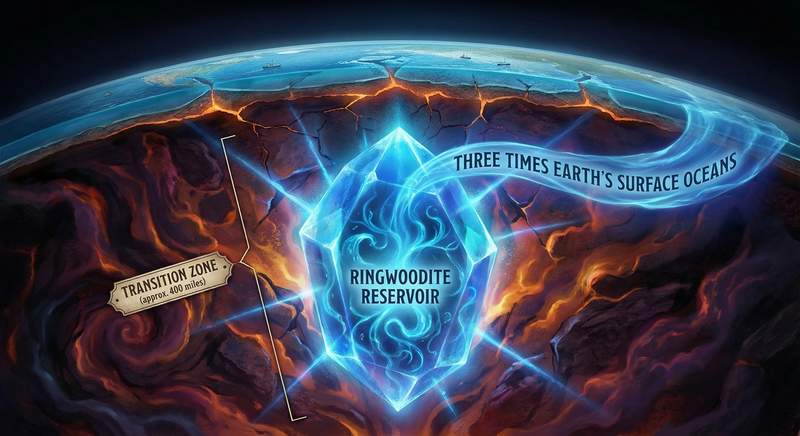
“Deep within the Earth's transition zone, approximately 400 miles below the surface, there is a massive reservoir of water trapped inside a rare blue mineral called ringwoodite. This subterranean cache is estimated to contain three times as much water as all of the planet's surface oceans combined. Rather than being liquid, the water is chemically locked within the mineral's crystal lattice, providing evidence that Earth's oceans may have originated from deep within the mantle rather than from external comet impacts.”
One of the most widely repeated deep-Earth facts says there may be “an ocean inside the Earth” hundreds of kilometers down. That slogan is catchy, but misleading. What scientists actually found is more subtle and, in a way, more interesting: minerals in the mantle transition zone can store large amounts of chemically bound water inside their crystal structures. The clearest direct evidence came from a tiny inclusion of hydrous ringwoodite trapped inside a natural diamond, described in Nature in 2014, which showed that at least part of the transition zone is hydrous at roughly the 1 weight percent level (https://www.nature.com/articles/nature13080).
The transition zone is the layer of Earth’s mantle roughly 410 to 660 kilometers below the surface. It sits between the shallower upper mantle and the deeper lower mantle, at pressures so high that familiar minerals change structure. Ringwoodite is one of those high-pressure phases. It is related to olivine, the greenish mineral common in the upper mantle, but its crystal structure is denser and can accommodate hydrogen in the form of hydroxyl defects. That is the crucial point: the “water” in this story is not a hidden subterranean sea. It is hydrogen and oxygen bound into solid minerals.
That distinction matters because popular language invites the wrong picture. There are not waves breaking in a gigantic underground cavern. Instead, the mantle may contain a vast reservoir capacity for water, distributed through rocks whose atoms can host it. A mineral can be dry-looking, solid, and still contain a surprisingly large amount of structurally bound water. The 2014 ringwoodite inclusion was so important because it converted a long-standing laboratory possibility into direct natural evidence. Scientists had known from experiments that ringwoodite could hold lots of water; the diamond inclusion showed that natural ringwoodite from Earth’s interior actually did (https://www.nature.com/articles/nature13080).
The diamond mattered too. Ringwoodite is stable only at high pressure, so it does not normally survive the trip to Earth’s surface. Encapsulation inside a diamond protected the inclusion well enough for researchers to identify it and analyze its infrared absorption. The reported water content was about 1.4 weight percent, which was enough for the authors to argue that the surrounding mantle source region was hydrous. Their claim was carefully worded: this was direct evidence that at least locally the transition zone contained water-rich material, not proof that the entire layer is uniformly soaked.
That “at least locally” caveat is the difference between science and mythmaking. A single inclusion cannot automatically represent the whole planet. It might reflect a special environment, perhaps influenced by subduction or volatile-rich material. That is why later work tried to connect mineral physics with larger-scale geophysics. A 2017 Science Advances paper approached the question from another angle, comparing mantle viscosity with the behavior of water-bearing ringwoodite and concluding that the transition zone could be nearly water-saturated globally, with something like 1 to 2 weight percent water in ringwoodite (https://www.science.org/doi/10.1126/sciadv.1603024).
Even that stronger claim came with limits. The authors argued from rheology and mantle dynamics rather than from a planet-wide sampling campaign, because no such campaign is possible. Their paper explicitly acknowledged that the diamond inclusion might reflect local conditions and that different geophysical methods have produced different estimates for transition-zone water content. So the best-supported synthesis is not “scientists proved there is a buried ocean larger than the Pacific.” It is “multiple lines of evidence suggest the transition zone may be a major deep reservoir for mineral-bound water, but the amount and distribution are still debated.”
Why does this matter? Because deep water changes how Earth works. Water affects melting temperatures, viscosity, electrical conductivity, and the way rocks deform. A wetter transition zone could influence how subducting slabs sink, how mantle material circulates, and how volatiles cycle between Earth’s surface and interior over geologic time. In that sense, water in ringwoodite is not just a curiosity. It is part of the plumbing of the planet.
It also helps explain why the phrase “oceans worth of water” appears so often in coverage. If a huge volume of transition-zone rock contains around 1 weight percent water, the total amount of water stored there could add up to something comparable to the mass of surface oceans. That comparison is about aggregate quantity, not about physical form. A sponge holds a lot of water without becoming a lake; the mantle analogy is even more abstract, because the water is incorporated at the atomic scale rather than pooled in pores.
So the headline idea is directionally right but needs careful wording. Deep within Earth, around transition-zone depths, ringwoodite and related minerals appear capable of storing enormous amounts of water. A ringwoodite inclusion in diamond gave direct evidence that this really happens in nature, and later modeling work suggested the reservoir could be extensive (https://www.nature.com/articles/nature13080; https://www.science.org/doi/10.1126/sciadv.1603024). But this is not proof of underground seas in the ordinary sense. It is evidence that Earth may hide a vast, solid-state water reservoir inside the minerals of its deep mantle.
That may sound less cinematic than “there is an ocean 400 miles down,” but it is closer to the truth. And the truth is impressive enough: a planet that looks dry and rocky from orbit may store a major part of its water budget deep inside crystals, far below the crust, in a region humans will never visit directly but can still study through diamonds, laboratory physics, and seismic reasoning.