Humans and Bananas Share Genes, Not Half a Genome
The banana fact is one of those numbers that is catchy, squishy, and easy to misstate. Humans do share many deeply conserved genes with bananas, but “50% of our DNA” is too vague: depending on what is being compared, scientists get values ranging from modest fractions of shared genes to higher similarity among specific shared proteins.
Published
Filed under
Byline
 Brainblast archive
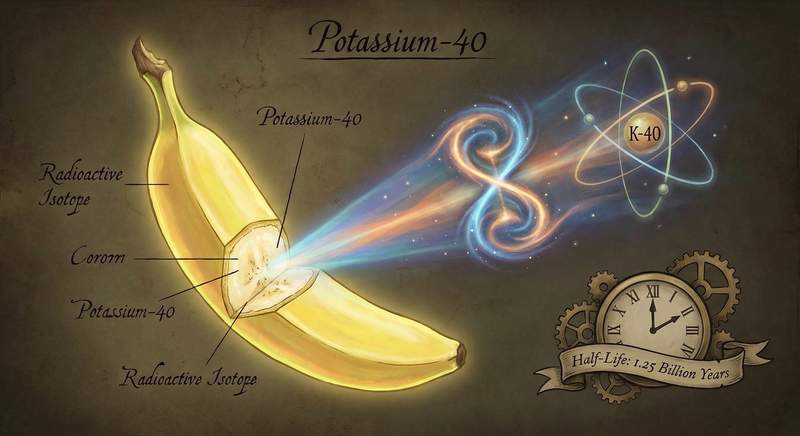
2026-03-02-09-35-00-radioactive-bananas.png (source: app assets)
The fact
“Humans share 50% of their DNA with bananas; while we are obviously very different, many of the basic biological functions like cell division and metabolic processes are governed by the same genes inherited from a common ancestor.”
“Humans share 50% of their DNA with bananas” sounds delightfully absurd, which is why it keeps surviving. The trouble is that it compresses several different biological ideas into one fuzzy sentence. The National Human Genome Research Institute’s DNA fact sheet defines DNA as the molecule containing the biological instructions of an organism and its complete set of nuclear DNA as its genome. Once you say “50% of our DNA,” you are talking about a very big and very specific thing. Most banana memes are not actually using the phrase that carefully.
Part of the confusion comes from gene comparisons rather than whole-genome comparisons. Pfizer’s comparative-genomics explainer says bananas are “more than 60 percent identical” in the sense that many housekeeping genes necessary for basic cellular function are shared between plants and animals. That sounds dramatic, but it refers to a particular kind of similarity: conserved genes involved in core cellular jobs such as DNA replication, cell-cycle control, and division.
A more technical critique comes from the Dessimoz Lab’s “Banana Conjecture” analysis. That post traces the meme’s history and points out that the widely repeated “50%” figure is too vague to be scientifically satisfying. It notes that one source of the claim involved an unpublished educational comparison in which roughly 7,000 human and banana protein matches had an average amino-acid identity of about 41 percent. That is not the same as saying half of the human genome is banana DNA.
The Dessimoz analysis pushes further and asks a more meaningful question: what fraction of human genes have recognizable banana counterparts? Using several orthology-inference approaches, the author reports that the percentage of human genes with banana orthologs tops out around one quarter, not one half, under the permissive protein-based comparison she used. The same post also argues that whole-genome alignment between something as evolutionarily distant as humans and bananas would be far smaller still. So the viral number is not exactly false; it is blurry enough to hide what is actually being counted.
That evolutionary distance is the real story. Humans and bananas both descend from ancient common ancestry, which means neither lineage invented biology from scratch. Cells still need membranes, energy systems, protein factories, gene regulation, and mechanisms for copying DNA. That is why Pfizer’s explainer emphasizes “housekeeping” genes. A banana and a human are wildly different organisms, but both remain eukaryotic life running on ancient molecular machinery.
What they do not share is a literal half-and-half genome in the everyday sense most listeners imagine. The NHGRI fact sheet reminds us that a genome is the entire nuclear DNA set. Once you compare total genomes, sequence alignability, protein identity, gene presence, and gene function separately, the banana slogan starts to dissolve into several distinct measurements. That is why one comparison can yield “more than 60 percent identical” for some shared genes while another can yield roughly one quarter of human genes having banana orthologs.
This is not pedantry for its own sake. Biology is full of percentage claims that sound interchangeable but are not. Sequence identity is different from gene sharing. Gene sharing is different from having similar traits. And similarity among proteins that perform basic cell maintenance is different from similarity across the full genome, including noncoding DNA, duplicated regions, and lineage-specific features. The Dessimoz Lab post is useful precisely because it forces that distinction into the open.
Oddly enough, the corrected version is more interesting than the meme. If humans and bananas truly had nothing in common, life would be harder to understand. The fact that a plant and an animal still share ancient molecular toolkits tells you just how deep common descent runs. The banana does not embarrass human uniqueness; it reveals the age of the cellular machinery we inherited.
So the safest version of the fact is this: humans and bananas share many conserved genes involved in fundamental cell biology, as Pfizer’s genomics explainer notes, but the phrase “50% of our DNA” is too sloppy on its own. NHGRI’s DNA fact sheet defines what a genome actually is, and the Dessimoz Lab’s analysis shows why the meme changes meaning depending on whether you compare genes, proteins, or whole genomes. Bananas are our distant molecular cousins. They are not half of us.