In 2017, geologists officially confirmed the existence of an eighth...
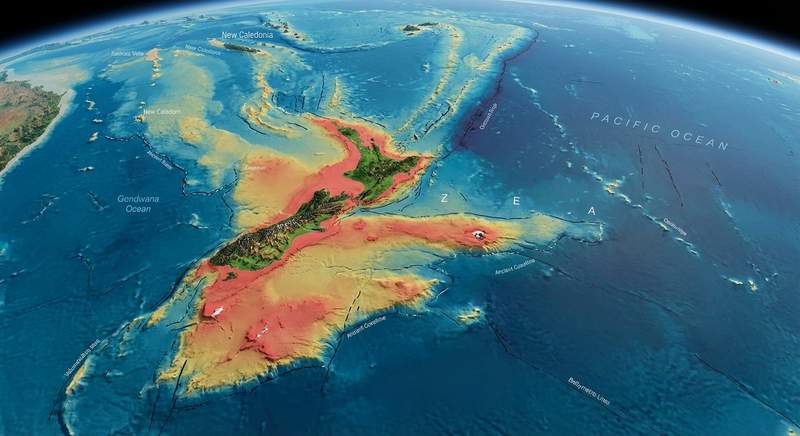
The 2017 Zealandia paper did not conjure a new continent from nowhere, but it assembled the scientific case that a 4.9-million-square-kilometer mostly submerged block of continental crust in the southwest Pacific should be recognized as a continent.
Published
Filed under
Byline
 Brainblast archive
2026-03-06-16-43-00-zealandia-continent.png (source: app assets)
The fact
“In 2017, geologists officially confirmed the existence of an eighth continent called Zealandia, a 1.9 million-square-mile landmass that is 94% submerged beneath the Pacific Ocean. While only New Zealand and New Caledonia remain above the waves today, the entire region consists of a distinct, thick crust that is geologically separate from the Australian plate. This submerged continent was once part of the Gondwana supercontinent before breaking away roughly 80 million years ago and gradually sinking as the crust thinned and stretched. The discovery of Zealandia proves that even on a planet we have thoroughly mapped, massive geological features can remain hidden for centuries. This finding provides critical insights into the history of plate tectonics and the ancient movements of the Earth's crust. It serves as a powerful reminder that our understanding of the planet's physical geography is still being actively rewritten by modern scientific exploration.”
The Zealandia story is real, but the phrase “geologists officially confirmed an eighth continent” needs a little sanding. In 2017, researchers published a peer-reviewed paper arguing that a 4.9 million square kilometer region of the southwest Pacific should be recognized as a continent called Zealandia. In that paper, the authors said the region consists of continental crust, has elevated bathymetry relative to oceanic crust, contains diverse silica-rich rocks, has relatively thick and low-velocity crust, is isolated from Australia, and is about 94% submerged today (https://www.geosociety.org/gsa-today/march-april-2017/zealandia-earths-hidden-continent).
That was not the same thing as suddenly discovering a lost Atlantis-sized landmass nobody had noticed before. The authors themselves emphasized that Zealandia was “not a sudden discovery but a gradual realization” built from decades of bathymetric, geological, and geophysical work (https://www.geosociety.org/gsa-today/march-april-2017/zealandia-earths-hidden-continent). New Zealand geologists had been discussing the region for years. What happened in 2017 was that the case was formally assembled in a widely read, peer-reviewed paper and framed explicitly in continent-level terms.
The key scientific question was not “is there rock under the water?” Obviously there is. The question was whether the region counts as a continent rather than a scattered collection of submerged fragments and plateaus. The GSA Today paper argued yes, using the usual working criteria for continents: relative elevation, distinctive continental rock types, thicker crust and lower seismic velocities than oceanic crust, and a large enough coherent area with recognizable limits (https://www.geosociety.org/gsa-today/march-april-2017/zealandia-earths-hidden-continent).
That distinction matters because Zealandia is weirdly submerged. Continents are often imagined as big dry landmasses, but the geological definition is about crustal character, not how much of it sticks above sea level. Zealandia includes New Zealand, New Caledonia, and a broader swath of submarine rises and plateaus. According to both the paper and a GNS Science summary, about 94% of it lies underwater today (https://www.geosociety.org/gsa-today/march-april-2017/zealandia-earths-hidden-continent; https://www.gns.cri.nz/news/new-hidden-continent-mostly-underwater-scientists-say/).
The reason it sank is also part of the story. The 2017 paper argues that Zealandia was formerly part of Gondwana and became so submerged largely because of widespread Late Cretaceous crustal thinning linked to breakup and later isostatic balance (https://www.geosociety.org/gsa-today/march-april-2017/zealandia-earths-hidden-continent). In plain English: as the crust stretched and thinned during rifting, it rode lower, leaving only the highest parts above water.
That makes Zealandia scientifically useful, not just cartographically cute. GNS Science called the 2017 paper a benchmark because it pulled more than 20 years of work into one referenced, peer-reviewed case and highlighted Zealandia as the youngest, thinnest, and most submerged continent (https://www.gns.cri.nz/news/new-hidden-continent-mostly-underwater-scientists-say/). Researchers care because Zealandia offers a natural laboratory for studying continental rifting, thinning, breakup, drowning, and the evolution of life on a continent whose exposed area shrank dramatically over time.
There are, however, two caveats people often skip. First, “officially confirmed” overstates how geology works. There is no single world referee that stamps a continent as official in the way the International Astronomical Union names planets or the periodic table names elements. What happened is that the scientific case became strong, explicit, and influential enough that many geologists now treat Zealandia as a continent. That is a real achievement, but it is still a matter of scientific classification rather than papal decree.
Second, calling it the “eighth continent” depends on how you count continents in the first place. In everyday geography, schoolchildren may learn seven continents, six continents, or other groupings depending on whether Europe and Asia are separated, among other conventions. The Zealandia paper itself speaks of a geological continent and notes that conventional continent names are partly inherited categories (https://www.geosociety.org/gsa-today/march-april-2017/zealandia-earths-hidden-continent). So “eighth continent” is catchy but not mathematically universal.
Even with those caveats, the basic fact holds up well. In 2017, a major peer-reviewed synthesis argued that Zealandia is not merely continental in composition but large, coherent, and distinct enough to qualify as a continent in its own right. The surprising part is not that seafloor exists beneath New Zealand. It is that a mostly submerged continental block this large can be so underappreciated in popular geography.
That is why Zealandia became such a hit outside geology. It feels like a loophole in our mental map of Earth. We think the planet’s biggest features were all labeled centuries ago. Then along comes a case where the rocks, crustal thickness, and geophysics suggest that one of Earth’s major continental objects has been sitting in plain scientific view—just mostly underwater, which is apparently enough to hide a continent from the public imagination for a very long time.